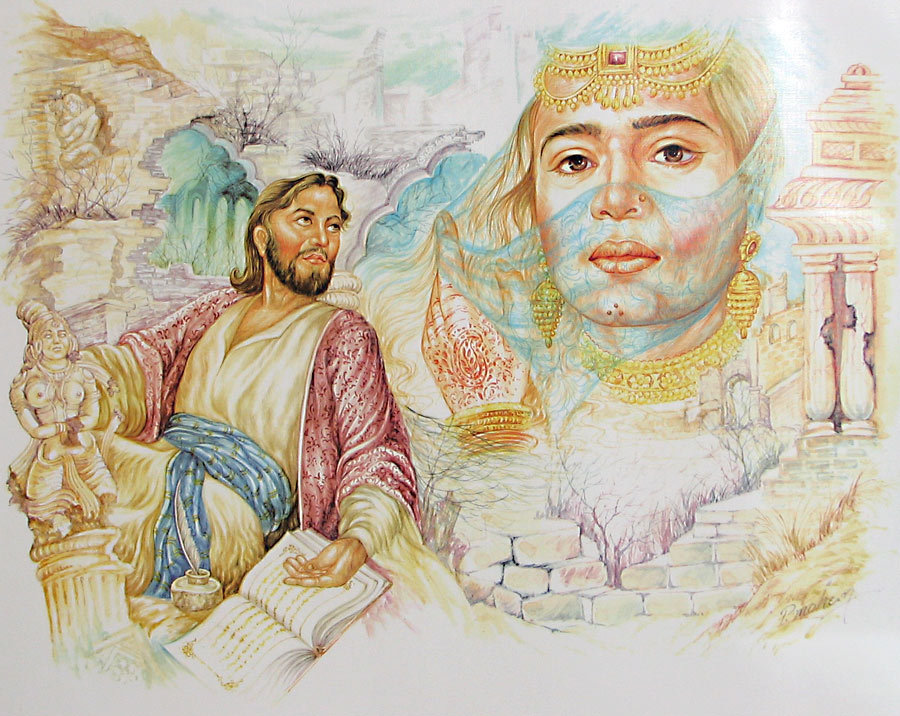
The beauty of the heart
is the lasting beauty:
its lips give to drink of the water of life.
Truly it is the water, that which pours,
and the one who drinks—all three
become one when your talisman is shattered.
That oneness you can't know by reasoning.
Rumi: Mathnawi II: 716-718
version by Camille and Kabir Helminski via Sunlight
Today's excerpt from Rumi's
Mathnawi is referenced (by R.A. Nicholson in his own translation) to sayings attributed to one of the great saints of early Islam, Bayazid Bastami (804-874 CE).
I am the wine-drinker and the wine and the cup-bearer.
I came forth from Báyazíd-ness (individuality) as a snake from its skin. Then I looked and saw that lover, beloved, and love are one, for in the world of Unity all can be one.
sayings of Bayazid, via Nicholson, via dar-al-masnavi
This triune nature of unity has an obvious parallel with the Christian trinity, a most famous icon of which is shown below:
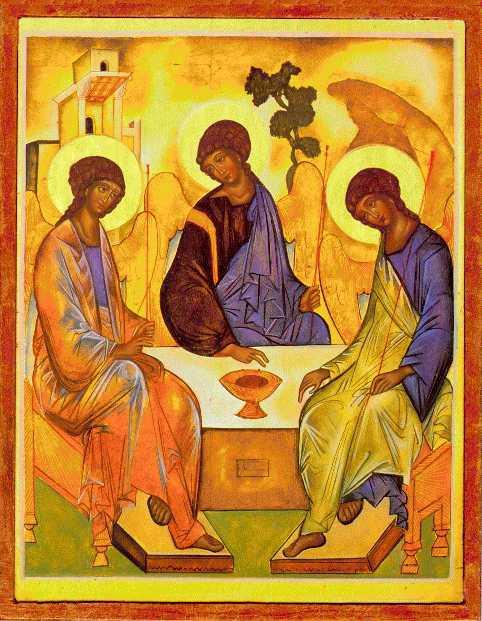
icon by Russian artist, Andrei Rublev c. 1360-1430
In this image, the three angels that visited Abraham (Genesis 18) are depicted. Though three in number, they are also referred to as a visitation from "the Lord", implicitly The One. The unity of the threesome is conveyed by the artist through the bowl or cup at the centre as well as through the containing circular form of the composition. What contains the three (the envelope) is also the centre (the nub) that holds them all together.
This Old Testament trinity is seen, of course, by Christians as a foretaste of the later trinity, clarified now as God the Father, God the Son, and God the Holy Ghost (or Spirit). In some images of this trinity the cup appears as a receptacle for Christ's blood and in the "vierge ouvrante" statues, it is the Great Mother as Virgin Mary that contains the Divine Trinity.
There is, therefore, always this fourth and unifying entity that is both the source and the end point of unity. As the early alchemist, Maria Prophetissa, is said to have put it:
One becomes Two,
Two becomes Three,
and out of the Third comes the One as the Fourth.
There are, in fact, two original Ones in this schema: the Great Mother as original whole and the Great Father as creator and generative principle. The second element is the Son and the third the Spirit. Finally, the whole returns to unity in the original One though now with the difference that distinctions have been made and transcended.
The parallels with Bayazid are as follows:
* The cup-bearer or
saqi is God as original One, the Great Mother or Great Father depending on the emphasis.
* The cup itself is not mentioned by Bayazid or referred to by Rumi: it is "the forgotten cup" of the title.
* The wine is Christ, or more specifically, His blood as it is poured out in sacrifice.
* The drunkard or drinker is the Spirit, so evidently present in alcohol and therefore so perfectly represented by the person filled with the Spirit of God.
* All three (or four if the cup itself is included) are One, as Bayazid and Rumi assert,
after not
before making the distinctions among the elements.
The further parallels inside orthodox Islam are as follows:
* Allah, like the
saqi, covers both the original Great Mother and Great Father.
* Mohammad is the cup that received God's Word.
* The Koran is the wine or the Word itself.
* Muslims themselves are the community receiving the wine.
* Allah, Mohammad, the Koran, and the community of Muslims form one unity in The One.
These mythopoetic elements in the Judaic, Christian, and Islamic trinities are not hard-and-fast. Like all such elements, they are fluid and any one element can readily flow into any other. Thus can Mohammad be seen in the role of Great Father (as non-Muslims see him, that is, as the originator or creator of Allah), in the role of the wine (as when Muslims imbibe his life story as spiritual nourishment) or in the role of the Final One (as when he is perceived as the Last Prophet).
Coming back to Bayazid, we still have the "lover, beloved, and love are one" idea. We could equate the Beloved with God (the Father or the Mother) and the Lover with the devout seeker after truth. Love, then, would act like the wine that is passed from one to the other. If lover and beloved are equals, then the equation can go either way and God is no longer appropriately seen as Father or Mother but simply as Friend. Still, we are left with the missing or forgotten cup. I suspect this is the Heart as Rumi might express it or the Soul or Psyche as we might express it today. I think, too, that the cup hints at the body, the house of the soul. The larger cup, God as Mother and container, is also the material world.
These are only sketchy outlines of ideas, each element worthy of considerable amplification and the whole leading to further interesting avenues to explore. However, I will have to leave that for another day.
Update: An expanded article with more images is now available as
The Forgotten Cup.
Labels: Bayazid, Grail, Maria Prophetissa, Nicholson, Saqi, Trinity, Wine