Friday, May 01, 2009

torrent of consciousness

Jewish World Review ... QUOTE OF THE DAY

"Religion is not, at the outset, a refuge of grace and mercy for the despondent and desperate, an enchanted stream for crushed spirits, but a raging, clamorous torrent of man's consciousness, with all its crises, pangs, and torments."

--- Rabbi Dr. J. B. Soloveitchik

Labels:

Monday, April 27, 2009

moving lips

And when, by the hair, the headsman held up the head
Of Mary of Scots, the lips kept on moving,
But without sound. The lips,
They were trying to say something very important.

excerpt from Robert Penn Warren:
A Way to Love God

Labels:

Sunday, August 03, 2008

fine words

Salim Mansur has some fine words to say about the American people today:
Folks in Middle America are realists. Middle America, besides geography, also refers to the American character -- irrespective of ethnic origin -- of being proud of a country built by the love and sacrifice of previous generations into the greatest power in history.

Middle Americans uncomplainingly run the daily routines of keeping America free, prosperous and strong. Theirs is a story of unfailing optimism, generosity, courage and romance.

from Salim Mansur: Kerry, too, was the media darling

Labels: , ,

Tuesday, July 01, 2008

our silent chords

We live and move and think; but we are not the creators of our own origin and existence. We are not the arbiters of every motion of our own complicated nature; we are not the masters of our own imaginations and moods of mental being. There is a Power by which we are surrounded, like the atmosphere in which some motionless lyre is suspended, which visits with its breath our silent chords at will.

from Percy Bysshe Shelley: Essay on Christianity

Labels:

Friday, April 25, 2008

tantalizing tales

Wikipedia on Winston Churchill (novelist):

Winston Churchill (November 10, 1871 - March 12, 1947) was an American novelist.

[...]

In 1919, Churchill decided to enter a prolonged period of self-reflection. He stopped writing and withdrew from public life. As a result of this he was gradually forgotten by the public. In 1940, The Uncharted Way, his first book in twenty years, was published. The book was a reflection of Churchill's thoughts on religion. He did not seek to publicize the book and it received little attention. Shortly before his death he said, "It is very difficult now for me to think of myself as a writer of novels, as all that seems to belong to another life."


churchill


TIME review of The Uncharted Way titled Prophet and dated June 17, 1940:

In the 23 years since U. S. Novelist Winston Churchill (The Crisis, Richard Carvel) last published a book, he has kept much to himself. He lived quietly in Cornish, N. H., and it was understood that he had stopped writing. Far from it: he was ruminating and writing his profession of religious faith, The Uncharted Way.

The book is an examination, chiefly through the Old Testament prophets and the parables of Jesus, of the roots of religion, individualism, science, human conduct, human hope. It is the work of a stonily independent amateur thinker. Winston Churchill is convinced that certain of the prophets, notably Isaiah (a collaboration) and Jesus (if he existed), had hold of a form of science, psychology and self-knowledge which all religions, including Christianity, have repudiated, and which science itself rather scorns than endorses.

The U. S. Churchill's thesis: The essence of the prophets' perception was a form of creative, evolutionary energy, through which an individual might free himself from fear, desire, moral death.

This form of energy is described in the Gospels, Churchill believes, by the Greek word agape: non-possessive rather than possessive love. This was and is, he believes, perhaps as actual a force as electricity. Fear is the root of all state-religions, it suffuses and gives shape to society, and is described by the prophets as Satan or the Tempter. Craving, a low state of creative energy, is the root of rebellion, and rebellion likewise is a state of sin or death. The technique by which the hostile power of the world is "bound" is broadly similar to Tolstoy's or Gandhi's nonresistance of evil.

Churchill divides the human career into three days or ages: that of the animal, free in his instincts; that of the human world, tortured between fear and craving; that of resurrection. Indirectly suggesting that the end of the second age, of the human world, is at hand, he recalls that Christ compared such catastrophes to the first leaves of a fig tree, by which men know that summer is near. In his closing chapter Winston Churchill begins to sketch a program for The Third Day. His resurrection is not supernatural but earthly. The reader who finds in this chapter cold comfort may perhaps be pardoned. But he who finds in it mere idiocy may perhaps be mistaken.

Winston Churchill is not to be confused with Great Britain's Prime Minister, but often has been. No kin, they are old acquaintances. Britain's Churchill once suggested that one of them change names; U. S. Churchill, as the senior, passed the buck. Britain's Churchill thenceforth signed his books Winston S. (for Spencer). In 1903, when Winston banqueted Winston S. at Boston's Copley-Plaza, Winston S. got the bill.


Update: A drawing of Churchill is available here.


Labels: ,

Thursday, February 21, 2008

dissolving

Last night, I finished reading Michael Ondaatje: The English Patient (Bloomsbury, London, 1992). It left me feeling unresolved, the narrative having dispersed into a morphine haze with none of the usual strings tied up neatly. I felt my firm hold on reality dissolving. I guess that is partly the intent of the author.

The film corrects a lot of that and rounds things out, so it was strange to read the novel after seeing the film. It was as if the film's resolutions were undone and left hanging about in untidy heaps.

I found the novel's opening pages intriguing and so I wandered into Ondaatje's world but in the end I was tired of the novel and wanted it to finish. At the last page, I was relieved but bemused.

In sum, I was finally left unconvinced, unsure even of what I should have been convinced of.

Labels:

Thursday, February 07, 2008

Rumi on speech and silence

People have three spiritual states. In the first they have no thought of God at all, but worship and pay service to everything else: friends and lovers, wealth and children, stones and clods. Once they gain a little knowledge and awareness, then they serve nothing but God. Yet, after learning and seeing more they enter a state of silence. They do not say, “I serve God,” nor “I do not serve God,” for they have transcended both. No sound issues from these people into the world.

"God is neither present nor absent,
For God is the Creator of both."

All words, all sciences, all skills, all professions derive their flavor and relish from Speech. The end of that chapter cannot be known, however, for they are only expressions, and not the state of itself. This is illustrated by the man, who in seeking the hand of a wealthy and beautiful woman, looks after her sheep and horses, and waters her orchards. Though his time is occupied with those services, their flavor derives from the woman. If the woman were to disappear, those tasks would become cold and lifeless. In this same way, all professions and sciences derive life, pleasure and warmth from the rays of the Saints’ inspiration. But for their inspiration, all tasks would be utterly without relish and enjoyment.


from Rumi: Discourse 53

Labels: ,

an echo in hollow places

Having recently watched the film, I'm now reading Michael Ondaatje's "The English Patient" (Bloomsbury, 1992) and I was curious about the line at p.21 of the text: "For echo is the soul of the voice exciting itself in hollow places." It comes from a long poem by 18th century poet Christopher Smart, written during a spell of madness. Here is an excerpt containing the line Ondaatje used:

For applause or the clapping of the hands is the natural action of a man on the descent of the glory of God.

For EARTH which is an intelligence hath a voice and a propensity to speak in all her parts.

For ECHO is the soul of the voice exerting itself in hollow places.

For ECHO cannot act but when she can parry the adversary.

For ECHO is greatest in Churches and where she can assist in prayer.

For a good voice hath its Echo with it and it is attainable by much supplication.

For the VOICE is from the body and the spirit -- and is a body and a spirit.

For the prayers of good men are therefore visible to second-sighted persons.

from Christopher Smart: Jubilate Agno via pseudopodium.org


There is a curious resonance with the passage below from Elizabeth Lash, who simply happens to be the mother of the actor, Ralph Fiennes, who played the titular role in the movie.


Labels:

live cantata of silence

There is a very clear echo in the valley. During the day, while I was writing out on the terrace, I heard voices calling R O C A MAD OOOUURRRR. On the last midnight, after the bells had sounded, I walked out to the end of the valley. I called aloud, one by one the names of the children. Mick, Ralph, Martha, Magnus, Sophie, Jacob and Joseph. The sounds flew round the valley, several seconds of clear, uncanny call. The best two, the sounds going on and on, were Jacob and Joseph ... It felt as if those names sped into the midnight rocks, and would remain there, in some way, to guide the named. Rocamadour remains for me, above all else, this spirit of the place; something complete and tangible by the sheer force of its intangibility. Within that simple, listening experience, there seemed to be all I sought and all I would ever find. A continuous, live cantata of silence; the hinge and sum and fulcrum of the rest.


from Jennifer Lash: On Pilgrimage via NOJ

Labels:

Tuesday, January 08, 2008

a second blogging of the qur'an

I have been following Robert Spencer's weekly series of which the latest is Blogging the Qur’an: Sura 10, “Jonah” and now, much to his own delight, Spencer will be joined by a second blogging the qur'an series, only this time by a prominent Muslim writer, Ziauddin Sardar. I've not come across this guy before but I accept the Guardian's blurb on him as a man "considered a pioneering writer on Islam" and "widely known for his radio and television appearances". I will certainly follow Sardar as assiduously as I have been following Spencer.

The first blog entry is a personal account of his Muslim upbringing, starting with Koranic readings from his mother's lap, moving through the stricter environment of the madrassa, and culminating in an ongoing process of adult appraisal. I am happy to enter into Sardar's world to get a better feel for how the Koran moves the Muslim soul but there nevertheless remains a gap in the writing culture for we non-Muslims must also write about how the Koran moves us, though in different ways, and I would like to see Muslims making a genuine open-hearted attempt to enter into our own non-Muslim's Koranic world. For me, this starts at the beginning with the Fatiha which, I'm sure, has a happy sound for Muslims but for me and other non-Muslims sounds deeply offensive because it is so clearly pointing at us in a wrathful and derogatory manner. It makes my flesh creep and I would dearly love - one day - to read a Muslim acknowledging that this offense and apprehension are realistically based and not some paranoid symptom of "Islamophobia". For now, I will wait and see what develops in this and the corresponding series by Spencer.

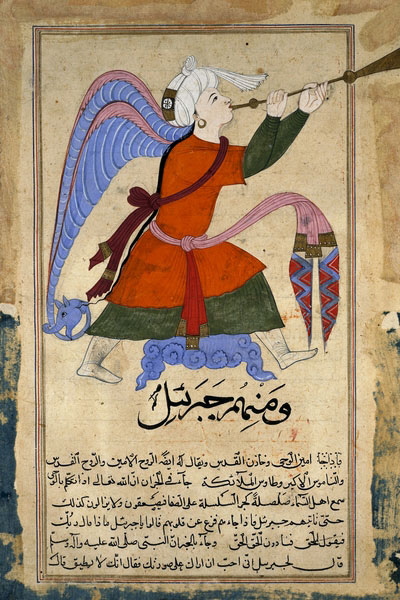
In point of fact, my attention was more strongly drawn to the illustration that The Guardian provided. It was curious, for example, that the British Museum page on this image names the figure Gabriel (the archangel that announced Jesus' coming to Mary) rather than Israfil (or Raphael). The latter has a strongly Islamic function of standing at the ready with trumpet to mouth for he will blow two blasts at the Final Hour: one to mark the death of us all and the second to mark our resurrection - more precisely, the resurrection of all good Muslims - from the dead.

Israfil

Archangel Israfil @ British Museum


My research also turned up some other variants of this image, clearly less refined ones but both contained in the same book. It seems that both the text and the artwork were copied by one to the next artist scribe, with results exhibiting more or less artistic merit or refinement. There is always a certain charm in the more primitive forms but the British Museum variant is stunningly beautiful. It doesn't really matter who created the first form of this angelic image but one does get a sense of the Islamic straightjacket that forbade innovation, specifically in theology but surely in any field - such as religious art - touched by deity.


Labels: , , ,

Monday, January 07, 2008

the lame god passes the cup among the gods

A conflict has been brewing among the gods of Olympus, especially between Hera, Queen of Heaven, and Zeus, her husband. Her son, the lame god Hephaestus, calms her down and passes sweet wine or nectar among the gods so that "all feasted equally". Finally the King retires to sleep by the side of his Queen.

Hephaestus spoke, then stood up, passed a double goblet
across to his dear mother, saying:
"Stay calm, mother, even though you are upset.
If not, then, as beloved as you are,
I may see you beaten up before my eyes, 
with me incapable of helping out,
though the sight would make me most unhappy.
It's hard to take a stand opposing Zeus.
Once, when I was eager to assist you,
Zeus seized me by the feet and threw me out,
down from heaven's heights.  The entire day
I fell and then, right at sunset, dropped
on Lemnos, almost dead.  After that fall,
men of Sintes helped me to recover."

As he spoke, the white-armed goddess Hera smiled.
She reached for her son's goblet. He poured the drink,
going from right to left, for all the other gods,
drawing off sweet nectar from the mixing bowl. 
Then their laughter broke out irrepressibly,
as the sacred gods saw Hephaestus bustling around,
concerned about the feast. All that day they dined,
until sunset. No one's heart went unsatisfied.
All feasted equally.  They heard exquisite music,
from Apollo's lyre and the Muses' beautiful song
and counter-song. When the sun's bright light had set,
the gods all went to their own homes.  Hephaestus,
the famous lame god, with his resourceful skill,
had made each god a place to live.  Olympian Zeus, 
god of lightning, went home to his own bed,
where he usually reclined whenever sweet sleep
came over him.  He went inside and lay down there,
with Hera of the golden throne stretched out beside him.  

from Homer: Iliad, final verses of Book I
trans Ian Johnston


hephaestus

Hephaestus riding a donkey
Athenian red-figure skyphos or drinking cup,
5th century BC @ answers.com


Labels: , , , ,

Sunday, December 23, 2007

a letter in reply

Today, with Christmas approaching, Salim Mansur has chosen to share some words of that great mystic poet of the English language, William Blake.

Mystery surrounds us from the moment we arrive on Earth until we depart. At its most elementary the mystery is about what sustains this "brief crack of light" -- as the great writer Vladimir Nabokov in his autobiography, Speak, Memory, phrased his opening sentence -- "between two eternities of darkness."

Is life merely this fleeting moment compressed between eternal darkness on either side?

This remains the most compelling question that men and women of varying intellects through the ages have pondered over and most, I suspect, preferred believing that life is a passage, in the words of William Blake, "through Eternal Death! And of the awaking to Eternal Life."

Such belief rests on faith that there is an unseen power, eternally good, merciful, loving and beautiful beyond our earthly sight yet visible to our inner vision as Blake reminds us.

from Salim Mansur: Sharing Blake at Christmas


Whenever Mansur moves away from political commentary and into the more intimate world of faith, poetry and imagination, he seems less like a journalist and more like a friend writing to beloved friends, perhaps far away in time or space. Certainly, I get a feeling of receiving a letter from Salim, from half way across the world. I often have a similar feeling when reading Rumi at his intimate best but the distance then is not mere space but centuries of time as well.

vermeer

Johannes Vermeer: Woman in Blue Reading a Letter @ wikimedia commons


Indeed, Salim refers to this closeness in Blake's own experience of God.

All his life Blake was moved by the vision of God whose love was incarnated in the human form of Jesus.

God in Blake's vision was a personal Deity.

He was not lodged within the formal ornate settings of religious institutions or encountered in the lifeless pages of sacred texts.

In the long poem Jerusalem, Blake writes:

"I am not a God afar off, I am a brother and a friend;

Within your bosoms I reside, and you reside in me."


Three years ago, in the pre-Xmas season of 2004, our publicly funded TV broadcaster, ABC TV, ran a popular program called My Favourite Book in which viewers nominated and thereby voted in books that had made a major impact on them. The top four books were:

1. The Lord Of The Rings - by J.R.R. Tolkien
2. Pride and Prejudice - by Jane Austen
3. The Bible - by Various Contributors
4. To Kill a Mockingbird - by Harper Lee


The first and third books are epic tales on a grand scale, written by men; while the second and fourth are set in a more intimate or personal context and are written by women. There are intimate moments in the epic tales and there are grand themes woven into Austen's conventional love tale and the small town childhood experiences related by Lee. However, the grand predominates in the tales told by men while the small events of everyday life seem to be where women find their inspiration. The artist Vermeer, displayed above and painting a century before Blake, seems to have been atuned to a divine aesthetic present in the small and everyday feminine world. Below, that aesthetic finds voice in a female poet, a great but gentle mystic in her own right and following on soon after Blake.

THE SECRET.

Some things that fly there be, —
Birds, hours, the bumble-bee:
Of these no elegy.

Some things that stay there be, —
Grief, hills, eternity:
Nor this behooveth me.

There are, that resting, rise.
Can I expound the skies?
How still the riddle lies!

from Emily Dickinson: Poems


Perhaps, the essence of divinity lies in the intersection of these two worlds: the grander masculine and the more humble feminine. Where Blake finds the first in the second - Infinity in a hand, Eternity in an hour - perhaps it is the juncture that matters, just as Jesus stood and Christ ever stands at that juncture between humanity and God.

Because Salim is a Muslim and it behooves me to include at least a small element from his own faith tradition inside this article that attempts to act as a letter in reply to his, I would like to quote from the Koran:

We verily created man and We know what his soul whispereth to him, and We are nearer to him than his jugular vein.
Koran 50:16, trans Pickthall


In this verse the God of Mohammad's vision locates Himself at that most vulnerable spot in the neck where the life-blood flows and can so easily be spilt. He does not - like all those other deities in Blake's vision - "reside in the human breast", in that bosom or place of the heart. Allah is not a God of love but a God that threatens death, a God that reminds us of the thin line that separates a living soul from a corpse. It takes but a simple neat stroke to sever the jugular vein, to slit a throat. As that handful of Muslims demonstrated on that September 11, a lot can be achieved with a small box cutter held against a jugular vein.

At Christmas, English speakers love to listen to Handel's Messiah which tells the full tale of Jesus the Christ, from prophecies of His coming, to His humble birth, His suffering and death, and finally His resurrection. The last part affirms the life everlasting that will follow from this story.

I joined those many others in listening to this great masterpiece but the last part left me cold for I cannot believe that the life everlasting supercedes the life of today, the life of now, the life so simply depicted in so many of Vermeer's paintings.

There have also been celebrations lately around the date of Rumi's death which he himself described as his wedding day: the Urs or wedding with the Beloved. A poem from his own son portrays it thus:

From this foul, fulsome world, Rumi moved on

from Sultan Valad: Valad nameh, trans Franklin D. Lewis
via sunlight


I simply do not accept that this world is foul or fulsome. It's true that some eyes can see it so but others, with a different sensitivity, see it otherwise.

I simply do not accept that a man's world or a man's view is better than a woman's. Each has its own truth, its own validity, and its own necessity in the larger scheme of things.

Likewise, I simply do not accept that God (Heaven, Infinity, Eternity) is better than humanity (earth in time and space). Each needs the other and it is about time that God acknowledged that man created Him just as truly as He created man.


Labels: , , , ,

Friday, December 21, 2007

now a plate of rice

This supreme joy has no resting place -
It enters one form then another,
from box to box – an eternal movement
between heaven and earth.

Here it comes, pouring down from the sky,
seeping into the earth,
and rising up again as a bed of roses.

Now it is water, now a plate of rice,
Now the swaying trees, now a horse and rider.
It lies within these forms for awhile
then bursts forth to become something new.


excerpt from Rumi: Ghazal (Ode) 1937
version by Jonathan Star via sunlight


Ah, yes, the numinous can appear in the most unlikely places.

Labels: ,

Tuesday, December 18, 2007

last words

afaint afar away over there what -
folly for to need to seem to glimpse
    afaint afar away over there what -
what -
what is the word -

what is the word


These are the last few lines of the last poem by Samuel Beckett.

I'm currently reading Enoch Brater: Why Beckett
(New York, N.Y : Thames and Hudson, 1989)

Labels:

Monday, December 17, 2007

learning, earning, yearning

Quotes from Christopher Morley:

There are three ingredients in the good life: learning, earning and yearning.

The real purpose of books is to trap the mind into doing its own thinking.

There is only one success - to be able to spend your life in your own way, and not to give others absurd maddening claims upon it.

The courage of the poet is to keep ajar the door that leads into madness.


source: BrainyQuote

Labels: