Monday, February 04, 2008

three princes from India

fairy tale illustration

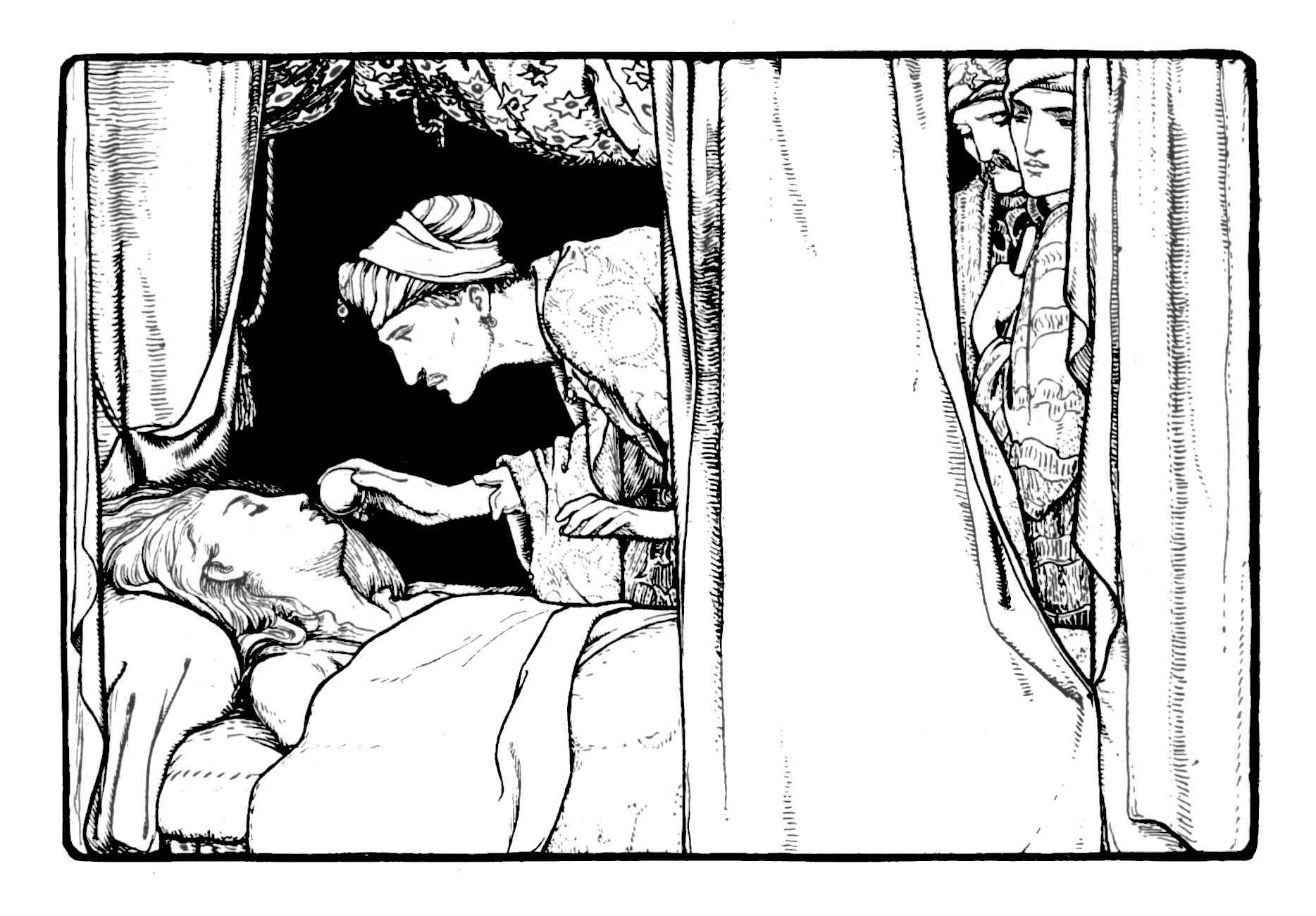
Illustration by J. D. Batten to the story
"The Three Princes and Princess Nouronnihar"
in E. Dixon (ed): Fairy Tales from the Arabian Nights (1893)
@ Wollamshram World


In this story, each of the three princes contributes to achieving the end of saving the princess from a near fatal illness: the eldest acquires a tube that allows him to see at a great distance (and hence learn of her fate), the second has a carpet that allows the princes to travel quickly to her bedside, and the youngest has an artificial apple that is a panacea or universal remedy for any ailment.

In determining which prince will take the maiden in marriage, the sultan orders that each shoot an arrow with the one shooting farthest obtaining the princess as wife.

The sultan did not make them wait long; and as soon as he arrived, Prince Houssain, as the eldest, took his bow and arrow, and shot first. Prince Ali shot next, and much beyond him; and Prince Ahmed last of all; but it so happened, that nobody could see where his arrow fell; and, notwithstanding all the search of himself and everybody else, it was not to be found far or near. And though it was believed that he shot the farthest, and that he therefore deserved the Princess Nouronnihar, it was necessary that his arrow should be found, to make the matter evident and certain; so, notwithstanding his remonstrances, the sultan determined in favour of Prince Ali, and gave orders for preparations to be made for the wedding, which was celebrated a few days afterwards with great magnificence.

from E. Dixon (ed): The Three Princes and Princess Nouronnihar


This is a really odd ending. It seems contrived and unfair, especially when compared to the outcome of almost every other known fairy tale of its sort. I certainly know of no other exception to the rule that gives the bride to the youngest of the three sons. I'm not sure - just now - what to make of this curiosity.

Labels: , ,

the cup gets a bad press

Be not intoxicated with these goblets of forms,
Lest you become a maker and worshipper of idols.
Pass by these cups full of forms, linger not;
There is wine in the cups, but it proceeds not from them.
Look to the Giver of the wine with open mouth;
When His wine comes, is not cup too small to hold it?


Rumi: Mathnawi Book VI, Story IX, trans Whinfield


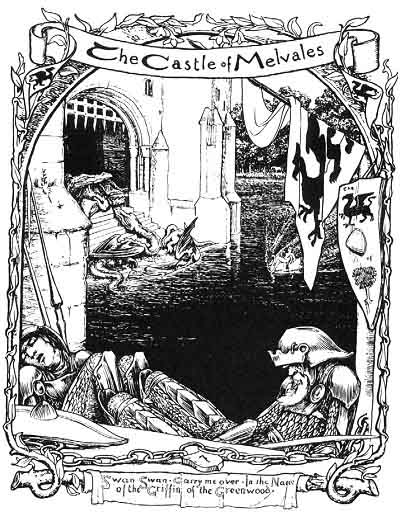
These are the opening verse lines of a story called "The King and his Three Sons". It has a classic fairy tale format in which the eldest and middle sons fail in an important quest but the youngest succeeds. Rumi left the story unfinished with little elaboration on how the third prince achieved what the first and the second did not.

Since Rumi often uses the idea of "the King" as a synonym for God, this story effectively allows that God might have three sons or have a trinity potential that can be manifested or realized as three divine offspring. The Jungians would see this as the Self differentiating into three conscious functions with the two primary ones being inadequate to the task of full individuation. It is the third - or "inferior" - function that connects consciousness to the unconscious and ultimately leads to wholeness or a state of kingliness.

Was Rumi beginning to understand this? Was it dawning on him - or had it already dawned on him - that the Christian trinity had some validity to it? Was this why he balked at finishing this story? According to one tradition - or edition of the Mathnawi - Rumi's own son provided a commentary as follows:

Part of the story remains untold; it was retained

In his mind and was not disclosed.

The story of the princes remains unfinished,

The pearl of the third brother remains unstrung.

Here speech, like a camel, breaks down on its road;

I will say no more, but guard my tongue from speech.

The rest is told without aid of tongue

To the heart of him whose spirit is alive.


by Bahau-'d-Din Sultan Valad according to Bulaq edition of Mathnawi, trans Whinfield as above


fairy tale illustration

Illustration by John D. Batten to the story
"The King of England and his Three Sons"
in Joseph Jacobs: More English Fairy Tales
@ Sacred Texts


Labels: , , ,

Sunday, February 03, 2008

and bread itself

masnaviVI67

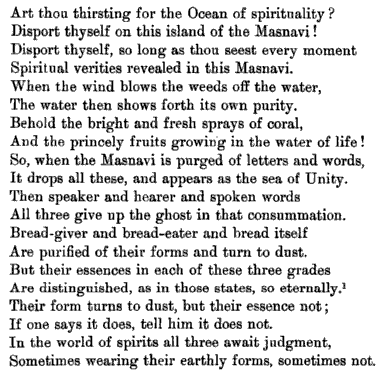
Mathnawi VI: 67-76, trans Whinfield
Masnavi I Ma'navi (2000, Routledge) @ google books


Update: Barks and Nicholson versions available at Sunlight.

Labels: ,

Sunday, December 30, 2007

peace through appeasement? nay, peace through war

Today, Salim Mansur has drawn my attention to the Swiss Roman Catholic theologian, Hans Küng. I've not read any of his many books but will look out for his writings when next at the library. For this post, I've relied on what is available on the internet, such as through wikipedia and reviews of his books. He appears to be a man of wide learning and of strong commitment, as well as having the personal gifts necessary to bring these into the public arena so as to make a real and practical impact on his world. I admire those qualities and cannot but be impressed.

küng

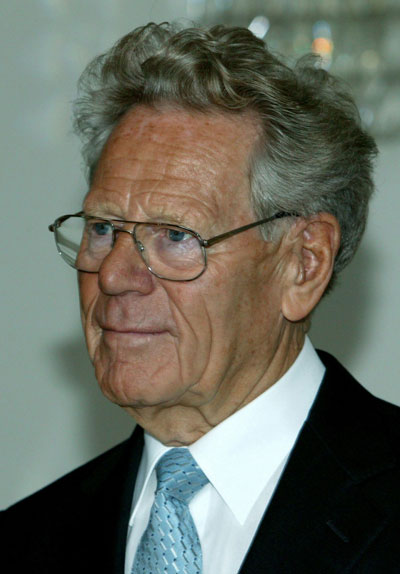
Hans Küng in 2005


Mansur opens with what he calls Küng's "theorem": "No peace among the nations without peace among the religions." As a mathematician myself, I find the use of this term puzzling since a theorem is something that can be formally proved. Küng's statement has more of the quality of a mantram or a slogan. The terms are ill-defined, making it impossible to assess the statement's real worth. It has an undeniable "feel good" ring to it and sets forth a worthy goal, but this is precisely what mantras and slogans merely amount to.

What has more substance for me is the simple fact that Mansur has bothered to read Küng's lengthy work on Islam and considered it worth a focus in his weekly article for the Toronto Sun. That demonstrates his continuing openness to the very dialogue that Küng recommends, albeit within the confines of a scholarly and somewhat prim conversation. As he himself reminds us, this openness is not too common among Muslims:

There is no Muslim scholar I can readily think of who might be mentioned in the same breath as Kung for engaging with similar devotion and humility in the study of Judaism and Christianity, while putting aside any expectation that Muslims should similarly engage in studying and learning from the faith-traditions nominally described as Eastern religions.

from Salim Mansur: Theologian finds peace path


The comparative study of religions has been very much a part of the scientific spirit of world discovery, perhaps more aptly described as a discovery of worlds since each faith-tradition is like a different world. There is indeed little evidence of a similar outgoing curiosity from within the Islamic world except, historically, among some of the Sufis.

When Rumi, for example, touches on the life of Jesus or of Job, it is clear that he has researched these earlier "prophets" through the actual scriptures of Judaism and Christianity.

In the case of Job, there is virtually no information about him in the Koran. For a Muslim to know Job's story, he must go to the Old Testament book and read there directly. It's clear that Rumi had done this or had an intimate acquaintance with those who had. He knew his Job and he knew his Jesus.

I've never encountered this kind of knowledgeability among other Muslim writers, whether past or present.

And if the stories told of his funeral are even partly true, then Rumi did achieve this rare understanding across religions that Küng and similar proponents of "interfaith dialogue" are seeking.

There is, however, a fatal flaw in the approach of well meaning men like Küng. It is an easy exercise to find parallels and similarities between religions. However, real "peace" is not possible unless the differences are honestly and forthrightly confronted rather than politely glossed over. This is a main criticism coming out of the following review of Küng's book on Islam:

Although well aware of questionable, or at least all too human, aspects of Muhammad’s life, Küng demands categorically that Christian theology and the Christian Churches should recognise “without reservation” that: “Through the Qur’an the Prophet gave countless people in his century and in the centuries that followed infinite inspiration, courage and power to make a new religious beginning: a move towards greater truth and deeper knowledge and a breakthrough towards enlivening and renewing traditional religion. Islam was the great help in life”.

But the Christian believer and theologian cannot but judge this statement about the person of Muhammad and of the Qur’an as unqualified and undifferentiated, not least in the light of the absolutely central Christian theological question at issue here: in the light of the life and teaching of the great biblical prophets Hosea, Jeremiah and Isaiah and especially and finally of Jesus of Nazareth and his Gospel, what are the adequate and God-pleasing “means” and ways of acting, which the true messenger of God is to employ to further the cause of God? Does not the way Muhammad opted for, namely, political and military means in furthering the cause of Islam, need to be viewed as objectively irreconcilable with the life, example and teaching of the non-violent, suffering “servant of Yahweh”?

from Christian Troll: Book Review for The Tablet


Küng has been quoted as saying: "As a matter of fact, you have deficiencies in all religions, but you have truth in all religions." The word "deficiencies" is a polite way of saying "falsehood" but an honest dialogue must address both the true and the untrue and it must especially focus on those areas where the "truth" of one religion clashes with the "truth" of another in a way that does not readily allow for overlap. In the case of Christianity and Islam, there are two especially hot spots: the mystery of the trinity and the very factuality of Jesus' crucifixion, letting alone its meaning.

I have tried to look into the first issue in some of my recent posts (under Trinity). On the second issue, I have considered the "dialogue" possibilities of looking at Rumi's ghazal 728 which compares Jesus with Hallaj. The pertinent lines are as follows:

That idea the Christian carries abroad, the Moslem has not that
idea, that He is slaying this Messiah upon the cross.
Every true lover is like Mansur, they slay themselves; show any
beside the lover who deliberately slays himself!


excerpt from ghazal 728, trans A.J. Arberry


Earlier this year, I offered this possibility to the Catholic priest conducting the course on Mysticism: Islamic and Christian Perspectives but he showed no interest in pursuing it. I'm not sure why it is so but this reluctance to honestly face up to these differences is as evident on the one side as on the other.

So for me, it's: Dialogue, schmialogue. We can go nowhere if appeasement is the only approach used. A war of words must be started, else a war of nuclear weaponry will likely take its place.

Labels: , , , , , ,

Saturday, December 08, 2007

questions

O chestnut-tree, great-rooted blossomer,
Are you the leaf, the blossom or the bole?
O body swayed to music, O brightening glance,
How can we know the dancer from the dance?

last four lines from William Butler Yeats: Among School Children

source

Labels: , ,

Tuesday, October 16, 2007

fleurs trinitaires

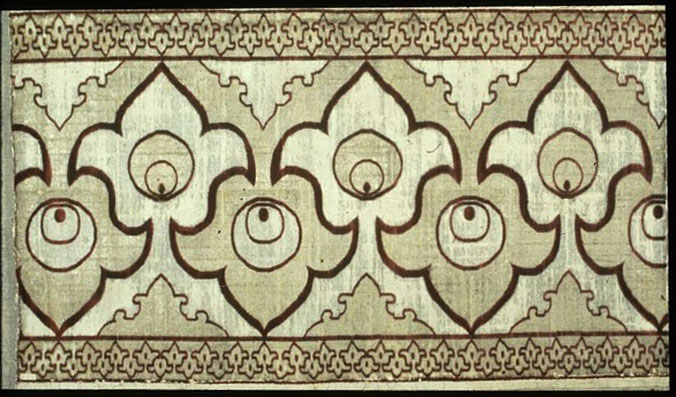
This is a follow-up to an earlier post on trinity flowers. I've been looking out for threefold patterns in Islamic arts and crafts and I was especially intrigued by the Turkish panel shown below:

panel

Velvet panel, Turkey 17th century. Museum of Fine Arts, Boston.


Not only does it have a pattern based on vaguely triangular shapes - similar to the French fleur-de-lys emblem - but it features an Escher-style repeating pattern in which the foregrounds and backgrounds "mirror" each other. I was moved to make a simple design derived from this panel, using the vector graphic program Inkscape:

trellis

fleur-de-lys trellis rendered in Inkscape


I went on to use this design as a decorative element at my article on The Forgotten Cup.

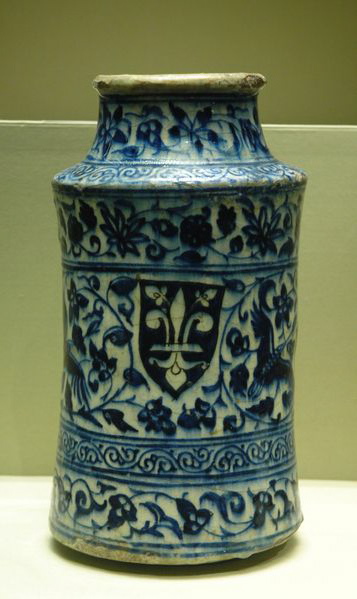
As I did further research on the fleur-de-lys emblem, I was led to the following further example of it within Islamic arts.

fleur jar

Albarello with fleur-de-lys decoration. Syria, 14th century.
Musée du Louvre, Paris. via wikimedia commons


From the wikipedia article on the fleur-de-lys, we learn that:

The use for ornamental or symbolic purposes of the stylised flower usually called fleur de lis is common to all eras and all civilizations. It is an essentially graphic theme found on Mesopotamian cylinders, Egyptian bas-reliefs, Mycenean potteries, Sassanid textiles, Gaulish coins, Mameluk coins, Indonesian clothes, Japanese emblems and Dogon totems. The many writers who have discussed the topic agree that it has little to do graphically with the lily, but disagree on whether it derives from the iris, the broom, the lotus or the furze, or whether it represents a trident, an arrowhead, a double axe, or even a dove or a pigeon. It is in our opinion a problem of little importance. The essential point is that it is a very stylised figure, probably a flower, that has been used as an ornament or an emblem by almost all civilizations of the old and new worlds.

Michel Pastoureau: Traité d'Héraldique, 2006.


This emblem, then, is quite ancient and can carry many meanings. It could be said to represent a natural threefold quality that expresses itself in many other ways but especially in the various triune deities. Islam repudiated such a triunity, not only in the Christian version (which Mohammad understood as God, Jesus and Mary) but in the pagan Arab version as the three goddesses Uzza, al-Manāt and al-Lāt.

Various esoteric meanings have been assigned to the number three (see this table of comparative numerology) but it is common to associate it with energy, movement, dynamism and change. By contrast, the number four stands for solidity, stability, conservatism and stasis. Both the numbers 7 (via addition) and 12 (via multiplication) are seen as syntheses of these opposites.

It seems to me that Islam, by consciously repressing triunity and three-ness, turned its back on change, on any idea of an evolving consciousness whether in the form of further advances in empirical knowledge or further clarifications through revelation.

And yet, such a powerful archetype, such an important aspect of deity, must have tried to "creep in" somehow and get a foot in the door of the two-way dialogue between Allah and Mohammad. It seems to me to be doing just that when those bizarre Arabic letters turn up at the start of Koranic chapters or suras. The first two suras (after the fatiha or opening) have three such letters: Alif Lam Mim. In all, three suras start with 1 letter, 10 with 2, 14 with 3, 2 with 4, and 2 with 5. It seems, then, that the theme of two (dialogue) is fairly strongly outweighed by the theme of three (in this case, a third party observer of the dialogue).

There is much talk about whether Islam can achieve some kind of renaissance or reformation that would render it better suited to the modern world. For Islam to change, I believe it must return to this issue of the triune nature of deity and come to a better understanding of this mystery. Reformers might look to those Islamic trinities like Rumi's water of life, the one who pours, and the one who drinks or Bayazid's wine-drinker, wine, and cupbearer or his even simpler (though more abstract) lover, beloved, and love. Perhaps the trinity flowers or today's fleurs trinitaires could be used as meditative tools, images for contemplation of how Islam might be transformed or understood in more modern and dynamic ways.

I can offer these flowers or fleurs but, as a non-Muslim or Kafir, I cannot take this any further. With God's grace, these flowers can shed seeds and take root in the good earth but it is up to a devout and modern Muslim to gather in whatever harvest emerges. In that task, he or she might take heed from the Word of God:

It is He who looses the winds, bearing good tidings before His mercy, till, when they are charged with heavy clouds, We drive it to a dead land and therewith send down water, and bring forth, therewith all the fruits. Even so We shall bring forth the dead; haply you will remember.

Koran 7:55 (7:57 in most editions), trans A.J. Arberry


Labels: , ,

Wednesday, October 10, 2007

trinity flowers

In a recent post titled the forgotten cup (and expanded into an article titled The Forgotten Cup), I was exploring parallels between Judaic, Christian and Islamic themes relating to the triune nature of deity. Orthodox Islam does not, of course, recognize any Divine Trinity and, indeed, quite specifically and emphatically denies its validity. However, this theme is an archetypal one, embedded in the very nature of the human psyche and its mythopoetic imagination. Somehow or other, the Divine Trinity must express itself, even within Islamic culture and especially within Islamic arts. An exquisite example of this is shown below:

Muhammad Mahdi: Flower Study, Iran c.1750 @ State Hermitage Museum


The main flower in this arrangement is a red and yellow iris. In its commentary on this painting, the State Hermitage Museum explains:

The iris, for instance, was a holy flower of Islam - some of its leaves point upwards towards Allah, while others drop down towards the earth; yet others are level, as if indicating Man himself.


Already, the symbolic significance of this flower has a three-fold aspect: Heaven above, Earth below, and Humanity in between. However, the trinity is further emphasized in the three stamens that surround the central pistil of the flower. In an odd reversal of usual sexual symbolism the central pistil is the female part of the flower despite its evident phallic shape. As a symbolic feature, it represents the Unity inside the Trinity and is a close parallel to the central and containing cup already discussed. Archetypal symbols have this tendency to shift from masculine to feminine and back again almost like a breathing in and a breathing out.

The main iris flower is depicted in a very naturalistic manner, quite resembling an illustration in a scientific work on botany. However, that is where the naturalism ends. The leaves emerging from the left-most stem are also naturalistic in shape but they are not iris leaves. My own botanical knowledge is too limited for me to recognize the plant but I do know that iris leaves are more grass-like or sword-like, highly elongated and nothing like the leaves depicted here. They do bear a resemblance to celery leaves or to the leaves of some herbs like flat-leaf parsley. They may be intended as a contrast to the flower that pleases the eye while this plant pleases the palate.

The group, then, contains two naturalistic elements but belonging to two different plant species. A third element, the flower between the herb and the iris, is a decorative fancy, an almost abstract mandala, though it closely resembles a naturalistic flower. Again, my botanical knowledge is limited but I very much doubt that there exists in nature a flower with five outer and six inner petals as this one displays. My guess is that it is a transitional symbol, bridging the natural and the abstract, and thus again bridging the earth and the heavens.

Finally, there is the long flat leaf at the right of the composition. This can no longer have any pretense to being naturalistic, it is frankly symbolic. It seems to be the final abstract point resulting from a meditation on the actual iris flower and herb. Here, the unity expresses itself primarily in its overall containing aspect, the envelope or larger container of the trinity, rather than as a central nub (the smaller cup in the Russian icon discussed previously). The three flowers within this arrangement sit like peas in a pod, a quite unnatural placement. The flower colours are also alternating from pink (for girls?) to blue (for boys?) and back to pink again.

Christian icons of the type of the Russian icon of the trinity are designed to provide a window into the world of the divine, the archetypal world within the human soul. Certainly, this small Islamic artwork (the original only about the size of an A4 sheet of paper) has this quality. As one enters it, one plunges into a veritable ocean of lively possibilities, a boundless meditation on three-ness, one-ness, nature, symbols, male-ness, female-ness, and much much more.

Labels: ,

Thursday, September 27, 2007

the forgotten cup

The beauty of the heart
is the lasting beauty:
its lips give to drink of the water of life.
Truly it is the water, that which pours,
and the one who drinks—all three
become one when your talisman is shattered.
That oneness you can't know by reasoning.

Rumi: Mathnawi II: 716-718
version by Camille and Kabir Helminski via Sunlight


Today's excerpt from Rumi's Mathnawi is referenced (by R.A. Nicholson in his own translation) to sayings attributed to one of the great saints of early Islam, Bayazid Bastami (804-874 CE).

I am the wine-drinker and the wine and the cup-bearer.

I came forth from Báyazíd-ness (individuality) as a snake from its skin. Then I looked and saw that lover, beloved, and love are one, for in the world of Unity all can be one.


sayings of Bayazid, via Nicholson, via dar-al-masnavi


This triune nature of unity has an obvious parallel with the Christian trinity, a most famous icon of which is shown below:
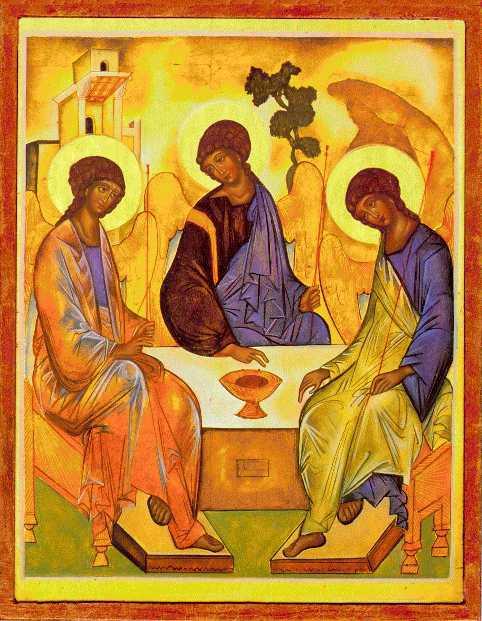
trinity

icon by Russian artist, Andrei Rublev c. 1360-1430


In this image, the three angels that visited Abraham (Genesis 18) are depicted. Though three in number, they are also referred to as a visitation from "the Lord", implicitly The One. The unity of the threesome is conveyed by the artist through the bowl or cup at the centre as well as through the containing circular form of the composition. What contains the three (the envelope) is also the centre (the nub) that holds them all together.

This Old Testament trinity is seen, of course, by Christians as a foretaste of the later trinity, clarified now as God the Father, God the Son, and God the Holy Ghost (or Spirit). In some images of this trinity the cup appears as a receptacle for Christ's blood and in the "vierge ouvrante" statues, it is the Great Mother as Virgin Mary that contains the Divine Trinity.

There is, therefore, always this fourth and unifying entity that is both the source and the end point of unity. As the early alchemist, Maria Prophetissa, is said to have put it:

One becomes Two,
Two becomes Three,
and out of the Third comes the One as the Fourth.


There are, in fact, two original Ones in this schema: the Great Mother as original whole and the Great Father as creator and generative principle. The second element is the Son and the third the Spirit. Finally, the whole returns to unity in the original One though now with the difference that distinctions have been made and transcended.

The parallels with Bayazid are as follows:

* The cup-bearer or saqi is God as original One, the Great Mother or Great Father depending on the emphasis.
* The cup itself is not mentioned by Bayazid or referred to by Rumi: it is "the forgotten cup" of the title.
* The wine is Christ, or more specifically, His blood as it is poured out in sacrifice.
* The drunkard or drinker is the Spirit, so evidently present in alcohol and therefore so perfectly represented by the person filled with the Spirit of God.
* All three (or four if the cup itself is included) are One, as Bayazid and Rumi assert, after not before making the distinctions among the elements.

The further parallels inside orthodox Islam are as follows:

* Allah, like the saqi, covers both the original Great Mother and Great Father.
* Mohammad is the cup that received God's Word.
* The Koran is the wine or the Word itself.
* Muslims themselves are the community receiving the wine.
* Allah, Mohammad, the Koran, and the community of Muslims form one unity in The One.

These mythopoetic elements in the Judaic, Christian, and Islamic trinities are not hard-and-fast. Like all such elements, they are fluid and any one element can readily flow into any other. Thus can Mohammad be seen in the role of Great Father (as non-Muslims see him, that is, as the originator or creator of Allah), in the role of the wine (as when Muslims imbibe his life story as spiritual nourishment) or in the role of the Final One (as when he is perceived as the Last Prophet).

Coming back to Bayazid, we still have the "lover, beloved, and love are one" idea. We could equate the Beloved with God (the Father or the Mother) and the Lover with the devout seeker after truth. Love, then, would act like the wine that is passed from one to the other. If lover and beloved are equals, then the equation can go either way and God is no longer appropriately seen as Father or Mother but simply as Friend. Still, we are left with the missing or forgotten cup. I suspect this is the Heart as Rumi might express it or the Soul or Psyche as we might express it today. I think, too, that the cup hints at the body, the house of the soul. The larger cup, God as Mother and container, is also the material world.

These are only sketchy outlines of ideas, each element worthy of considerable amplification and the whole leading to further interesting avenues to explore. However, I will have to leave that for another day.

Update: An expanded article with more images is now available as The Forgotten Cup.

Labels: , , , , , ,