Saturday, June 28, 2008

divine hands


Detail of Kwan Yin figure, Museum of Scotland, Edinburgh
photo by Akuppa @ flickr

Labels: , ,

Sunday, April 27, 2008

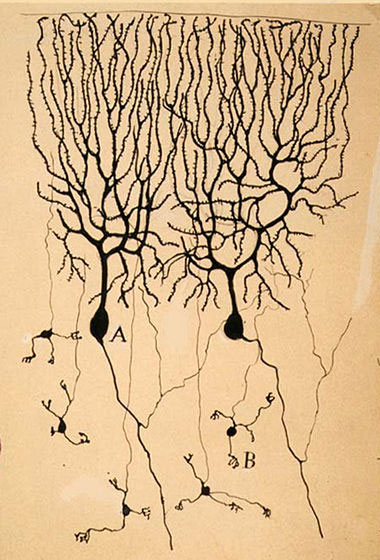
pigeon brain cells

brain cells

Drawing of Purkinje cells (A) and granule cells (B) from pigeon cerebellum
by Santiago Ramón y Cajal, 1899;
Instituto Santiago Ramón y Cajal, Madrid, Spain. @ wikipedia

Labels: , ,

Sunday, January 13, 2008

warrior woman in wool

extreme wool

Florence catwalk @ smh

Labels: ,

Tuesday, January 08, 2008

a second blogging of the qur'an

I have been following Robert Spencer's weekly series of which the latest is Blogging the Qur’an: Sura 10, “Jonah” and now, much to his own delight, Spencer will be joined by a second blogging the qur'an series, only this time by a prominent Muslim writer, Ziauddin Sardar. I've not come across this guy before but I accept the Guardian's blurb on him as a man "considered a pioneering writer on Islam" and "widely known for his radio and television appearances". I will certainly follow Sardar as assiduously as I have been following Spencer.
The first blog entry is a personal account of his Muslim upbringing, starting with Koranic readings from his mother's lap, moving through the stricter environment of the madrassa, and culminating in an ongoing process of adult appraisal. I am happy to enter into Sardar's world to get a better feel for how the Koran moves the Muslim soul but there nevertheless remains a gap in the writing culture for we non-Muslims must also write about how the Koran moves us, though in different ways, and I would like to see Muslims making a genuine open-hearted attempt to enter into our own non-Muslim's Koranic world. For me, this starts at the beginning with the Fatiha which, I'm sure, has a happy sound for Muslims but for me and other non-Muslims sounds deeply offensive because it is so clearly pointing at us in a wrathful and derogatory manner. It makes my flesh creep and I would dearly love - one day - to read a Muslim acknowledging that this offense and apprehension are realistically based and not some paranoid symptom of "Islamophobia". For now, I will wait and see what develops in this and the corresponding series by Spencer.

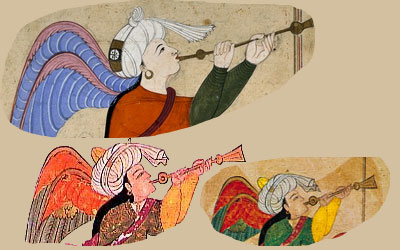
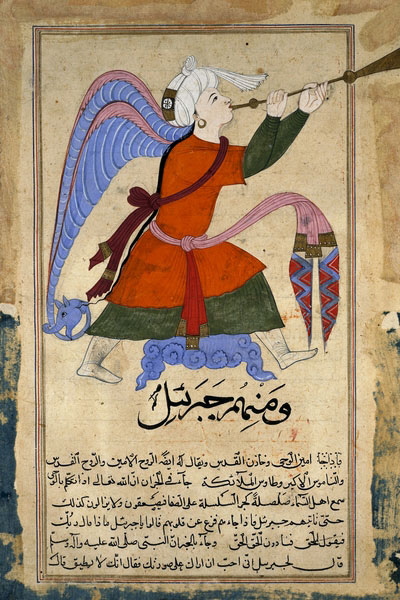
In point of fact, my attention was more strongly drawn to the illustration that The Guardian provided. It was curious, for example, that the British Museum page on this image names the figure Gabriel (the archangel that announced Jesus' coming to Mary) rather than Israfil (or Raphael). The latter has a strongly Islamic function of standing at the ready with trumpet to mouth for he will blow two blasts at the Final Hour: one to mark the death of us all and the second to mark our resurrection - more precisely, the resurrection of all good Muslims - from the dead.

Israfil

Archangel Israfil @ British Museum


My research also turned up some other variants of this image, clearly less refined ones but both contained in the same book. It seems that both the text and the artwork were copied by one to the next artist scribe, with results exhibiting more or less artistic merit or refinement. There is always a certain charm in the more primitive forms but the British Museum variant is stunningly beautiful. It doesn't really matter who created the first form of this angelic image but one does get a sense of the Islamic straightjacket that forbade innovation, specifically in theology but surely in any field - such as religious art - touched by deity.


Labels: , , ,

innovation in Islamic art

israfil

Archangel Israfil blowing a trumpet: 3 variations


Labels: ,

Monday, January 07, 2008

the lame god passes the cup among the gods

A conflict has been brewing among the gods of Olympus, especially between Hera, Queen of Heaven, and Zeus, her husband. Her son, the lame god Hephaestus, calms her down and passes sweet wine or nectar among the gods so that "all feasted equally". Finally the King retires to sleep by the side of his Queen.

Hephaestus spoke, then stood up, passed a double goblet
across to his dear mother, saying:
"Stay calm, mother, even though you are upset.
If not, then, as beloved as you are,
I may see you beaten up before my eyes, 
with me incapable of helping out,
though the sight would make me most unhappy.
It's hard to take a stand opposing Zeus.
Once, when I was eager to assist you,
Zeus seized me by the feet and threw me out,
down from heaven's heights.  The entire day
I fell and then, right at sunset, dropped
on Lemnos, almost dead.  After that fall,
men of Sintes helped me to recover."

As he spoke, the white-armed goddess Hera smiled.
She reached for her son's goblet. He poured the drink,
going from right to left, for all the other gods,
drawing off sweet nectar from the mixing bowl. 
Then their laughter broke out irrepressibly,
as the sacred gods saw Hephaestus bustling around,
concerned about the feast. All that day they dined,
until sunset. No one's heart went unsatisfied.
All feasted equally.  They heard exquisite music,
from Apollo's lyre and the Muses' beautiful song
and counter-song. When the sun's bright light had set,
the gods all went to their own homes.  Hephaestus,
the famous lame god, with his resourceful skill,
had made each god a place to live.  Olympian Zeus, 
god of lightning, went home to his own bed,
where he usually reclined whenever sweet sleep
came over him.  He went inside and lay down there,
with Hera of the golden throne stretched out beside him.  

from Homer: Iliad, final verses of Book I
trans Ian Johnston


hephaestus

Hephaestus riding a donkey
Athenian red-figure skyphos or drinking cup,
5th century BC @ answers.com


Labels: , , , ,

Tuesday, December 25, 2007

holy glow in the dark

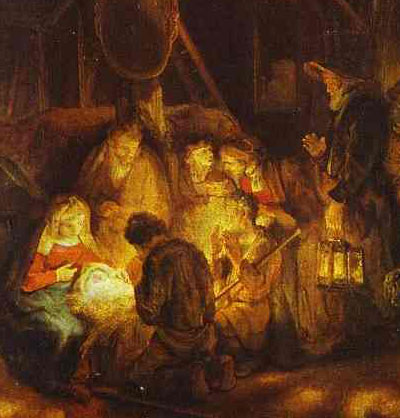
rembrandt

detail from Rembrandt: Adoration of the Shepherds


Labels: ,

Monday, December 24, 2007

waiting at a station

waiting

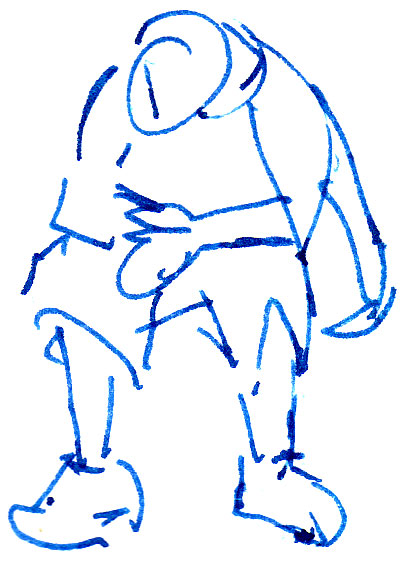
Arizona: man waiting at a railway station, ink on paper scanned


Labels:

Sunday, December 23, 2007

a letter in reply

Today, with Christmas approaching, Salim Mansur has chosen to share some words of that great mystic poet of the English language, William Blake.

Mystery surrounds us from the moment we arrive on Earth until we depart. At its most elementary the mystery is about what sustains this "brief crack of light" -- as the great writer Vladimir Nabokov in his autobiography, Speak, Memory, phrased his opening sentence -- "between two eternities of darkness."

Is life merely this fleeting moment compressed between eternal darkness on either side?

This remains the most compelling question that men and women of varying intellects through the ages have pondered over and most, I suspect, preferred believing that life is a passage, in the words of William Blake, "through Eternal Death! And of the awaking to Eternal Life."

Such belief rests on faith that there is an unseen power, eternally good, merciful, loving and beautiful beyond our earthly sight yet visible to our inner vision as Blake reminds us.

from Salim Mansur: Sharing Blake at Christmas


Whenever Mansur moves away from political commentary and into the more intimate world of faith, poetry and imagination, he seems less like a journalist and more like a friend writing to beloved friends, perhaps far away in time or space. Certainly, I get a feeling of receiving a letter from Salim, from half way across the world. I often have a similar feeling when reading Rumi at his intimate best but the distance then is not mere space but centuries of time as well.

vermeer

Johannes Vermeer: Woman in Blue Reading a Letter @ wikimedia commons


Indeed, Salim refers to this closeness in Blake's own experience of God.

All his life Blake was moved by the vision of God whose love was incarnated in the human form of Jesus.

God in Blake's vision was a personal Deity.

He was not lodged within the formal ornate settings of religious institutions or encountered in the lifeless pages of sacred texts.

In the long poem Jerusalem, Blake writes:

"I am not a God afar off, I am a brother and a friend;

Within your bosoms I reside, and you reside in me."


Three years ago, in the pre-Xmas season of 2004, our publicly funded TV broadcaster, ABC TV, ran a popular program called My Favourite Book in which viewers nominated and thereby voted in books that had made a major impact on them. The top four books were:

1. The Lord Of The Rings - by J.R.R. Tolkien
2. Pride and Prejudice - by Jane Austen
3. The Bible - by Various Contributors
4. To Kill a Mockingbird - by Harper Lee


The first and third books are epic tales on a grand scale, written by men; while the second and fourth are set in a more intimate or personal context and are written by women. There are intimate moments in the epic tales and there are grand themes woven into Austen's conventional love tale and the small town childhood experiences related by Lee. However, the grand predominates in the tales told by men while the small events of everyday life seem to be where women find their inspiration. The artist Vermeer, displayed above and painting a century before Blake, seems to have been atuned to a divine aesthetic present in the small and everyday feminine world. Below, that aesthetic finds voice in a female poet, a great but gentle mystic in her own right and following on soon after Blake.

THE SECRET.

Some things that fly there be, —
Birds, hours, the bumble-bee:
Of these no elegy.

Some things that stay there be, —
Grief, hills, eternity:
Nor this behooveth me.

There are, that resting, rise.
Can I expound the skies?
How still the riddle lies!

from Emily Dickinson: Poems


Perhaps, the essence of divinity lies in the intersection of these two worlds: the grander masculine and the more humble feminine. Where Blake finds the first in the second - Infinity in a hand, Eternity in an hour - perhaps it is the juncture that matters, just as Jesus stood and Christ ever stands at that juncture between humanity and God.

Because Salim is a Muslim and it behooves me to include at least a small element from his own faith tradition inside this article that attempts to act as a letter in reply to his, I would like to quote from the Koran:

We verily created man and We know what his soul whispereth to him, and We are nearer to him than his jugular vein.
Koran 50:16, trans Pickthall


In this verse the God of Mohammad's vision locates Himself at that most vulnerable spot in the neck where the life-blood flows and can so easily be spilt. He does not - like all those other deities in Blake's vision - "reside in the human breast", in that bosom or place of the heart. Allah is not a God of love but a God that threatens death, a God that reminds us of the thin line that separates a living soul from a corpse. It takes but a simple neat stroke to sever the jugular vein, to slit a throat. As that handful of Muslims demonstrated on that September 11, a lot can be achieved with a small box cutter held against a jugular vein.

At Christmas, English speakers love to listen to Handel's Messiah which tells the full tale of Jesus the Christ, from prophecies of His coming, to His humble birth, His suffering and death, and finally His resurrection. The last part affirms the life everlasting that will follow from this story.

I joined those many others in listening to this great masterpiece but the last part left me cold for I cannot believe that the life everlasting supercedes the life of today, the life of now, the life so simply depicted in so many of Vermeer's paintings.

There have also been celebrations lately around the date of Rumi's death which he himself described as his wedding day: the Urs or wedding with the Beloved. A poem from his own son portrays it thus:

From this foul, fulsome world, Rumi moved on

from Sultan Valad: Valad nameh, trans Franklin D. Lewis
via sunlight


I simply do not accept that this world is foul or fulsome. It's true that some eyes can see it so but others, with a different sensitivity, see it otherwise.

I simply do not accept that a man's world or a man's view is better than a woman's. Each has its own truth, its own validity, and its own necessity in the larger scheme of things.

Likewise, I simply do not accept that God (Heaven, Infinity, Eternity) is better than humanity (earth in time and space). Each needs the other and it is about time that God acknowledged that man created Him just as truly as He created man.


Labels: , , , ,

Tuesday, December 18, 2007

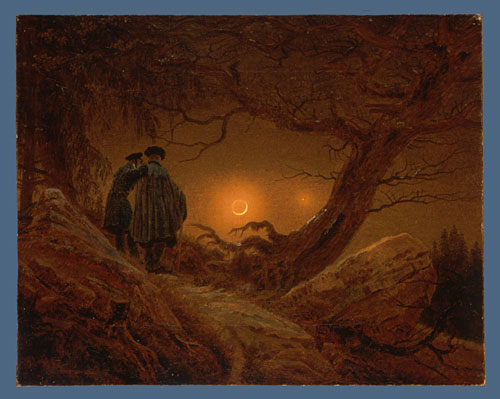
contemplating the moon

friedrich

Caspar David Friedrich: Two Men Contemplating the Moon
@ The Metropolitan Museum of Art


This is a painting that is said to have inspired Samuel Beckett to write Waiting for Godot.

Labels:

Monday, December 17, 2007

cup of destiny

destiny

John William Waterhouse: Destiny @ wikimedia commons


Labels: