Joseph Campbell: functions of mythology - part 1
In a recent post titled poet or priest, prophet or clown, I revisited the concluding chapter of Joseph Campbell's The Masks of God: Occidental Mythology. I looked at Mohammad through the lens of Campbell's categories of mythological manifestations, characterizing him as a prophet with a clown shadow.
Since that post however, I have wanted to complete my task by looking at the other set of categories that Campbell identifies in his conclusion. These categories relate to the functions of mythologies, as discerned through "the long view of the history of mankind" that Campbell undertook in the first three volumes of his Masks of God. Others will surely see different functions or will see the same functions in different lights, but Campbell has laid them out in a neat and clear form accessible to the educated layperson. They are four in number:
1) "eliciting and supporting a sense of awe before the mystery of being"
2) "to render a cosmology"
3) "to support the current social order"
4) "to initiate the individual into the order of realities of his own psyche"
I want here to begin to look at Islam in light of these four functions with a view to assessing what lasting merit it may have for today, which aspects are worthy of being retained and which aspects must be shed. Muslims will do their own work on this but there is no law under heaven that says that I cannot make a start, albeit from the standpoint of a non-Muslim. It is, after all, work that I need to do so that I can "have my story straight", so to speak, when interacting with Muslims.
Here is a longer quote from Campbell relating to the first function:
Professor Rudolf Otto has termed this recognition of the numinous the characteristic mental state of all religions properly so called. It antecedes and defies definition. It is, on the primitive level, demonic dread; on the highest, mystical rapture; and between there are many grades. Defined, it may be talked about and taught; but talk and teaching cannot produce it. Nor can authority enforce it. Only the accident of experience and the sign symbols of a living myth can elicit and support it; but such signs cannot be invented. They are found. Whereupon they function of themselves. And those who find them are the sensitized, creative, living minds that once were known as seers, but now as poets and creative artists. More important, more effective for the future of a culture than its statesmen or its armies are these masters of the spiritual breath by which the clay of man wakes to life.
I actually find passages such as this one in Campbell's writings quite numinous in themselves. He writes of the numinous in a tone that evokes it. The passage may, however, have absolutely no numinous quality to a different reader. There is always an element of personal taste in this, just as there is in the equally mysterious - and clearly related - phenomenon of falling in love. We only truly respect God when we respect this personal peculiarity of the numinous.
For Muslims, the numinous is present in the Quran, in the person or the life of Muhammad, in the vast literature of the traditions or ahadith, as well as in the further elaborations of poetic expression and architecture. Where a Muslim tells me he finds the numinous in those places, I can but respect that. I believe that the vast consensus in the modern Western world is that Muslims are or should be quite free to find the numinous wherever that may be. However, "official" or mainstream Islam does not reciprocate. It consistently fails to understand that Jesus - as the Christ - is divine or numinous to Christians, and that a respect for His divinity is a fair exchange for a respect for divinity as the Muslim sees it. I have witnessed the occasional rare Muslim who does actually understand this but it is, I believe, a rarer thing in the Muslim world than in the modern post-Christian world.
While Islam might offer plentiful opportunities to Muslims for experiencing the numinous it has a bad record when it comes to respecting the different ways in which the numinous is evoked in other cultures and faith traditions. This intolerance is built into its core dogmas and the monotheistic aspect of it promotes this especially. This is a fault that lies with Christianity as well and is best exemplified by Jesus' saying: "I am the way, the truth, and the life: no man cometh unto the Father, but by me." The modern post-Christian world has largely grown out of that intolerance while, sadly, the Muslim world seems to be becoming all the more entrenched.
The maverick Muslim, Stephen Schwartz, in a recent article on Moderate Islam and Its Muslim Enemies refers to and quotes from a work of a respected Sunni Muslim scholar known as Tahawi. According to Schwartz, this ancient document ("almost 1,100 years old") provides "a defining summation" of "the essential principles of mainstream Islam". Below is an opening excerpt from this opus [my emphasis]:
We say about Allah's unity, believing by Allah's help that:
1. Allah is One, without any partners.
2. There is nothing like Him.
3. There is nothing that can overwhelm Him.
4. There is no god other than Him.
5. He is the Eternal without a beginning and enduring without end.
6. He will never perish or come to an end.
7. Nothing happens except what He wills.
8. No imagination can conceive of Him and no understanding can comprehend Him.
9. He is different from any created being.
10. He is living and never dies and is eternally active and never sleeps.
Tahawi: Statement of Islamic Doctrine (Al-'Aqida al-Tahawiyya)
It is really only at point 8 that Tahawi firmly asserts the numinosity, the profound mystery and awe that surrounds what we call God. As soon as God is defined or delineated - whether as One, as Three, as Living, or Dead - then the awe and the mystery are diminished. A statement like "Allah is One, without any partners" is, in and of itself, an act of deicide, an act of killing God by limiting God's possibilities. It has been the great mystics, like Rumi and Hallaj and Hafiz, who have reaffirmed God's numinosity by reminding Muslims again and again of the truth of point 8 above.
However, point 1 - "God is One" - is a very very powerful idea that has always gripped humanity and been expressed in many and diverse ways, not simply in the way of Islam. As anyone with but a cursory knowledge of history knows, however, it is an idea that has produced more violence, chaos, confusion, rivers of blood and hateful divisions than has any other. This is because every numinous idea, every archetype, has an inbuilt shadow, a flipside of itself. The more we strive for unity, especially in a blind and forceful way, the more we produce its opposite, the more that things fall apart.
In the Christian world, this issue came to a head with the Reformation when the central unified authority of the Church was challenged. Protestantism eventually resulted in as many variants of Christianity as there are Christians. Still, though, the Pope exerts an enormous influence as a residual symbol of unity and centrality. Midnight mass at St Peter's cathedral remains a powerful focal moment for the Christian world, no matter even if one no longer "believes".
Islam seems to be struggling to find such a centre and this is expressed through the great longing for a renewed caliphate. Mecca works up to a point but it is a place and not a living person. If Islam were to achieve its own Reformation, I'm convinced it would take a reverse form to the Christian one. Instead of breaking up a central religious authority and placing power in the reading of the sacred text, Islam would need to break up the authority of that sacred text and seek authority from a new religious leader and a new religious institution, comparable to though not an exact mirror of the Papacy.
This seems to me, an outsider, to be somewhat akin to a US Presidential race. I hear the different Muslim voices, from this or that school, from this or that geopolitical world, each struggling to define or contain what Islam is, what is its enduring reality. I know that the Christian Church prides itself on being built on solid rock (as in the person of Peter) and I wonder if the Islamic central authority is not continually being undermined because it is built on shifting sands. If, after 14 centuries, no one really knows what the "real" Islam is, might it not be best to abandon what seems to be a futile project? Many brave Muslim apostates are saying "yes" to that proposal. Others more loyal to the original mad enterprise might grasp precisely at those shifting sands and see God's mystery most clearly expressed there. A Presidential race has a timeframe. No matter the confusion in the lead-up, a day will come when resolution is finally achieved (or perhaps slightly delayed as happened in the 2000 fiasco). There is no such clear final day for the Muslim world and perhaps this is why the "end of days" is so longed for, especially by many Shias, for this is precisely when a saviour-leader will appear in the return of the hidden imam or Mahdi.
So, for many Sunnis, it is a renewed Caliph that they seek while for many Shias, it is a renewed Imam. The one is the political leader or statesman, while the other is the seer that Campbell favours in the quote above. Muhammad is revered because he is seen as having embodied both of these leadership functions. Osama bin Laden clearly believes he can be a "new Muhammad" and no one else around even holds such an aspiration. He expresses and embodies, then, a powerful combination of numinous archetypes: there is a frail Jesus quality to him and a successful warrior side to him (the sep11 attack has to be rated a great military and symbolic success, however "evil" its source or intent). There seems to be no corresponding warrior-saint on the modern post-Christian side to combat him. Bush is on his way out and neither of the front-runners, Clinton or Giuliani, seem likely to fit the bill. The world hangs in the balance but we know that some resolution at least will come at the end of 2008. At least when it comes to the US Presidential race. It's harder to say what will happen in the Muslim world and when. It looks like a painful and unresolved stalemate will persist.
Campbell sees this numinous function of mythology as the primary one, the one that vivifies and permeates all the others. The key to our survival on this planet rests with our discovering a mythology that can embrace both the Christian and Islamic monotheistic mythologies as well as the many other valid forms of expression of the numinous. As Campbell suggests, this mythology will need to be discovered, almost as if stumbled on, by accident. It will take the right kind of sensitive souls to see it and recognize it for what it is. For this particular soul at this particular time, it is inconceivable just what shape it might take. I stubbornly long for that bonfire, I hope and pray to see it happen, not as a real-life conflagration, as a holocaust of human self-destruction, but as a willing sacrifice of all of our frames of reference by which we seek to ensnare the ultimately unsnarable.
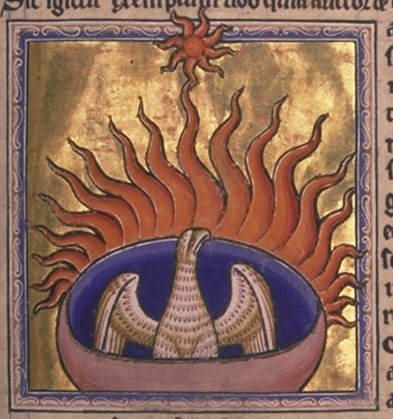
Phoenix illumination miniature from the Aberdeen Bestiary
via wikimedia commons
via wikimedia commons
Labels: Archetypes, bin Laden, Campbell, elections, Mohammad, Schwartz
posted by Arizona @ 4:43 pm
0 comments