Friday, February 22, 2008

on this and the "other" view

Mystical Meaning of "Daylight"

God has named the resurrection "that day;"
Day shows off the beauty of red and yellow.
Wherefore "Day" in truth is the mystery of the saints;
One day of their moons is as whole years.
Know, "Day " is the reflection of the mystery of the saints,
Eye-closing night that of their hidden secrets.
Therefore hath God revealed the chapter "Daylight," [Koran XCIII]
Which daylight is the light of the heart of Mustafa.
On the other view, that daylight means "The Friend,"
It is also a reflection of the same prophet.


Masnavi I Ma'navi Book II, Story I, trans Whinfield

In the Name of God, the Merciful, the Compassionate

93:1   By the white forenoon
           and the brooding night!
           Thy Lord has neither forsaken thee nor hates thee
           and the Last shall be better for thee than the First.

93:5   Thy Lord shall give thee, and thou shalt be satisfied.

           Did He not find thee an orphan, and shelter thee?
           Did He not find thee erring, and guide thee?
           Did He not find thee needy, and suffice thee?

93:9   As for the orphan, do not oppress him,
           and as for the beggar, scold him not;
           and as for thy Lord's blessing, declare it.


XCIII The Forenoon 93:1-11, trans Arberry

Labels: , , , , ,

Monday, February 04, 2008

patient research

The latest book I've been looking at is The place of tolerance in Islam by Khaled Abou El Fadl (as main author) and edited by Joshua Cohen and Ian Lague for Boston review (Beacon Press, 2002).

book cover


I found (Abou El) Fadl's initial long essay quite reasonable, despite its apologist overtones. A main difficulty arises in his shifting of moral judgment and clarity away from the Qur'an and onto the reader (p.14-15) [my emphasis]:

In a further example, as to justice, the Qur'an states: "O you who believe, stand firmly for justice, as witnesses for God, even if it means testifying against yourselves, or your parents, or you kin, and whether it is against the rich or poor, for God prevails upon all. Follow not the lusts of your hearts, lest you swerve, and if you distort justice or decline to do justice, verily God knows what you do." [Qur'an 4:135] The idea that Muslims must stand up for justice even against their own self-interests is predicated on the notion that human beings are capable of achieving a high level of moral agency. As agents, Muslims are expected to achieve a level of moral conscientiousness, which they will bring to their relationship with God. In regards to every ethical obligation, the Qur'anic text assumes that readers will bring a pre-existing, innate moral sense to the text. Hence, the text will morally enrich the reader, but only if the reader will morally enrich the text. The meaning of the religious text is not fixed simply by the literal meaning of its words, but depends, too, on the moral construction given to it by the reader. So if the reader approaches the text without moral commitments, it will almost inevitably yield nothing but discrete, legalistic, technical insights.

see also online: The Place of Tolerance in Islam


However, it is in his Reply to the eleven other contributors that I find him unreasonable or leaning toward an Islamist view. It is especially evident in his frequent - and often subtle - shifting of responsibility away from Muslims and onto non-Muslims. An example (p.96): "After all, isn't the real question whether non-Muslims are willing to tolerate Muslims, instead of the other way around?" Another (p.104): "[...] I believe that Muslims such as the Taliban [...] are not the outgrowth of a religious process, as much as a reaction to external secular forces, such as colonialism or corporate capitalism. "

The most serious example, however, is the moral equivalence demonstrated here (p.98) [my emphasis]:

If Americans allow the attacks of September [11, 2001] to alienate them from their moral values and from the civil liberties won in countless battles over two hundred years, then the terrorists have won. Similarly, if the Muslim response to the state terror inflicted upon them by Israel and other countries is to become alienated from their religious morality, then Muslims have lost something that is far more important than the political struggle - they have lost their moral grounding.


The exact repetition of wording here affirms that Israeli "state terror" is equivalent to the Islamist terror of Sep11, a deliberate act of murder against innocent and unsuspecting civilians. And since Israel has been indulging in "state terror" since (no doubt) at least 1967, it follows that the Sep11 attacks are what you'd expect as a justified retaliation. My own "pre-existing, innate moral sense" tells me that Fadl himself has completely lost his own moral grounding.

This is a man touted as a "moderate" and a respectable scholar of Islamic law (an identity he promotes on his own website: Scholar of the House). This kind of guy gives me the creeps. Utterly. I'm so glad that truer and better scholars like Daniel Pipes are keeping an eye on people like him:

The case of Abou El Fadl points to the challenge of how to discern Islamists who present themselves as moderates. This is still possible to do with Abou El Fadl, who has left a long paper trail; it is harder with those who keep their opinions to themselves. In either case, the key is old-fashioned elbow grease: reading, listening, and watching. There is no substitute for research. It needs to be done by White House staffers, district attorneys, university search committees, journalists, Jewish defense agencies, and churches. Failing proper research, Islamists will push their way through Western institutions and ultimately subvert them.

from Daniel Pipes: Stealth Islamist: Khaled Abou El Fadl


Finally, here is the last paragraph of Fadl's Reply (p.111):

God relegated to Muslims a moral trust. At no point in history can Muslims ignore their unending obligations to appropriately discharge this moral trust. The basic and invariable point is that Muslims - and non-Muslims - must understand that it is in the power and is in fact the duty of Muslims of every generation to answer the question: What Islam? The response must not be left in the hands of the bin Ladens of the world.

also online in draft version as: Khaled Abou El Fadl Replies


I would simply add that the response should never have been left in the hands of a man like Mohammad on whom bin Laden conscientiously - and quite precisely - models himself. Mohammad was a thief, a terrorist, an assassin, and a mass murderer. If, as Muslims believe, he is "the best of men" then it follows that Sep11 was a noble act along similarly "noble" lines. Deep down inside men like Fadl - and bin Laden - there must lie a numb and dumb and quivering mass of terrified "innate moral sense" too frightened even to squeak in the name of authentic Truth and Justice. How pathetic and pitiful are these poor Muslims, how cruel has been that Allah that led them to this dire circumstance. I can only thank God that I was not born into that world myself.

Labels: , , , , , ,

Friday, January 25, 2008

dumb on deity

After reading the atheistic Dawkins book (see collateral damage), I thought it appropriate to read a book from the opposing theistic camp. The library was accommodating in presenting me with Francis S. Collins' The Language of God (Free Press, 2006). This writer is earnest and at times quite sympathetic but he lacks the theatrical flair of Dawkins. Because he has a strong background and wide personal experiences in the areas he covers, his book is both informative and credible. However, there were several gaffes arising from what I perceive to be a shallow theism that matches Dawkins' shallow atheism.

The first most glaring gaffe occurs on page 41 [my emphasis]:
While the prophet Muhammad never himself used violence in responding to persecutors, Islamic jihads, dating to the earliest of his followers and including present-day violent attacks such as that of September 11, 2001, have created the false impression that the Islamic faith is intrinsically violent.


Never? Muhammad never himself used violence? What has Collins been doing since Sep11? Surely not reading any of the discussion on violence in Islam. Definitely never venturing anywhere near JihadWatch.org let alone FaithFreedom.org, AnsweringIslam.org, or other similar sites. If he had, he would know at least some of the following:

  • In the initial phase of Mohammad's "prophetic" career, while he was in Mecca with but a few followers, he had no power or opportunity to use violence. He deserves no credit for that restraint.

  • Shortly after being forced to leave Mecca and settle in Medina, Mohammad began to order (and also lead) raids against Quraysh caravans, killing the guards and stealing the loot from the camels' backs. He was thus a thief, an armed robber, and a murderer to boot. Details of the very first act of violence, a raid ordered against a caravan at Nakhla, are given in The earliest biography of Muhammad, by ibn Ishaq and also from page 97 of Robert Spencer's The Truth About Muhammad: Founder of the World's Most Intolerant Religion (Regnery Publishing, 2007). I will refer mainly to the latter resource for details as I have found Spencer to be reliable in his own reliance on original Muslim sources.

  • These violent raids progressed to full-blown battle at Badr where victory for the Muslims was claimed as evidence of the "truth" of Islam. See Koran 8:8 - "That He might cause the Truth to triumph" - and surrounding verses.

  • Following a victorious battle against a Jewish tribe, the Banu Quraysah, Mohammad ordered and supervised the massacre of all the men of the tribe. The women were distributed among his gang to be raped and, along with their children, taken as slaves. Details are given from page 128 of Spencer.

  • Mohammad was happy to order the torture of a captive, simply to extract information on the whereabouts of treasure. For details, see page 140 of Spencer. Torture was used on other occasions with clearly little other than sadistic intent as, for example, detailed in a Bukhari hadith.

  • Mohammad encouraged - or effectively ordered - the assassination of a Jewish poet guilty of composing "verses of an insulting nature". See page 115 of Spencer. There were several other similar incidents as listed at page 197 of Spencer.

  • For me, Mohammad's greatest sin of violence was indirect, relating to his approval of his followers' murder of women guilty of "disparaging" him. Details and sources can be found at my hearing the breath post.


Any of the above victims of Mohammad's cruelty and brutality could be characterized as his "persecutors", people who criticized or opposed him. Once he had the means to do so, he pursued his goals on the basis of a "might is right" prescription, terrorizing and murdering without scruple and often with supposedly "divine" approval.

Perhaps Collins has not educated himself sufficiently to be aware of every gory detail of this saga but he should have become acquainted with at least one detail by now, sufficient at least to balk at the use of the word "never" in the passage quoted above. He comes across as a very very naive man indeed, as one who sees the world - and other faith traditions - through the rose-coloured glasses of Christian sentimentality. If he can get this much so wrong, what value can there be in the remainder of his views?

The most positive element of Collins' book is his forthright defense of Darwinian "truth" and the lucidly presented details gleaned from his own field of genetics. It was fascinating, for example, to learn how the apparent extra chromosome (24 total) of our nearest relative, the chimpanzee, appears to have fused with another chromosome to result in the lesser count (23 total) in humans. Everything falls into place as Darwin would have predicted it.

If Collins can influence a good number of his fellow theistic Americans then he will have done a good service to science and to evolutionary biology in particular.

However, on the side of religious "truth", he sounds to me as hollow as Dawkins. He does not use the aggressive arrogance of Dawkins but a softly-softly "Christian" approach, gently trying to persuade any atheistic audience of the reasonableness of his own position. However, at bottom, he really is but a Christian apologist. He really does, quite literally, believe in the unique godhead of Jesus Christ and in the miracle of His resurrection.

To be fair, however, Collins states his Christian beliefs in a special chapter providing a more personal perspective. In terms of a more universal "truth" he proposes a faith he terms BioLogos, which includes 6 points. The first 3 are summaries of what science has come to know of the age of the universe, its physical properties "precisely tuned for life", and the onset of evolution as a process leading to life's diversity and complexity. In the next 2 points, the divine is specifically excluded and our animal nature affirmed:

4. Once evolution got under way, no special supernatural intervention was required.
5. Humans are part of this process, sharing a common ancestor with the great apes.


All of the theistic "damage" occurs in the final point:

6. But humans are also unique in ways that defy evolutionary explanation and point to our spiritual nature. This includes the existence of the Moral Law (the knowledge of right and wrong) and the search for God that characterizes all human cultures throughout history.


For me, this still looks like a "god of the gaps" and an arbitrary place to introduce God. From my observation of plants, animals, and fellow humans, I see no good reason to make such a radical distinction between "us" and "them". I see as strong a sense of right and wrong in my cat as I do in my human neighbour (or myself) and I'm not sure the unfolding of a seed into a plant is not a silent striving toward deity, a plant's version of "the search for God". Collins' BioLogos contains the same human arrogance as is present especially in the Judaically derived faiths, being all so influenced by the dreaded Book of Genesis.

Collins introduces the idea of the Moral Law much earlier in his book, in the chapter where he describes his own journey "From Atheism to Belief". It is in that section (on page 24) that he makes, ironically, a huge moral gaffe:

In some unusual cultures the law takes on surprising trappings - consider witch burning in seventeenth-century America. Yet when surveyed closely, these apparent aberrations can be seen to arise from strongly held but misguided conclusions about who or what is good or evil. If you firmly believed that a witch is the personification of evil on earth, an apostle of the devil himself, would it not seem justified to take such drastic action?


I will leave it to another reviewer to respond more fully to this and, at the same time, I would recommend Korthof's more detailed elaboration of problems with point 6 of BioLogos, similar to my own concerns stated but briefly above.

Shockingly, Collins highest priority is showing that witch burning does not invalidate the Moral Law and he does not bother to tell his readers that he is unconditionally against all torture of all human beings or against the death penalty. Or did he just forget to tell us? It should be easy to condemn an inhuman practice of more than 300 years ago. The 'aberration' seems to be that they burned the wrong people and that the Moral Law they tried to follow is good. The implication would be that Christians today more accurately know which people they have to burn. At the time they only got a few minor details wrong and executed 60,000 people. 'Some unusual cultures'? The European witch-hunt was not a single historical event, but took place from Scotland to Transylvania and from Spain to Finland over a 300-year period (1450 - 1750). Collins completely overlooks that witch burning is not an aberration of otherwise clear and sound concepts and principles. These poor individuals were charged with killing babies, causing sterility among cattle, and destroying crops by magical means, worship the Devil, and nocturnal flight (yes, the executors believed that witches can fly). An ordinary criminal could have been imprisoned or have a painless and quick death penalty. What is the harm done by witches to their neighbours? Does Collins think that magic works and that it has been proven by the inquisitors? Does Collins think that babies are killed and crops fail by magic? Does Collins think that the Devil exists and that 'the pact with the devil' has been proven in any case? Does Collins think that a 'firm belief' in stead of legal proof is enough to execute people in the cruellest way? The real aberration is in the abstract and fictional nature of the theological concepts such as 'witch', 'personification of evil', 'apostle of the devil'. There is the problem. There is the danger. Collins provides on these pages the best evidence of the dangers of fictional, abstract concepts so characteristic of religion. A closely related religious concept is eternal burning in hell. He completely fails to attempt a scientific analysis of this kind of thinking, instead he is part of the problem and he is completely carried away by abstract concepts himself.

from Gert Korthof's review of The Language of God (linked sources in the original)


Finally, near the end of the book, I found myself cringing at the arrogance of Collins' exclusive monotheism and two-faced "tolerance" of other faith traditions. First, on page 225, is the first face of his "tolerance" [with my own read-between-the-line additions]:
I do not mean by telling this story to evangelize or proselytize. [though that is, in fact, what I'm doing] Each person must carry out his or her own search for spiritual truth. If God is real, He will assist. [that man or woman to come to Him, that is, Christ] Far too much has been said by Christians about the exclusive club they inhabit. Tolerance is a virtue; intolerance is a vice. [and I so want to appear virtuous both to the reader and to myself] I find it deeply disturbing when believers in one faith tradition dismiss the spiritual experiences of others. [though I will do this myself in a few pages from here] Regrettably, Christians seem particularly prone to do this. Personally, I have found much to learn from and admire in other spiritual traditions, though I have found the special revelation of God's nature in Jesus Christ to be an essential component of my own faith.


Two pages later, on page 227, there is an about-turn followed by a final about-turn back to the initial "tolerant" face [my emphasis]:
Many of these [Golden Rule] principles can be found in other great religions of the world. Yet if faith is not just a cultural practice, but rather a search for absolute truth, we must not go so far as to commit the logical fallacy of saying that all conflicting points of view are equally true. Monotheism and polytheism cannot both be right. Through my own search, Christianity has provided for me that special ring of eternal truth. But you must conduct your own search.


Well, mate, I have conducted my own search and let me tell you this: Why can't there be different doorways to deity? Different approaches that suit different people? Many of the great mystics have exclaimed that God (or nirvana or the Tao) transcends all of our human intellectual categories including the apparently opposing ideas that God is One and that It is Many. Maybe God is indeed "above" your petty distinction between monotheism and polytheism. Isn't it possible that Unity and Multiplicity are two paradoxical aspects of God just as light sometimes seems wave-like and sometimes matter-like? James Hillman, an advocate of polytheistic psychology (see my Kali Xronia post for some background), contends that it includes non-exclusive (though not exclusive) monotheism. Some people may be more suited to a monotheistic approach, others to a polytheistic. Making dogmatic pseudo-logical assertions may not be helpful when facing a mystery as deep as deity.

Dawkins likes the propagandist motto that "atheists are bright" and I would have to agree with him that Collins does not deserve the label, at least when it comes to theology. He is "bright" when it comes to genetic science and so also is Dawkins when it comes to evolutionary biology. But both men are equally dumb on deity.

Labels: , , , ,

Sunday, December 16, 2007

yes, Zuhdi, let's talk

The final installment of the NRO Q&A with Zuhdi Jasser arrived in my inbox today. A key question was as follows [my emphasis]:

Lopez: What’s the most important question you get when you speak on radical Islam?

Jasser: I would weigh the importance of all of the various questions I get with their centrality in promoting American security. That said, the most important question or concern I get from audiences to which I have the privilege to speak, is whether spiritual Islam and political Islam are in fact contrary to my beliefs — inseparable? And whether I am whitewashing a dangerous political ideology? An appropriate answer to this question would need volumes of discourse. Ultimately, I ask them not only to believe my voice and my ideas, which appear to be in the wilderness, but rather to begin the ground work of speaking to Muslims in the grass roots about their political and spiritual constructs. We need to multiply this debate exponentially within the Muslim community.

from NRO Q&A: We Need a Hero


In the interests of contributing to those "volumes of discourse", I'll throw my tuppence worth in here.

Jasser asks me to believe his voice and his ideas. I have no trouble with his basic sincerity but I have grave doubts regarding his capacity to sell his story fully to Muslims and non-Muslims alike. As Robert Spencer of Jihad Watch has expressed it, first in the positive, then in the negative:

Meeting intimidation with a demonstration of nobility and generosity. Bravo, Zuhdi Jasser.

source: U.S. Islamic group ...


This is very good, but of course it doesn't go far enough. I hope that M. Zuhdi Jasser would be willing to confront Taheri-azar's abundant Qur'an quotations, and the role of the example of Muhammad in inspiring jihad violence today. If he is, and if others like him are, then there might really be some progress toward the ideological confrontation with jihadism that he calls for.

source: American Muslim leader ...


Jasser especially urges "speaking to Muslims in the grass roots" but this I have attempted several times, always with highly discouraging results. I'm met with a variety of evasions, defensive walls, threats and even pleas to desist, along the lines of:


  • "It is generally impolite to discuss religion and politics. Just raising these matters is offensive and a sign of belligerence and intolerance."

  • "You don't know Islam. You're an ignorant Kafir."

  • "Be careful what you say or even suggest against Islam as we Muslims will defend our faith with violence if need be and that includes violence against you, your loved ones, and your possessions. The police won't help either, not if you merely find your pet cat poisoned or a deep scrape in your car's paintwork."

  • "We're terrified ourselves of the violent Muslims and we don't want to be seen associating with a non-Muslim on anything more than the most superficial level. Let's talk about the weather, that's fine, but no more. And even there, let's not talk about God bringing the rain or the sunshine. Leave God out of it."


Nowhere is there any honest and forthright debate. Nowhere. Even Jasser himself is evasive, rarely making direct references to the Koran or the life of Mohammad.

At the very end of the interview Lopez asks: "Who are your heroes?" Jasser provides a list of four men: his grandfather and namesake Zuhdi Al-Jasser, US Presidents Reagan and Jefferson, and fictional TV hero Jack Bauer. What kind of a Muslim leaves Mohammad out of a list like that? Is Mohammad absent because Jasser has genuinely come to repudiate him as a role model or is he not there because Jasser is practising a form of taqiyyah, diplomatically neglecting to mention something that might sound too "un-American".

To convince me, Jasser will need to do far more than denounce Islamists (under whichever of their many names). He will need to put some substance into his airy-fairy assertion that there is a separate spiritual Islam unpolluted by Islamist political ideology.

This is how I see it:


  • The Koran, the life of Mohammad, the traditions and the classical interpretations form a coherent whole with a clear Islamic supremacist message: God is One, His Centre is located at Mecca, His Final Prophet was Mohammad, His Final Word was the Koran, no other conception of deity has any validity, the Jewish and Christian conceptions are especially pernicious for making apparently credible but deceptive claims, and it is the duty of every Muslim to spread the One True Faith of Islam whether by the sword, by unrestrained fertility, by the (literal or metaphoric) handing out of sweets to children, or by forceful evangelization.

  • "Nice" Muslims like Jasser are employing the tactic of handing out metaphoric sweets to gullible adults.

  • Yes, there is "a spiritual Islam" of sorts. There is a mystical tradition, called Sufism, which arose within the Islamic empire but has clear influences from abroad, from outside the core supremacist Islamic tradition described above. Those influences include much Hindu and Buddhist mysticism, deep and direct influences from Zoroastrian, Christian and Jewish sources (through an actual reading of and meditation on their sacred texts), as well as wider Mediterranean influences (such as Greek neoPlatonism and ancient strands of Egyptian alchemy and theosophy). The core values of Sufism can be represented by the poetic works of one man alone, known to us all as Rumi. However, if you took his two major works, the Mathnawi and the Shams collection, and removed from them every clear Islamic (Koranic or Mohammadan) reference, then you would still be left with an oceanic and essentially divine corpus. Take Islam out of Rumi and you're still left with the Divine.

  • Do a similar but opposite job on the main Islamic works, especially the Koran itself: remove every clear supremacist, political, ideological statement - every "Islamist" statement - and what remains? Perhaps a puddle or two of insipid and unoriginal pronouncements as to the glory of God. The kind of thing that a dozen monkeys on a dozen typewriters could easily produce in a dozen days.


I'm happy to discuss any of this with you, Zuhdi, at whatever length you wish, here or elsewhere.

I'm prepared to be infinitely patient but not to the point of holding my breath. I will continue to be engaged in many other activities such as enjoying the fruits of the rich culture to which I'm fortunate to be an heiress. Stuff like Beethoven and professional tennis, but especially stuff like civilized adult conversation unfettered by fear or favour.

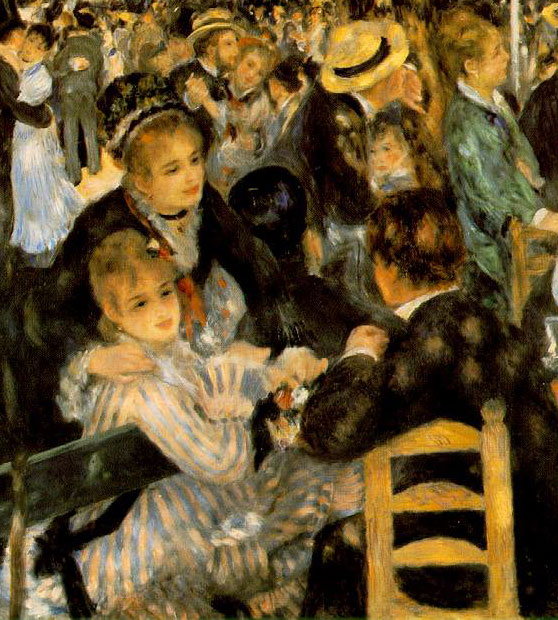
renoir conversation

detail from Pierre-Auguste Renoir: Le Moulin de la Galette, 1876


Yes, Zuhdi, let's talk. I'm ready, willing, and waiting.


Labels: , , , , ,

Thursday, October 25, 2007

Joseph Campbell: functions of mythology - part 1

In a recent post titled poet or priest, prophet or clown, I revisited the concluding chapter of Joseph Campbell's The Masks of God: Occidental Mythology. I looked at Mohammad through the lens of Campbell's categories of mythological manifestations, characterizing him as a prophet with a clown shadow.

Since that post however, I have wanted to complete my task by looking at the other set of categories that Campbell identifies in his conclusion. These categories relate to the functions of mythologies, as discerned through "the long view of the history of mankind" that Campbell undertook in the first three volumes of his Masks of God. Others will surely see different functions or will see the same functions in different lights, but Campbell has laid them out in a neat and clear form accessible to the educated layperson. They are four in number:

1) "eliciting and supporting a sense of awe before the mystery of being"

2) "to render a cosmology"

3) "to support the current social order"

4) "to initiate the individual into the order of realities of his own psyche"

I want here to begin to look at Islam in light of these four functions with a view to assessing what lasting merit it may have for today, which aspects are worthy of being retained and which aspects must be shed. Muslims will do their own work on this but there is no law under heaven that says that I cannot make a start, albeit from the standpoint of a non-Muslim. It is, after all, work that I need to do so that I can "have my story straight", so to speak, when interacting with Muslims.

Here is a longer quote from Campbell relating to the first function:

Professor Rudolf Otto has termed this recognition of the numinous the characteristic mental state of all religions properly so called. It antecedes and defies definition. It is, on the primitive level, demonic dread; on the highest, mystical rapture; and between there are many grades. Defined, it may be talked about and taught; but talk and teaching cannot produce it. Nor can authority enforce it. Only the accident of experience and the sign symbols of a living myth can elicit and support it; but such signs cannot be invented. They are found. Whereupon they function of themselves. And those who find them are the sensitized, creative, living minds that once were known as seers, but now as poets and creative artists. More important, more effective for the future of a culture than its statesmen or its armies are these masters of the spiritual breath by which the clay of man wakes to life.


I actually find passages such as this one in Campbell's writings quite numinous in themselves. He writes of the numinous in a tone that evokes it. The passage may, however, have absolutely no numinous quality to a different reader. There is always an element of personal taste in this, just as there is in the equally mysterious - and clearly related - phenomenon of falling in love. We only truly respect God when we respect this personal peculiarity of the numinous.

For Muslims, the numinous is present in the Quran, in the person or the life of Muhammad, in the vast literature of the traditions or ahadith, as well as in the further elaborations of poetic expression and architecture. Where a Muslim tells me he finds the numinous in those places, I can but respect that. I believe that the vast consensus in the modern Western world is that Muslims are or should be quite free to find the numinous wherever that may be. However, "official" or mainstream Islam does not reciprocate. It consistently fails to understand that Jesus - as the Christ - is divine or numinous to Christians, and that a respect for His divinity is a fair exchange for a respect for divinity as the Muslim sees it. I have witnessed the occasional rare Muslim who does actually understand this but it is, I believe, a rarer thing in the Muslim world than in the modern post-Christian world.

While Islam might offer plentiful opportunities to Muslims for experiencing the numinous it has a bad record when it comes to respecting the different ways in which the numinous is evoked in other cultures and faith traditions. This intolerance is built into its core dogmas and the monotheistic aspect of it promotes this especially. This is a fault that lies with Christianity as well and is best exemplified by Jesus' saying: "I am the way, the truth, and the life: no man cometh unto the Father, but by me." The modern post-Christian world has largely grown out of that intolerance while, sadly, the Muslim world seems to be becoming all the more entrenched.

The maverick Muslim, Stephen Schwartz, in a recent article on Moderate Islam and Its Muslim Enemies refers to and quotes from a work of a respected Sunni Muslim scholar known as Tahawi. According to Schwartz, this ancient document ("almost 1,100 years old") provides "a defining summation" of "the essential principles of mainstream Islam". Below is an opening excerpt from this opus [my emphasis]:

We say about Allah's unity, believing by Allah's help that:

1. Allah is One, without any partners.
2. There is nothing like Him.
3. There is nothing that can overwhelm Him.
4. There is no god other than Him.
5. He is the Eternal without a beginning and enduring without end.
6. He will never perish or come to an end.
7. Nothing happens except what He wills.
8. No imagination can conceive of Him and no understanding can comprehend Him.
9. He is different from any created being.
10. He is living and never dies and is eternally active and never sleeps.

Tahawi: Statement of Islamic Doctrine (Al-'Aqida al-Tahawiyya)


It is really only at point 8 that Tahawi firmly asserts the numinosity, the profound mystery and awe that surrounds what we call God. As soon as God is defined or delineated - whether as One, as Three, as Living, or Dead - then the awe and the mystery are diminished. A statement like "Allah is One, without any partners" is, in and of itself, an act of deicide, an act of killing God by limiting God's possibilities. It has been the great mystics, like Rumi and Hallaj and Hafiz, who have reaffirmed God's numinosity by reminding Muslims again and again of the truth of point 8 above.

However, point 1 - "God is One" - is a very very powerful idea that has always gripped humanity and been expressed in many and diverse ways, not simply in the way of Islam. As anyone with but a cursory knowledge of history knows, however, it is an idea that has produced more violence, chaos, confusion, rivers of blood and hateful divisions than has any other. This is because every numinous idea, every archetype, has an inbuilt shadow, a flipside of itself. The more we strive for unity, especially in a blind and forceful way, the more we produce its opposite, the more that things fall apart.

In the Christian world, this issue came to a head with the Reformation when the central unified authority of the Church was challenged. Protestantism eventually resulted in as many variants of Christianity as there are Christians. Still, though, the Pope exerts an enormous influence as a residual symbol of unity and centrality. Midnight mass at St Peter's cathedral remains a powerful focal moment for the Christian world, no matter even if one no longer "believes".

Islam seems to be struggling to find such a centre and this is expressed through the great longing for a renewed caliphate. Mecca works up to a point but it is a place and not a living person. If Islam were to achieve its own Reformation, I'm convinced it would take a reverse form to the Christian one. Instead of breaking up a central religious authority and placing power in the reading of the sacred text, Islam would need to break up the authority of that sacred text and seek authority from a new religious leader and a new religious institution, comparable to though not an exact mirror of the Papacy.

This seems to me, an outsider, to be somewhat akin to a US Presidential race. I hear the different Muslim voices, from this or that school, from this or that geopolitical world, each struggling to define or contain what Islam is, what is its enduring reality. I know that the Christian Church prides itself on being built on solid rock (as in the person of Peter) and I wonder if the Islamic central authority is not continually being undermined because it is built on shifting sands. If, after 14 centuries, no one really knows what the "real" Islam is, might it not be best to abandon what seems to be a futile project? Many brave Muslim apostates are saying "yes" to that proposal. Others more loyal to the original mad enterprise might grasp precisely at those shifting sands and see God's mystery most clearly expressed there. A Presidential race has a timeframe. No matter the confusion in the lead-up, a day will come when resolution is finally achieved (or perhaps slightly delayed as happened in the 2000 fiasco). There is no such clear final day for the Muslim world and perhaps this is why the "end of days" is so longed for, especially by many Shias, for this is precisely when a saviour-leader will appear in the return of the hidden imam or Mahdi.

So, for many Sunnis, it is a renewed Caliph that they seek while for many Shias, it is a renewed Imam. The one is the political leader or statesman, while the other is the seer that Campbell favours in the quote above. Muhammad is revered because he is seen as having embodied both of these leadership functions. Osama bin Laden clearly believes he can be a "new Muhammad" and no one else around even holds such an aspiration. He expresses and embodies, then, a powerful combination of numinous archetypes: there is a frail Jesus quality to him and a successful warrior side to him (the sep11 attack has to be rated a great military and symbolic success, however "evil" its source or intent). There seems to be no corresponding warrior-saint on the modern post-Christian side to combat him. Bush is on his way out and neither of the front-runners, Clinton or Giuliani, seem likely to fit the bill. The world hangs in the balance but we know that some resolution at least will come at the end of 2008. At least when it comes to the US Presidential race. It's harder to say what will happen in the Muslim world and when. It looks like a painful and unresolved stalemate will persist.

Campbell sees this numinous function of mythology as the primary one, the one that vivifies and permeates all the others. The key to our survival on this planet rests with our discovering a mythology that can embrace both the Christian and Islamic monotheistic mythologies as well as the many other valid forms of expression of the numinous. As Campbell suggests, this mythology will need to be discovered, almost as if stumbled on, by accident. It will take the right kind of sensitive souls to see it and recognize it for what it is. For this particular soul at this particular time, it is inconceivable just what shape it might take. I stubbornly long for that bonfire, I hope and pray to see it happen, not as a real-life conflagration, as a holocaust of human self-destruction, but as a willing sacrifice of all of our frames of reference by which we seek to ensnare the ultimately unsnarable.
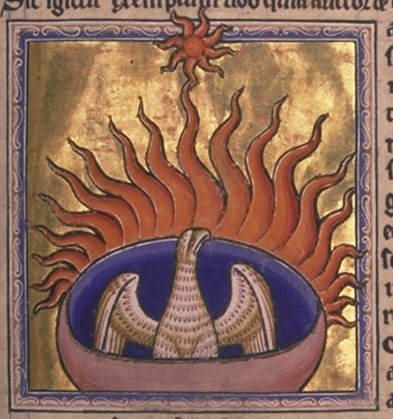
phoenix

Phoenix illumination miniature from the Aberdeen Bestiary
via wikimedia commons

Labels: , , , , ,

Tuesday, October 16, 2007

fleurs trinitaires

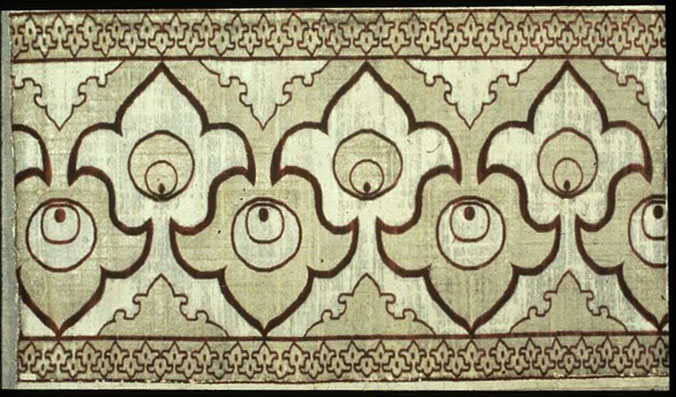
This is a follow-up to an earlier post on trinity flowers. I've been looking out for threefold patterns in Islamic arts and crafts and I was especially intrigued by the Turkish panel shown below:

panel

Velvet panel, Turkey 17th century. Museum of Fine Arts, Boston.


Not only does it have a pattern based on vaguely triangular shapes - similar to the French fleur-de-lys emblem - but it features an Escher-style repeating pattern in which the foregrounds and backgrounds "mirror" each other. I was moved to make a simple design derived from this panel, using the vector graphic program Inkscape:

trellis

fleur-de-lys trellis rendered in Inkscape


I went on to use this design as a decorative element at my article on The Forgotten Cup.

As I did further research on the fleur-de-lys emblem, I was led to the following further example of it within Islamic arts.

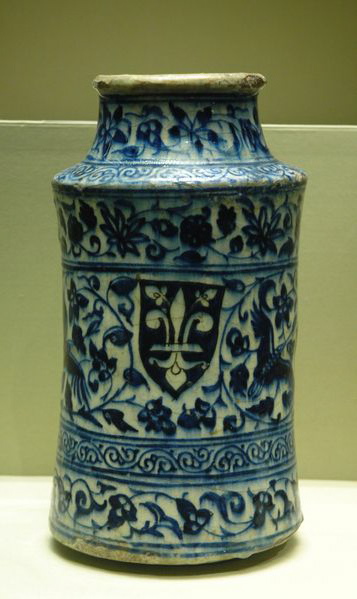
fleur jar

Albarello with fleur-de-lys decoration. Syria, 14th century.
Musée du Louvre, Paris. via wikimedia commons


From the wikipedia article on the fleur-de-lys, we learn that:

The use for ornamental or symbolic purposes of the stylised flower usually called fleur de lis is common to all eras and all civilizations. It is an essentially graphic theme found on Mesopotamian cylinders, Egyptian bas-reliefs, Mycenean potteries, Sassanid textiles, Gaulish coins, Mameluk coins, Indonesian clothes, Japanese emblems and Dogon totems. The many writers who have discussed the topic agree that it has little to do graphically with the lily, but disagree on whether it derives from the iris, the broom, the lotus or the furze, or whether it represents a trident, an arrowhead, a double axe, or even a dove or a pigeon. It is in our opinion a problem of little importance. The essential point is that it is a very stylised figure, probably a flower, that has been used as an ornament or an emblem by almost all civilizations of the old and new worlds.

Michel Pastoureau: Traité d'Héraldique, 2006.


This emblem, then, is quite ancient and can carry many meanings. It could be said to represent a natural threefold quality that expresses itself in many other ways but especially in the various triune deities. Islam repudiated such a triunity, not only in the Christian version (which Mohammad understood as God, Jesus and Mary) but in the pagan Arab version as the three goddesses Uzza, al-Manāt and al-Lāt.

Various esoteric meanings have been assigned to the number three (see this table of comparative numerology) but it is common to associate it with energy, movement, dynamism and change. By contrast, the number four stands for solidity, stability, conservatism and stasis. Both the numbers 7 (via addition) and 12 (via multiplication) are seen as syntheses of these opposites.

It seems to me that Islam, by consciously repressing triunity and three-ness, turned its back on change, on any idea of an evolving consciousness whether in the form of further advances in empirical knowledge or further clarifications through revelation.

And yet, such a powerful archetype, such an important aspect of deity, must have tried to "creep in" somehow and get a foot in the door of the two-way dialogue between Allah and Mohammad. It seems to me to be doing just that when those bizarre Arabic letters turn up at the start of Koranic chapters or suras. The first two suras (after the fatiha or opening) have three such letters: Alif Lam Mim. In all, three suras start with 1 letter, 10 with 2, 14 with 3, 2 with 4, and 2 with 5. It seems, then, that the theme of two (dialogue) is fairly strongly outweighed by the theme of three (in this case, a third party observer of the dialogue).

There is much talk about whether Islam can achieve some kind of renaissance or reformation that would render it better suited to the modern world. For Islam to change, I believe it must return to this issue of the triune nature of deity and come to a better understanding of this mystery. Reformers might look to those Islamic trinities like Rumi's water of life, the one who pours, and the one who drinks or Bayazid's wine-drinker, wine, and cupbearer or his even simpler (though more abstract) lover, beloved, and love. Perhaps the trinity flowers or today's fleurs trinitaires could be used as meditative tools, images for contemplation of how Islam might be transformed or understood in more modern and dynamic ways.

I can offer these flowers or fleurs but, as a non-Muslim or Kafir, I cannot take this any further. With God's grace, these flowers can shed seeds and take root in the good earth but it is up to a devout and modern Muslim to gather in whatever harvest emerges. In that task, he or she might take heed from the Word of God:

It is He who looses the winds, bearing good tidings before His mercy, till, when they are charged with heavy clouds, We drive it to a dead land and therewith send down water, and bring forth, therewith all the fruits. Even so We shall bring forth the dead; haply you will remember.

Koran 7:55 (7:57 in most editions), trans A.J. Arberry


Labels: , ,

Wednesday, September 05, 2007

poet or priest, prophet or clown

He had not learned to preach from poring over commentaries;
no, he learned from the fountain of revelations and the spirit--
from the wine that is so potent that when it is quaffed
the water of speech gushes from the mouth of the dumb,
and the new-born child becomes an eloquent divine
and, like the Messiah, recites words of ripened wisdom.

Rumi: Mathnawi VI:2654-2656
version by Camille and Kabir Helminski
via Sunlight


The above three couplets from Rumi's Mathnawi refer to the prophet Noah who "preached a new sermon" everyday. Me, I'll just post a new blog entry everyday and see how I go with that.

I've been rereading Joseph Campbell: The Masks of God: Occidental Mythology, especially the chapters on Islam. However, it is the Conclusion that I have found most rewarding to reread. In it, Campbell makes some nice distinctions, firstly among "attitudes toward divinities": those of the priests and those of the poets. The first tend to take their gods literally or "for real" while the second understand the reality of human imagination. While priests tend to maintain a religion or mythology, prophets will often initiate a new direction or found a new cult. The prophet, for Campbell, is a certain kind of poet:

Overwhelmed by his own muse, a bad poet may imagine his visions to be supernatural facts and so fall into the posture of a prophet - whose utterances I would define as "poetry overdone," over-interpreted; wherefore he becomes the founder of a cult and a generator of priests.


Thus does Campbell move into a third component of distinction, yielding: "the true poetry of the poet, the poetry overdone of the prophet, and the poetry done to death of the priest". However, he does also refer to the "poetry underdone" of the poet who is limited to the personal and fails to reach the archetypal. More specifically, this kind of poetry tends "to rest in the whimsies of personal surprise, joy, or anguish before the realities of life".

It's hard to find a nice fourth word to name this last kind of poet. The best I could find is "humorist" or "comic". From there, one readily thinks of the joker, the jester, the clown. This is a hugely popular figure in our current culture, perhaps because we are weary of the archetypal. The Homer Simpson character created by Matt Groening is the great debunker of all things serious, sacred, or sanctified. He is utterly anti-numinous.

There is a great deal of humour within Rumi's own writings. This debunking wit flashes out here and there throughout his opus. Perhaps it is finally what makes Rumi's work so complete and so satisfying.

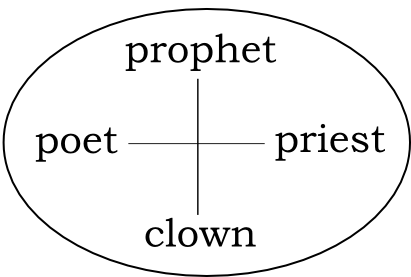
So now we have four manifestations in the field of mythology:

1) the true poetry of the poet, of which Campbell himself is a prime example since he writes in a serious vein but with often highly lyrical passages;

2) the poetry overdone of the prophet, of which the Qur'an is a prime example since it takes God so seriously from go to whoa;

3) the poetry done to death of the priest, of which so many prayers - such as Christianity's "The Lord's Prayer" - are typical; and finally

4) the poetry underdone of the comic, of which Matt Groening is an outstanding exemplar.

Come to think of it, I like the word "clown" best for the last manifestation in mythology. It finishes well when one lists the types: poet or priest, prophet or clown.

I often think of Mohammad simply as Mo, a clown figure ("real" name Roy Rene) once popular here in Australia. According to Campbell's schema, clown Mo is indeed the shadow side of prophet Mohammad.


Labels: ,