Sunday, January 16, 2011

the mother of truth

A nice quote from the Chinese dissident inside an article by Mansur:
“Freedom of expression,” Liu Xiaobo wrote, “is the foundation of human rights, the source of humanity, and the mother of truth. To strangle freedom of speech is to trample on human rights, stifle humanity, and suppress truth.”

from Salim Mansur: Beware Of China’s Meteoric Rise

Labels:

Sunday, August 03, 2008

fine words

Salim Mansur has some fine words to say about the American people today:
Folks in Middle America are realists. Middle America, besides geography, also refers to the American character -- irrespective of ethnic origin -- of being proud of a country built by the love and sacrifice of previous generations into the greatest power in history.

Middle Americans uncomplainingly run the daily routines of keeping America free, prosperous and strong. Theirs is a story of unfailing optimism, generosity, courage and romance.

from Salim Mansur: Kerry, too, was the media darling

Labels: , ,

Tuesday, July 15, 2008

Mansur on Sharia

Sharia is a legal system derived from the Qur'an and the traditions of Prophet Muhammad, and devised by Muslim scholars more than a millennium ago to dictate just about every aspect of individual living and thinking.

It is a closed system disallowing any innovation based on a modern reading of Islam's sacred texts, and it is violently at odds with liberal-democratic values.

The Islamist demand for introducing Sharia is strategically conceived to render Muslim populated areas in a multicultural Britain -- and similarly in other western democracies -- as Sharia-based enclaves set apart from the majority population.

The evidence of havoc Islamists have wrought across the Arab-Muslim world is overwhelming, and since Sept. 11, 2001, this evidence is daily news.

Yet a growing elite opinion in Britain, defying logic and history, has taken hold in support of Sharia while remaining unmindful of consequences and dismissive of the peril [...] of how internal enemies push their agenda to fatally weaken democracies.

from Salim Mansur: Sharia law thin edge of wedge

Labels: ,

Tuesday, February 05, 2008

Rumi on Jews

Sometimes Rumi comes across as a "good Muslim", complete with the arrogance and ignorance we've become used to; sometimes he transcends that partisanship and heads toward his mystic universalism. Either way, his characterization of Jews is telling.

In the first passage below [my emphasis], from the Mathnawi, Rumi portrays the Jew as the archetypal non-Muslim: infidel, undiscerning, in the wrong, like a base coin, in the dark, with dust in his eyes, a hater of the light, and so on. The Jew is the Evil Guy or Baddy, the dark side of existence where all ugliness, deceit, folly, and blindness reside. This is just how most mainstream Muslims view modern Israelis (with the ever loyal exception of Salim Mansur). In the second passage below [my emphasis], Rumi emphasizes the One God that Muslims, Jews and Christians share and affirms the mystic union of the three.

Why the prophets were sent.


God sent the prophets for this purpose,

Namely, to sever infidelity from faith.

God sent the prophets to mankind

That they might gather the pure grain on their tray.

Infidel and faithful, Mosalman and Jew,

Before the prophets came, seemed all as one.


Before they came we were all alike,

No one knew whether he was right or wrong.

Genuine coin and base coin were current alike;

The world was a night, and we travelers in the dark,

Till the sun of the prophets arose, and cried,

"Begone. O slumber; welcome, O pure light!"

Now the eye sees how to distinguish colors,

It sees the difference between rubies and pebbles.

The eye distinguishes jewels from dust,

Hence it is dust makes the eyes smart.

Makers of base coin hate the daylight,

Coins of pure gold love the daylight,

Because daylight is the mirror that reflects them,

So that they see their own perfect beauty.


Rumi: Mathnawi Book II, Story I, trans Whinfield


Everywhere the secret of God is coming -
see how the people are coming uncontrollably;
From him for whom all souls are athirst,
to the thirsty the cry of the water carrier is coming.
They are milk drinkers of divine generosity,
and are on the watch to see from whence the mother is coming.
They are in separation, and all are waiting
to see whence union and encounter are coming.
From Moslems, Jews, and Christians alike
every dawn the sound of prayer is coming;

Blessed is that intelligence into whose heart's ear
from heaven the sound of "come hither" is coming.
Keep your ear clean of scum,
for a voice is coming from heaven;
The defiled ear hears not that sound -
only the deserving gets his deserts.
Defile not your eye with human cheek and mole,
for that Emperor of eternal life is coming;
And if it has become defiled, wash it with tears,
for the cure comes from those tears.
A caravan of sugar has arrived from Egypt;
the sound of footfall and bells is coming.
Ha, be silent, for to complete the ode
our speaking King is coming.


Rumi: Ghazal (Ode) 637, trans Arberry via Sunlight

Labels: , , , ,

Sunday, January 06, 2008

Kali Xronia

Kali Xronia (καλη χρονια: literally "good year") is the Greek way of saying "Happy New Year". I'm adding it to the French and English from Salim Mansur's first Toronto Sun missive for 2008.

Bonne année. Welcome to the New Year.

Take a deep breath, savour the moment and be an adult in a world awash in a rising tide of bigotry and the noise of political drivel pouring forth from our media as news.

Being adult means being a realist.

It means looking at the world as it is and recognizing that the fundamental attributes of human nature reflected in politics remain mostly unchanged from the age, for instance, of Thucydides some 25 centuries ago when he chronicled the Peloponnesian War that consumed the city-states of Hellas or ancient Greece.

from Salim Mansur: Let's all get real in 2008


Now, it can readily be added that the "fundamental attributes of human nature" as seen through the lenses of psychology and religion cannot have changed much either in those 2,500 years. The Greeks at the time followed a polytheistic religion, one that is now regarded as having little more than literary value. At least one modern psychologist, James Hillman,would urge us to return to this original Greek vision much as Mansur seeks to remind us of the great values of that original Athenian political experiment.


Nicolas-André Monsiau (1754 - 1837): The Olympians @ wikimedia commons


James Hillman is an heir to Carl Jung's analytical psychology but he became discontent with what he perceived as a monotheistic bias in Jung's portrayal of the psyche. He proposed and elaborated a polytheistic psychology that supports and validates the multi-faceted style of personality rather than seeing it as an incomplete phase within a process toward unity or wholeness.

A good online description of Hillman's opus is available as Marc Fonda's dissertation titled Examining the New Polytheism: A Critical Assessment of the Concepts of Self and Gender in Archetypal Psychology from which I provide the following excerpt:

One of the most important aspects of a polytheistic paradigm for psychology is the implication for the sacred. The re-sacralization of our means of speaking about the human condition and the physical world are well served by polytheism. There is a felt need in the de-souled, excessively rational and material contemporary world to find a kind of meaning that is analogous to the sacred, as opposed to the mere exchange of information. For Hillman, religions are not defined by the presence of Gods and Goddesses, but rather in terms of observances or the binding of events to one or many instances of numinosity, of that which moves the soul. For all the questions this definition of religion brings up, we must understand that Hillman is not so concerned whether monotheism or polytheism is better or worse (an opposition inherent in the monotheistic bias). Rather it is a question whether

Polytheistic psychology has room for the preferential enactment of any particular myth in a style of life....And [this suggests that] even the myths may change in a life, and the soul serve in its time many Gods. Polytheistic psychology would not suspend the commandment to have "no other Gods before me," but would extend that commandment for each mode of consciousness....No one model would be "before" another, since in polytheism the possibilities of existence are not jealous to the point of excluding each other.

[from James Hillman: "Psychology: Monotheistic or Polytheistic?" (Spring 1971, New York: Spring Publications, 1971)]


To Hillman, polytheism offers a style of consciousness that disallows the strict separation of psychology and religion. As I see it, Hillman's polytheistic psychology can help repudiate other separations such as the mind from the body, rationalism from unconsciousness, self from the other, the animated and unanimated. Hillman believes that the two, religion and psychology, are assumed by one another. Indeed, with the soul as the root metaphor of a polytheistic psychology, religious concerns are automatically acknowledged. That is, if analysis leads one to the "dark center" from which it is difficult to make the distinction between the unconscious and God, then it is impossible for the therapist to not be involved with religious problems.

from Marc Fonda: Polytheism as an Alternate Paradigm for Psychology


For ease of reference, here are the Biblical and Koranic passages that most clearly assert the monotheistic position, followed by typical (and comparable) monotheistic statements from Rumi and Jung:

And God spake all these words, saying,

I am the LORD thy God, which have brought thee out of the land of Egypt, out of the house of bondage.

Thou shalt have no other gods before me.


Exodus 20:1-3 KJV

And say: Praise be to Allah, Who hath not taken unto Himself a son, and Who hath no partner in the Sovereignty, nor hath He any protecting friend through dependence. And magnify Him with all magnificence.

Koran 17:111 Pickthall

Your intelligence is split into a hundred busy tasks,
in thousands of desires, in large and small things.
You must unite these scattered parts with love and
become as sweet as Samarkand and Damascus.
Once you are unified, grain by grain, then you can be
stamped with the royal seal.


Rumi: Masnavi IV: 3288-90
trans Muriel Maufroy via dar-al-masnavi


The more one becomes aware of the contents of the personal unconscious, the more is revealed of the rich layer of images and motifs that comprise the collective unconscious. This has the effect of enlarging the personality.
In this way there arises a consciousness which is no longer imprisoned in the petty, oversensitive, personal world of the ego, but participates freely in the wider world of objective interests. This widened consciousness is no longer that touchy, egotistical bundle of personal wishes, fears, hopes, and ambitions which always has to be compensated or corrected by unconscious counter-tendencies; instead, it is a function of relationship to the world of objects, bringing the individual into absolute, binding, and indissoluble communion with the world at large.[Jung: "The Function of the Unconscious," CW 7, par. 275.]

from Daryl Sharp: Jung Lexicon: A Primer of Terms & Concepts (1991) available @ NYAAP (The New York Association for Analytical Psychology)

Self

The archetype of wholeness and the regulating center of the psyche; a transpersonal power that transcends the ego.

As an empirical concept, the self designates the whole range of psychic phenomena in man. It expresses the unity of the personality as a whole. But in so far as the total personality, on account of its unconscious component, can be only in part conscious, the concept of the self is, in part, only potentially empirical and is to that extent a postulate. In other words, it encompasses both the experienceable and the inexperienceable (or the not yet experienced). . . . It is a transcendental concept, for it presupposes the existence of unconscious factors on empirical grounds and thus characterizes an entity that can be described only in part.[Jung: "Definitions," CW 6, par. 789.]

The self is not only the centre, but also the whole circumference which embraces both conscious and unconscious; it is the centre of this totality, just as the ego is the centre of consciousness. [Jung: "Introduction," CW 12, par. 44.]

Like any archetype, the essential nature of the self is unknowable, but its manifestations are the content of myth and legend.
The self appears in dreams, myths, and fairytales in the figure of the "supraordinate personality," such as a king, hero, prophet, saviour, etc., or in the form of a totality symbol, such as the circle, square, quadratura circuli, cross, etc. [...][Jung: "Definitions," CW 6, par. 790.]

[...]

Experiences of the self possess a numinosity characteristic of religious revelations. Hence Jung believed there was no essential difference between the self as an experiential, psychological reality and the traditional concept of a supreme deity.
It might equally be called the "God within us."[Jung: "The Mana-Personality," CW 7, par. 399.

from Daryl Sharp: Jung Lexicon @ NYAAP [my emphasis]


On a final note, the above image of the Olympian pantheon is not strictly true to the original Greek polytheism since the gods and goddesses appear together. This is not characteristic of ancient Greek art where each deity was given its solitary due much as Hillman asks that we interpret the divine command against "other gods before me". At any moment we serve a particular deity, be it a God of War (Ares) or a Goddess of Love (Aphrodite), a God of Nature (Dionysus) or a Goddess of Civilization and Culture (Athena). When the god/dess is well served, the moment takes on the quality of eternity and nothing is removed if a different god/dess is served in the next moment of time. Yes, there is a unity in that shared quality of eternity and divinity but the plurality of the gods and the unique contribution of each must also be given its due. Ironically, unless we are completely open to that continuous flow of service from one god to another, unless we fully acknowledge the sovereignty of each god in turn, then we will fail to gather together those grains of our being that, together, make us whole.


Labels: , , , , ,

Wednesday, January 02, 2008

creepy quotes from quadrant

A long but fascinating essay from Australia's Quadrant Magazine turned up today. Written by Fr Paul Stenhouse, it is titled Islam's Trojan Horse? Turkish Nationalism and the Nakshibendi Sufi Order. It piqued my interest especially since it relates to the local (Melbourne) scene, to interfaith efforts within the Roman Catholic Church, as well as to the issue of whether Sufism can serve as a counterpoint to Islamism.

As the title suggests, Stenhouse provides background information on the Nakshibendi Sufi Order and its influence within Turkish politics. He profiles leading lights of the Order such as Said Nursi and Fethullah Gülen and it is from sermons of the latter that the "creepy quotes" occur.

"You must move in the arteries of the system, without anyone noticing your existence, until you reach all the power centers …"

"The philosophy of our service is that we open a house somewhere and, with the patience of a spider, we lay our web, to wait for people to get caught in the web; and we teach those who do. We don’t lay the web to eat or consume them, but to show them the way to their resurrection, to blow life into their dead bodies and souls, to give them a life."

from sermons by Fethullah Gülen quoted in Paul Stenhouse: Islam's Trojan Horse? Turkish Nationalism and the Nakshibendi Sufi Order


web

photo from flickr/wikimedia commons


Stenhouse is clearly warning the naive interfaith dialogue enthusiast about the dangers of Islamist propaganda efforts, known as da'wa and quite likely to be clothed precisely in "dialogue" terms.

Dialogue has always been of paramount concern to Catholics. Nevertheless, goodwill alone, unsupported by accurate and comprehensive knowledge of Islam, is demonstrably not enough. In fact it can fatally distort the process for all participants in the “dialogue”, non-Muslims and Muslims alike. The latter immediately sense when good-hearted but ignorant and incautious non-Muslims are utterly unaware of, or are not in agreement about, what is at stake, or what the rules of the game are.

However we may wish it to be otherwise, it is a kind of mind game that we are playing. The stakes are high—and none of the clichés and double-talk of coffee-table ecumenism will serve us well in this struggle of wits.


My attention was also drawn to Stenhouse's bringing in Salim Mansur as a fellow repudiator of "the appeasement mentality" of elements in the liberal-left (which clearly can include the "softer" side of the Church itself).

A similar criticism of Western naivety and “suicidal” complacence was articulated recently by Salim Mansur, a columnist in the Toronto Sun. Mansur is a Muslim and the relevance of his insight is not confined to Canada. He describes what he calls “the appeasement mentality” of the mainstream liberal-left media, and of “politicians trolling for ethnic votes” and of “bureaucrats running public institutions” in the West. He quotes Theodore Dalrymple, a retired physician and prolific writer, who reported in New York’s City Journal:

“In an effort to ensure that no Muslim doctors ever again try to bomb Glasgow Airport, bureaucrats at Glasgow’s public hospitals have decreed that henceforth no staff may eat lunch at their desks or in their offices during the holy month of Ramadan, so that fasting Muslims shall not be offended by the sight or smell of their food. Vending machines will also disappear from the premises during that period.”

“Imagine the uproar,” comments Mansur, that would greet “any suggestion that the mainstream liberal-left media, in appearance at least, is treasonously on side with the newest enemies of freedom and democracy.”


For me, a central message of Stenhouse's long essay comes from a quote he gives from a fellow priest [my emphasis added]:

[T]he Director of the Centre for Arab–Christian Documentation and Research in Beirut, Father Samir Khalil Samir, SJ, ... noted that Christians often suffer from:

“a false understanding of the concept of tolerance. All this is an error and leads to the loss of one’s own identity. Never attack in word or deed, but seek the truth and always point out error. To say only half of what one is thinking is a lie; a complicit silence. Truth cannot co-exist with lies, intolerance and injustice.”


There is far, far too much of this kind of lying coming from the Christian but especially from the Catholic and Anglican Churches. Sadly, even though Salim Mansur might be the last Muslim the West can trust, he may also be guilty of this kind of lying.

For various different reasons, we are all too afraid to tell it frankly as it is and as we truly feel it.

Labels: , , , ,

Sunday, December 30, 2007

peace through appeasement? nay, peace through war

Today, Salim Mansur has drawn my attention to the Swiss Roman Catholic theologian, Hans Küng. I've not read any of his many books but will look out for his writings when next at the library. For this post, I've relied on what is available on the internet, such as through wikipedia and reviews of his books. He appears to be a man of wide learning and of strong commitment, as well as having the personal gifts necessary to bring these into the public arena so as to make a real and practical impact on his world. I admire those qualities and cannot but be impressed.

küng

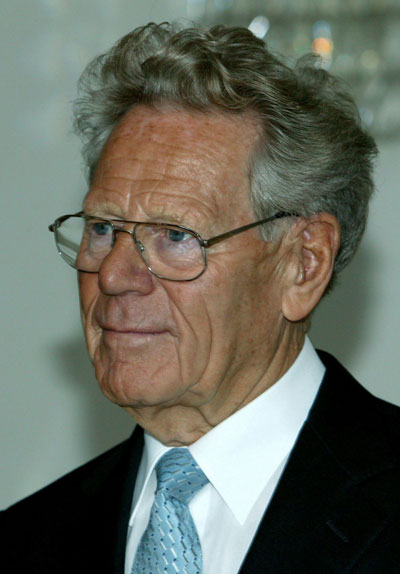
Hans Küng in 2005


Mansur opens with what he calls Küng's "theorem": "No peace among the nations without peace among the religions." As a mathematician myself, I find the use of this term puzzling since a theorem is something that can be formally proved. Küng's statement has more of the quality of a mantram or a slogan. The terms are ill-defined, making it impossible to assess the statement's real worth. It has an undeniable "feel good" ring to it and sets forth a worthy goal, but this is precisely what mantras and slogans merely amount to.

What has more substance for me is the simple fact that Mansur has bothered to read Küng's lengthy work on Islam and considered it worth a focus in his weekly article for the Toronto Sun. That demonstrates his continuing openness to the very dialogue that Küng recommends, albeit within the confines of a scholarly and somewhat prim conversation. As he himself reminds us, this openness is not too common among Muslims:

There is no Muslim scholar I can readily think of who might be mentioned in the same breath as Kung for engaging with similar devotion and humility in the study of Judaism and Christianity, while putting aside any expectation that Muslims should similarly engage in studying and learning from the faith-traditions nominally described as Eastern religions.

from Salim Mansur: Theologian finds peace path


The comparative study of religions has been very much a part of the scientific spirit of world discovery, perhaps more aptly described as a discovery of worlds since each faith-tradition is like a different world. There is indeed little evidence of a similar outgoing curiosity from within the Islamic world except, historically, among some of the Sufis.

When Rumi, for example, touches on the life of Jesus or of Job, it is clear that he has researched these earlier "prophets" through the actual scriptures of Judaism and Christianity.

In the case of Job, there is virtually no information about him in the Koran. For a Muslim to know Job's story, he must go to the Old Testament book and read there directly. It's clear that Rumi had done this or had an intimate acquaintance with those who had. He knew his Job and he knew his Jesus.

I've never encountered this kind of knowledgeability among other Muslim writers, whether past or present.

And if the stories told of his funeral are even partly true, then Rumi did achieve this rare understanding across religions that Küng and similar proponents of "interfaith dialogue" are seeking.

There is, however, a fatal flaw in the approach of well meaning men like Küng. It is an easy exercise to find parallels and similarities between religions. However, real "peace" is not possible unless the differences are honestly and forthrightly confronted rather than politely glossed over. This is a main criticism coming out of the following review of Küng's book on Islam:

Although well aware of questionable, or at least all too human, aspects of Muhammad’s life, Küng demands categorically that Christian theology and the Christian Churches should recognise “without reservation” that: “Through the Qur’an the Prophet gave countless people in his century and in the centuries that followed infinite inspiration, courage and power to make a new religious beginning: a move towards greater truth and deeper knowledge and a breakthrough towards enlivening and renewing traditional religion. Islam was the great help in life”.

But the Christian believer and theologian cannot but judge this statement about the person of Muhammad and of the Qur’an as unqualified and undifferentiated, not least in the light of the absolutely central Christian theological question at issue here: in the light of the life and teaching of the great biblical prophets Hosea, Jeremiah and Isaiah and especially and finally of Jesus of Nazareth and his Gospel, what are the adequate and God-pleasing “means” and ways of acting, which the true messenger of God is to employ to further the cause of God? Does not the way Muhammad opted for, namely, political and military means in furthering the cause of Islam, need to be viewed as objectively irreconcilable with the life, example and teaching of the non-violent, suffering “servant of Yahweh”?

from Christian Troll: Book Review for The Tablet


Küng has been quoted as saying: "As a matter of fact, you have deficiencies in all religions, but you have truth in all religions." The word "deficiencies" is a polite way of saying "falsehood" but an honest dialogue must address both the true and the untrue and it must especially focus on those areas where the "truth" of one religion clashes with the "truth" of another in a way that does not readily allow for overlap. In the case of Christianity and Islam, there are two especially hot spots: the mystery of the trinity and the very factuality of Jesus' crucifixion, letting alone its meaning.

I have tried to look into the first issue in some of my recent posts (under Trinity). On the second issue, I have considered the "dialogue" possibilities of looking at Rumi's ghazal 728 which compares Jesus with Hallaj. The pertinent lines are as follows:

That idea the Christian carries abroad, the Moslem has not that
idea, that He is slaying this Messiah upon the cross.
Every true lover is like Mansur, they slay themselves; show any
beside the lover who deliberately slays himself!


excerpt from ghazal 728, trans A.J. Arberry


Earlier this year, I offered this possibility to the Catholic priest conducting the course on Mysticism: Islamic and Christian Perspectives but he showed no interest in pursuing it. I'm not sure why it is so but this reluctance to honestly face up to these differences is as evident on the one side as on the other.

So for me, it's: Dialogue, schmialogue. We can go nowhere if appeasement is the only approach used. A war of words must be started, else a war of nuclear weaponry will likely take its place.

Labels: , , , , , ,

Sunday, December 23, 2007

a letter in reply

Today, with Christmas approaching, Salim Mansur has chosen to share some words of that great mystic poet of the English language, William Blake.

Mystery surrounds us from the moment we arrive on Earth until we depart. At its most elementary the mystery is about what sustains this "brief crack of light" -- as the great writer Vladimir Nabokov in his autobiography, Speak, Memory, phrased his opening sentence -- "between two eternities of darkness."

Is life merely this fleeting moment compressed between eternal darkness on either side?

This remains the most compelling question that men and women of varying intellects through the ages have pondered over and most, I suspect, preferred believing that life is a passage, in the words of William Blake, "through Eternal Death! And of the awaking to Eternal Life."

Such belief rests on faith that there is an unseen power, eternally good, merciful, loving and beautiful beyond our earthly sight yet visible to our inner vision as Blake reminds us.

from Salim Mansur: Sharing Blake at Christmas


Whenever Mansur moves away from political commentary and into the more intimate world of faith, poetry and imagination, he seems less like a journalist and more like a friend writing to beloved friends, perhaps far away in time or space. Certainly, I get a feeling of receiving a letter from Salim, from half way across the world. I often have a similar feeling when reading Rumi at his intimate best but the distance then is not mere space but centuries of time as well.

vermeer

Johannes Vermeer: Woman in Blue Reading a Letter @ wikimedia commons


Indeed, Salim refers to this closeness in Blake's own experience of God.

All his life Blake was moved by the vision of God whose love was incarnated in the human form of Jesus.

God in Blake's vision was a personal Deity.

He was not lodged within the formal ornate settings of religious institutions or encountered in the lifeless pages of sacred texts.

In the long poem Jerusalem, Blake writes:

"I am not a God afar off, I am a brother and a friend;

Within your bosoms I reside, and you reside in me."


Three years ago, in the pre-Xmas season of 2004, our publicly funded TV broadcaster, ABC TV, ran a popular program called My Favourite Book in which viewers nominated and thereby voted in books that had made a major impact on them. The top four books were:

1. The Lord Of The Rings - by J.R.R. Tolkien
2. Pride and Prejudice - by Jane Austen
3. The Bible - by Various Contributors
4. To Kill a Mockingbird - by Harper Lee


The first and third books are epic tales on a grand scale, written by men; while the second and fourth are set in a more intimate or personal context and are written by women. There are intimate moments in the epic tales and there are grand themes woven into Austen's conventional love tale and the small town childhood experiences related by Lee. However, the grand predominates in the tales told by men while the small events of everyday life seem to be where women find their inspiration. The artist Vermeer, displayed above and painting a century before Blake, seems to have been atuned to a divine aesthetic present in the small and everyday feminine world. Below, that aesthetic finds voice in a female poet, a great but gentle mystic in her own right and following on soon after Blake.

THE SECRET.

Some things that fly there be, —
Birds, hours, the bumble-bee:
Of these no elegy.

Some things that stay there be, —
Grief, hills, eternity:
Nor this behooveth me.

There are, that resting, rise.
Can I expound the skies?
How still the riddle lies!

from Emily Dickinson: Poems


Perhaps, the essence of divinity lies in the intersection of these two worlds: the grander masculine and the more humble feminine. Where Blake finds the first in the second - Infinity in a hand, Eternity in an hour - perhaps it is the juncture that matters, just as Jesus stood and Christ ever stands at that juncture between humanity and God.

Because Salim is a Muslim and it behooves me to include at least a small element from his own faith tradition inside this article that attempts to act as a letter in reply to his, I would like to quote from the Koran:

We verily created man and We know what his soul whispereth to him, and We are nearer to him than his jugular vein.
Koran 50:16, trans Pickthall


In this verse the God of Mohammad's vision locates Himself at that most vulnerable spot in the neck where the life-blood flows and can so easily be spilt. He does not - like all those other deities in Blake's vision - "reside in the human breast", in that bosom or place of the heart. Allah is not a God of love but a God that threatens death, a God that reminds us of the thin line that separates a living soul from a corpse. It takes but a simple neat stroke to sever the jugular vein, to slit a throat. As that handful of Muslims demonstrated on that September 11, a lot can be achieved with a small box cutter held against a jugular vein.

At Christmas, English speakers love to listen to Handel's Messiah which tells the full tale of Jesus the Christ, from prophecies of His coming, to His humble birth, His suffering and death, and finally His resurrection. The last part affirms the life everlasting that will follow from this story.

I joined those many others in listening to this great masterpiece but the last part left me cold for I cannot believe that the life everlasting supercedes the life of today, the life of now, the life so simply depicted in so many of Vermeer's paintings.

There have also been celebrations lately around the date of Rumi's death which he himself described as his wedding day: the Urs or wedding with the Beloved. A poem from his own son portrays it thus:

From this foul, fulsome world, Rumi moved on

from Sultan Valad: Valad nameh, trans Franklin D. Lewis
via sunlight


I simply do not accept that this world is foul or fulsome. It's true that some eyes can see it so but others, with a different sensitivity, see it otherwise.

I simply do not accept that a man's world or a man's view is better than a woman's. Each has its own truth, its own validity, and its own necessity in the larger scheme of things.

Likewise, I simply do not accept that God (Heaven, Infinity, Eternity) is better than humanity (earth in time and space). Each needs the other and it is about time that God acknowledged that man created Him just as truly as He created man.


Labels: , , , ,

Sunday, December 16, 2007

still, Salim, I'd be happy to talk

Salim Mansur, the brave warrior for freedom, is again forthrightly condemning disgusting Muslim behaviour: a father's murder of his own daughter and a Muslim body's frivolous attack on the effervescent Canadian writer Mark Steyn. As always with Mansur, it is a perverted form of Islam that is to blame, never Islam itself.

The murder was prompted by an ideology of bigotry and terror masked as a faith-tradition -- an ideology of radical Islamism at war with the modern world of freedom and democracy.

from Salim Mansur: Bigotry, terror masked as faith


The Islam and the Muslims represented by a body like CIC (Canadian Islamic Congress) is not the true Islam and not the true Muslims:

Moreover, they are fraudulent in their claims of representing Muslims in general as the CIC does. The fact is, on the contrary, most Muslims in Canada and elsewhere in the West left their native lands to escape from unmitigated cruelty, heartlessness and hypocrisy of Muslim rulers and religious leaders.

[...] as fraudsters they have developed the swindler's art of blackmailing free societies [...]


For Mansur, the true Muslims and the bulk of Muslims are those that repudiate but also fear the Islamists. Apart from an initial close circle of Mohammad's and the successors of that inner elite this would seem to characterize all Muslims from the very start to the hopefully inevitable end. It is what you'd expect from a political ideology masked as a divine prescription. It is what has been in place from the beginning.

And that "beginning" is not simply the beginning of Islam but the beginning of life on this planet: for females and young offspring have always been vulnerable and have always been the first to be exploited or destroyed by life's urge to establish dominant and dominating genetic material. It is most glaringly exemplified in the behaviour of lions, an animal that Muslim men are quick to identify with. When a new male defeats the ruling male of the pride he sets out to obliterate the previous male's genetic material by killing every lion cub he can lay a claw on in the intervals of his systematic rape of each of the pride's lionesses. OK, "rape" is not correct as it assumes that a female might - or might not - give consent. In the leonine world, the female is simply not consulted. They are not known to refuse. This is in fact quite a good description of the average Muslim wife: she could never be "raped" by her husband as she has never been "known to refuse".

That was "in the beginning" but then God arrived. Humanity conceived of a divine law giver that dictated that things would be otherwise. Not that women and children were given particular consideration. First and foremost, the Divinity Itself had to be honoured and with an utterly singular focus:

  • I am the LORD thy God

  • Thou shalt have no other gods before me

  • Thou shalt not make unto thee any graven image

  • Thou shalt not take the name of the LORD thy God in vain


excerpts from Bible: Exodus 20, King James Version


From a woman's point of view, nothing has really changed here. The dominant male, the Lion King, has simply been transformed into a "LORD thy God".

For us women and children, it took the coming of Jesus to change all that. Or at least to begin to change it all. There is a controversial saying of Jesus on this topic, the last in the Gospel of Thomas:

Simon Peter said to them: Let Mariham go out from among us, for women are not worthy of the life. Jesus said: Look, I will lead her that I may make her male, in order that she too may become a living spirit resembling you males. For every woman who makes herself male will enter into the kingdom of heaven.

from Gospel of Thomas Saying 114, trans Blatz


I tend not to take offense at this passage, seeing it as an invitation to women to become Lion Kings themselves. This is how Elizabeth I, Catherine the Great, Margaret Thatcher, at some moments even Condoleeza Rice, have come about. However, I would prefer a better acknowledgment of the sanctity of women in any role, for any woman living true to her essential nature can enter into the kingdom of heaven. That would even include a prostitute if that is genuinely her chosen profession (and indeed some of the ancient goddess faith systems did cultivate a sacred form of prostitution).

From a modern woman's point of view, Mohammad turned back the clock and returned women to a place as chattels, as hardly better than a cow or ass or any other beast owned by a man. There are many cultures - most notably the Chinese - in which women are or have been until recently treated badly, where they have had little or no separate rights and responsibilities. However, Islam - as it expresses itself in the Koran - is not woman-friendly and it further has the arrogance to proclaim itself as being from God and therefore as having an absolute merit and an eternal validity. Chinese culture has been able to change for the better perhaps because it was not so burdened by a God message set in the stone of the written word.

Mansur has a strong voice when condemning the current behaviour of Muslims generally (but especially Arabs in the Middle East). He doesn't mince his words and he often says what the "supinely appeasing" non-Muslims are too timid to say. However, like Jasser, he is less convincing when trying to make a case for a "true" or spiritual Islam, a genuine faith tradition, that has been hijacked by these nasty Islamists. He has not succeeded in showing us the difference between this so-called "real thing" and what seems to us - when examining the Islamic historical and written record - to be the real thing.

Salim, like Zuhdi, is a fine man, courageous and energetic in his efforts to defeat this supremacist ideology coming out of Islam. However, I have become more and more convinced that what has come out of Islam is Islam itself. Devout but "nice" Muslims like these will, I'm sure, continue to discover and experience the numinous through their Islamic traditions but, aside from such inner satisfactions, they can have nothing further to offer to the current debate.

Still, as with Zuhdi, so with Salim: I'm happy to talk these things over anytime you want to.


Labels: , ,

Wednesday, December 12, 2007

medical opinions

There are currently two men of medicine pushing their views of Islam: the one characterizing it as incorrigibly jihad prone and the other as a spiritual treasure hijacked by the jihadists. The first is Andrew Bostom, author of The Legacy of Jihad and an associate professor of medicine. The second is M. Zuhdi Jasser, founder of the American Islamic Forum for Democracy and a specialist physician in private practice. Presumably both men have an instinct and a motivation for healing but their views are opposed in their essence and therefore the guidance offered is conflicting. It would be interesting to hear the two of them debate, whether directly or through representatives or surrogates.

In fact, I've been reminded of Bostom through just such a representative or surrogate in the form of Philip Carl Salzman, author of a Middle East Quarterly essay titled The Middle East's Tribal DNA. It is a useful essay in bringing together relevant data and ideas from cultural and political studies. However, Salzman relies a good deal on the work of Bostom as well as other writers of similar vein such as Bat Ye'or and Robert Spencer. He belongs to a school of thought that is gaining strength due, especially, to the absence of clearly formulated counterarguments. What I find original in Salzman's essay is the idea that a bedouin tribal culture over which Islam was to dominate has, instead, succeeded in dominating Islam itself. Here are his concluding sentences [my emphasis added]:

Middle Eastern societies are not "modern," however, in the sense that European and American societies are. The tribal spirit holds sway. Its influence upon Islam permeates even the most cosmopolitan Arab states even if the tribal influences enshrined in the religion espoused or revealed by Muhammad are, almost fourteen centuries later, forgotten. Indeed, had Islam, whatever its many dimensions and complexities, not incorporated the balanced opposition structure of the tribal society that it sought to overlay, it is doubtful whether it could have been as accepted and successful as it was.


Salzman is suggesting here not only that Islam failed to transcend the tribal culture out of which it arose but that its own success lay in its elevation and sacralization of that very tribal culture. Indeed, it doesn't take a great leap to conclude further that that is essentially what Islam consists of, viz, a sacralization of tribal political culture.

Something along these lines is mentioned by Salim Mansur, also for the Middle East Quarterly, in a review of Mohamed Charfi's Islam and Liberty. Mansur acknowledges a similar view among some modern Muslims though it is unclear whether and how his own view differs from this:

Charfi is unabashedly a modernist Muslim who contends that the traditional insistence of Muslims on religion and politics in Islam being inseparable is the source of much difficulty. Historically Islam was shaped by men in politics to legitimize their power, to make the state an instrument of faith, and to invest the successors of the Prophet, the caliphs, with an aura of sacred authority, an argument that others beside Charfi have also illustrated (most notably Ali Abderrazak in Islam and the Foundation of Power).

President George W. Bush has spoken eloquently about freedom being God's gift to mankind; Muslims have not been denied this gift of heaven but have squandered and abused it. Charfi's study will be of interest for both specialists in Arab-Muslim politics and general readers keenly concerned in contemporary affairs. The author is to be commended for striving to kindle an understanding of Islam that would take Muslims back to the religion's original impulse and help non-Muslims to appreciate how difficult is the process of reform.


Mansur does refer to "the religion's original impulse" suggesting that this might have formed the basis for a spiritual liberation. From this and other writings, it is clear that Mansur accepts Mohammad's primary message as represented in the Koran as just such a "gift of heaven" as the idea of freedom is for Bush, a gift that has been "squandered and abused". This is very close to the notion of a pure or spiritual Islam that has been hijacked by the jihadists.

Here is how Jasser expresses that notion [my emphasis]:

I will finally add a caveat that my only fear is that many exposed to the term [Islamofascism] will have little prior knowledge of Islam or contact with Muslims and will carry away a belief that Islam as a spiritual faith is fascistic in its ideology. That cannot be further from the truth of the Islam which I teach my children and so many of the vast majority of Muslims teach their families. But that should stimulate Muslims to even more actively defeat the Islamists who have hijacked our faith for their own political agenda. In fact we can also cannot forget that the Islamofascists are a subset of a much larger ideological threat to the west of the Islamists. The Islamists include all those who believe in political Islam from the fascists of Al Qaeda to the rank and file political Islamists who believe in democracy, elections, and parliaments but still hold tight to a theocratically exclusivist Islamic state.

source: A Muslim American


We have here, then, a spiritually pure inner circle of Muslims who reject the political character of Islam, surrounded by Islamists, jihadists, and Islamofascists. Jasser would like to believe that the inner circle represents "the vast majority of Muslims" but various polls and surveys make that very hard to believe, especially outside of the United States. Robert Spencer at Jihad Watch has almost daily opportunities to scoff at "The Tiny Minority of [Extremist] Muslims" as one news story after another pours in, indicating just how mainstream is the Islamist view of Islam.

Sadly, I believe that counterarguments to the "Jihadism is the real Islam" idea are lacking because they cannot be expressed in any clear, coherent or logical manner. Inevitably, inconsistencies and contradictions emerge, a feature not present in the jihadists' case. I have noted elsewhere (in the Koran according to Jasser and the hidden hand) that Jasser must suffer a perpetual cognitive dissonance if he is to uphold the Koran as the Word of God since it involves such blatant contradictions. Jasser's capacity for persevering within such a discordant mental framework is further evidenced in the above interview where he says:

My love for my faith should drive me to wage a counter-jihad, and not blame the messenger (users of this term) and demand that the term be stricken so that I can live in denial. These thugs spread an evil in the name of a warped version of the faith they believe is Islam. However, I become like “al Qaeda” if I refuse to call them “Muslim” and commit takfir (determining who is and who is not a Muslim) by saying they are not “Muslim.” Their Muslim or Islamic identity is between them and God as it is for every Muslim. Once we open the door to debate who is and who is not a Muslim it empowers a theological hierarchy which will purport to speak for the faith community. I will never subscribe to that. As a moral human being and as an American, it is obvious that their actions are evil and barbaric and we should do everything we can to destroy them and defeat them wherever we find them.


The last phrase is an echo from that famous (or infamous) passage from the Koran as follows:

And slay them wherever ye find them, and drive them out of the places whence they drove you out, for persecution is worse than slaughter. And fight not with them at the Inviolable Place of Worship until they first attack you there, but if they attack you (there) then slay them. Such is the reward of disbelievers.

Koran 2:191, trans Pickthall


Is it just me or does Jasser start the above paragraph by refusing to deny Islamofascists as fellow Muslims while ending the paragraph by characterizing them as trouble-making disbelievers who must be sought out and slain just as the jihadists themselves are seeking out and slaying all the rest of us? For at least this poor addled brain, this "argument" is far far too self-contradictory to swallow.

I'm afraid that in the current debate, such as it is, I must assign one point to Dr. Bostom (et al) and deny one point to Dr. Jasser (et al). I'm also disinclined at this stage to hold my breath in expectation of any change in the situation. Islam, for me, is an attempt to sacralize the "might is right" outlook which is directly opposed to every aspect of humanism and natural justice that I know of. There is only one way for Islam to go and that is down. Down into the dust where it belongs.


Labels: , , , , , ,

Sunday, December 09, 2007

taqiyyah

[A]ssessing the intentions of Iranian decision makers is a beguiling task since tactics of intentionally misinforming or blatantly lying is sanctioned by the Shiite practice of "taqiyyah" (dissembling or concealing truth).

from Salim Mansur: Questionable intelligence on Iran


taqiya or taqiyyah

In Islam, the practice of concealing one's faith and forgoing ordinary religious duties under threat of death or injury to oneself or one's fellow Muslims. Its basis is found in the Qur'an, and Muhammad is regarded as having set its first example when he chose to make the Hijrah. It has since been practiced mostly among minority groups, particularly those of the Shi'ite branch.

The Qur'an allows Muslims to profess friendship with the unbelievers (3:28) and even outwardly to deny their faith (16:106), if doing so would save them from imminent danger …

from Britannica Concise under taqiyyah
and Britannica under taqiya


Let not the believers Take for friends or helpers Unbelievers rather than believers: if any do that, in nothing will there be help from Allah: except by way of precaution, that ye may Guard yourselves from them. But Allah cautions you (To remember) Himself; for the final goal is to Allah.

Koran 3:28, trans Yusuf Ali


Any one who, after accepting faith in Allah, utters Unbelief,- except under compulsion, his heart remaining firm in Faith - but such as open their breast to Unbelief, on them is Wrath from Allah, and theirs will be a dreadful Penalty.

This because they love the life of this world better than the Hereafter: and Allah will not guide those who reject Faith.

Koran 16:106-107, trans Yusuf Ali

Whether conscious or unintentional, Mansur is practising a little taqiyyah in his introduction of this concept inside today's article. Since the idea originates in the Koran it is not an exclusively Shiite notion though its practice would inevitably be more common among such a minority group.

Incidentally, verse 16:107 - included above where it follows on and completes the second Koranic source for taqiyyah - puts every modern or "moderate" Muslim (such as Mansur himself) in a difficult place for it is a prime verse justifying suicide in the name of Islam. It also essentially contradicts the preceding verse since the only "compulsion" that could justify denying one's Islamic faith would be torture or death, both of which are trials or pains "of this world" and therefore not to be compared with those of the Hereafter Where It Really Counts.


see also hiding and revealing

Labels: , , , ,

Saturday, November 17, 2007

clarifying the view from here

In a recent post titled the view from here, I expressed dismay at the way in which education funding was being discussed in Canada. Our federal elections are coming up and funding of independent schools is one small issue among many. An excellent example of how things are discussed here is provided below:

There are many perspectives on school funding, but the two main views tend to boil down to whether you fund schools on the basis of need or on the basis of entitlement. Giving more support to those in want is a principle enshrined in Judeo-Christian ethics, philanthropy and civic duty. Giving everyone their entitled share is enshrined in principles of equity and fairness.

Neither argument in its purest form is appropriate for schools funding. There needs to be a judicious mix of both to arrive at a sensible policy.

An extreme expression of the entitlement approach is the "voucher system", which would see a per capita grant made available to every student. It would be enough to fund them at a public school, but it could also be used to defray the cost of a private education. It's fair, perhaps, but it may be the death knell for several public schools, particularly those in disadvantaged areas.

An extreme expression of needs-based funding involves giving no money to "rich" schools, even though their families pay often significant taxes. It's fair, perhaps, but it erodes the right of entitlement and choice.

The present funding of independent schools according to the presumed wealth of parents is a needs-based model. It may not be perfect, but it is a much improved model on the messy funding method inherited by the Howard Government. The criteria are apolitical, transparent and sensible, and federal Labor has had difficulty improving upon them.

source: Tim Hawkes: Funds squabble impoverishes schools


It's all about rich and poor here and the entire discussion revolves around fundamental Judeo-Christian principles as Hawkes affirms. It makes a hell of a lot more sense than the Canadian situation in which "faith-based" education is the key concern.

Labels: , ,

Friday, October 12, 2007

the view from here

Your hand opens and closes and opens and closes.
If it were always a fist or always stretched open,
you would be paralyzed.


Your deepest presence is in every small
contracting and expanding,
the two as beautifully balanced and coordinated
as birdwings.

Rumi: Mathnawi III:3762-3766
trans Coleman Barks, via sunlight


The provincial elections in Ontario, Canada (see to and fro, forward and back), have concluded as predicted by late polling. The central and heated issue was the Tory proposal to provide public funding to faith-based schools. The clear response from the people was "no" and it is not a great stretch, I believe, to add that the "no" was strongly conditioned by the presence of Muslim schools in the mix. This was effectively a "no" to an independent Muslim presence in the Canadian education scene. Many a Muslim will see it as a "no" to an independent Muslim presence in the Canadian body politic.

Here in Australia, we have long provided funding to non-governmental or "private" schools. Many, though not all, of these schools are faith-based. Catholic schools form the largest sector with the remaining referred to simply as "independent" schools.

Although most are non-aligned, some of the best known independent schools also belong to the large, long-established religious foundations (Anglican, Uniting Church, Presbyterian) but in most cases they do not insist on their students’ religious allegiance. These schools are typically viewed as 'elite schools'. Many of the ‘grammar schools’ also fall in this category. They are usually expensive schools that tend to be up-market and traditional in style.

On the other hand, many independent schools are quite new, often small, and not necessarily traditional at all.

source: wikipedia: private schools in Australia


Here in Australia, when we have heated debates over public funding of private schools, the issue always revolves around money alone: the fairness of giving extra money to "rich" schools that can manage without while allowing government schools to become more and more neglected and "run down". Catholic schools are exempt because their population base is not wealthy to start with. Catholic schools are funded because it is deemed perfectly appropriate that Catholic parents want to send their kids to schools embued with a Catholic Christian atmosphere.

Here in Australia, Anglican parents can also send their kids to schools embued with an Anglican Christian atmosphere; Maronite Christian parents can do so too; and so also Egyptian Copts. And so also Muslims of any persuasion. Every school must abide by certain standards. No school can operate outside the basic guidelines set by the state departments of education. Even home schooling is constrained this way.

As an Australian coming from the experience here, I am stunned by this Canadian voice. Mind you, I can understand it and I am also sensitive to the difference in circumstances between Canada and Australia, especially as regards the relative proportion of Muslim migrants in our populations. However, I can also understand a resentment that must be growing among Canadian Muslims. And, indeed, among every other faith group (besides the Catholics) excluded from the Canadian table.

A strong and probably fairly influential voice opposing Tory's idea came from Canadian political scientist, Salim Mansur (again see details here). I have a great deal of respect for Salim Mansur in many of his views but on this issue I have profoundly mixed feelings. I open my hand in sympathy with his firm stand against Islamist intolerance and supremacism, but I close my hand against his rejection of the core inclusivist ideas behind multiculturalism. That concept originated with or was first most clearly articulated by Jesus of Nazareth as His teachings have been passed on to us in the canonical texts of the Christian faith. It is most succinctly embodied in the idea of leadership within communion and most clearly inaugurated at the Last Supper.

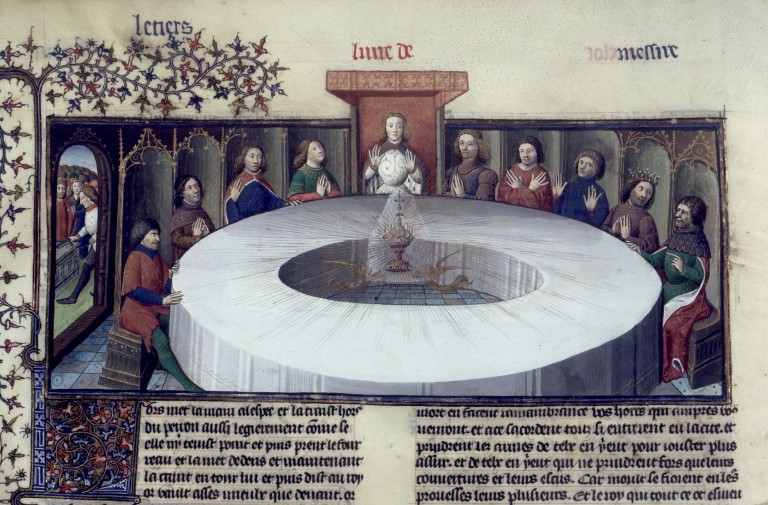
Later, during the Middle Ages, when England was pushing toward a national identity, the Christian Last Supper was transformed and re-envisioned at King Arthur's court and in the image of the Round Table.

Round Table

Apparition of the Holy Grail at King Arthur's Round Table @ wikimedia commons


In the context of the Canadian provincial election, the head of the table is the Canadian identity or nationalism. Only one other knight is allowed to sit at the table: the knight representing the Roman Catholic faith. John Tory proposed that all other knights be invited. No one had any in principle objection to any of the other knights. The only knight rejected was the Knight of Islam and, in order to exclude this knight, all other knights were excluded. Because we wouldn't want to make an exception of Islam, would we?

Everyone knows this is the reality. Nobody is fooled, not for a moment.

At present, ordinary Muslims rely heavily on funds from Saudi Arabia, and therefore from Wahhabism, in order to preserve their faith identity in a foreign land. How else will they develop their own integrated identity unless 1) they are clearly accepted as valid and valued members at the Round Table and 2) they are provided with fair funding that would allow a development of their faith independently of what should now become, for them, a "foreign land" (despite the reality that it houses their Mecca)?

This is all one God-awful mess and this "no" vote has not fixed it at all but only served to clarify it. Light - or consciousness - is more important than power and if John Tory has - albeit unwittingly - shed light on this issue, then he has shown the greatest leadership of all. For that, at least, he is to be commended.

I only hope that this "no" vote is really a "not yet" vote, that Tory's real error was to bring up this issue in the heat of an election. Though, would anyone have paid attention within a less volatile context?

When multiculturalism is rejected, when the Round Table is cut down to one (or two) seats only, then a highly dangerous situation is created, one that will surely lead humanity to a long long sleep. Perhaps this is the core Islamic idea (that Allah cannot tolerate any partners) that has led to the long long sleep of the Muslim world itself. If so, then this core idea has killed our Round Table culture more surely in this "no" vote than any number of sep11 incidents might achieve in themselves.

Labels: , , , , ,

Tuesday, October 09, 2007

to and fro, forward and back

Thy gentleness says, "Come forward!" Thy
severity says, "Go back!" Let me know at once, which of them
speaks the truth?

from Rumi: Ghazal (Ode) 1310
trans William C. Chittick via Sunlight


The Canadian province of Ontario is due (tomorrow) for a general election in which an aspiring Premier is John Tory of the Ontario Progressive Conservative Party. As part of his campaign:

[Tory] has promised if elected to spend $400 million on funding for Jewish, Muslim and other religious schools provided they follow the Ontario curriculum, submit to provincial standardized testing and use certified teachers.

The commitment was hailed by religious groups, but has also proved controversial, with even some Tory candidates admitting it will be a tough sell on the hustings.

James Cowan: John Tory grilled on faith-based schools proposal


In his latest Toronto Sun article, Salim Mansur has spoken out very stongly against this idea:

Unintentionally fragmenting the existing school system, as Mr. Tory's proposal would do, weakens the one institution that pulls the divergent communities of Ontario together, and strengthens those elements in our society that pull us apart on ethno-religious grounds.

Salim Mansur: How stupid is this idea?


In a somewhat inchoate response on the CCD forum, Edmund James begs to disagree with Mansur's negativity. He defends John Tory as "the type of executive and leader who excels because he listens to the people and can be persuaded" and insists that his "faith-based idea wasn't stupid" partly on severe (security) grounds, because it is "better we know what the Muslim world funded by Saudi Wahhabists and/or other fundamentalists are teaching and doing"; and partly on gentle (community cohesion) grounds:

The point being we go in stages rather than forcing immigrants to become full Canadian immediately though many try. And one of the the attractions to this grand country, and the USA , is because we are open to reasonable religions, private schools, hopefully funded. The Catholics had a good thing going; they have excellent teachers and higher marks, in general, than the public schools; but why exclude the others?

Edmund James on CCD forum


This prompted Mansur to reply at length, explaining his writing priorities as follows [my emphasis]:

The matter of opposing in print publicly Mr Tory's policy, as I have done, was far more important than wasting my ink on the "reform" proposal that others were weighing from varying perspectives. Moreover, I was in a position to state publicly what others were not going to touch upon for fear of being labeled bigots, i.e. write without any equivocation about the perils of Muslim faith-based schools receiving public funding and getting entrenched in our society to the detriment of everyone. This was not fear-mongering on my part as you suggest; instead it was placing the interests of my country in the broadest terms ahead of any partisan or sectarian loyalties in assessing factually and objectively what Mr Tory's policy amounts to for Ontario and Canada.


He also restates his position with greater clarity and emphasis:

A proliferation of faith-based schools (once public funding is available such proliferation would be the expected result as given by the laws of economics where demand for them would grow since supply would be made available at public expense) will invariably affect our social environment that is largely secular, and affect it for the worse. But most importantly, my concern of what follows arises from the reality of the post-9/11 world.

You should know better, and surprisingly your partisanship has blinded you on this matter of what Islamism (radical Islamist ideology on a rampage worldwide) in our province would do as Islamists receive public legitimacy by receiving public money to spread their toxin. The fact that Wahhabi funds are readily available from Saudi sources to Islamists in our midst does not warrant providing the same people with our tax money. The two matters cannot be conflated except by partisans like yourself who have lost their perspectives and their logic. The external funds available to Islamists in Ontario needs to be closed, and this is much more of a federal (Ottawa) responsibility than it is provincial in jurisdictional terms, and we should all be putting pressures on Ottawa to take this matter seriously and find the means to stop Wahhabi funds sowing discord and peril in our society.

Salim Mansur: CCD forum


Since I have been banned from the CCD forum (I was never given a reason for this but I suspect that I'm seen as a Karen Armstrong look-alike with leftist sympathies for all things Islamic) I cannot enter the fray with a comment and, in a way, the affair seems far too local - too literally "provincial" - to justify my own involvement. However, I detect deeper or more subtle layers of meaning in this conflict that resonate with the wider conversations on Islam.

In particular, a major division among progressive Muslims has been witnessed recently by Melanie Phillips at a discussion which began with Ibn Warraq reminding us of the immutability of the Koran and its central place in Islam as the word of God, thus leaving little or no room for reform. He was then opposed by more optimistic reformers:

They argued that the concept of the absolute authority of the Koran itself was a profound misapprehension, because every statement of what it meant was merely a matter of interpretation. It was therefore a question of whose interpretation should be regarded as authoritative; and since there were reformist traditions in Islam, it followed that it was possible for there to be an Islamic ‘renaissance’ of Islamic values which renounced the jihad and the cult of death. In other words, while the words of the holy text are regarded as divinely inspired, the religion itself is simply contestable commentary. And so, theologically speaking, there is everything to play for.

Melanie Phillips at her diary


As I read this, however, I couldn't help but notice that Ibn Warraq is named and is a clearly visible, present, identifiable, and articulate proponent of his own position (along with equally visible colleagues such as Ali Sina, Wafa Sultan and Ayaan Hirsi Ali) while his opponents are simply referred to as "they". Nothing clear and convincing is coming from the side of the Muslim world that holds out hope of reform or renaissance.

Whatever "new" interpretation this side comes up with, it will have to be convincing to "the West" as well as to fellow Muslims. Initial efforts by the likes of Tariq Ramadan have failed miserably, sounding to our ears as so much taqiyya or Islamic dissimulation. More sincere but ineffectual efforts by the likes of Zuhdi Jasser must also be dismissed (see the Koran according to Jasser).

So, what is left then? It seems to me that Salim Mansur now remains as a kind of "last man standing" and perhaps Edmund James is expressing a frustration that Mansur is holding back too much. Perhaps part of the heat of this debate comes from these deeper roots. It may be time for Mansur to emulate John Tory by listening more carefully to people and allowing himself to be persuaded.

I watch with a mix of patience and frustration as God calls him - and us - both forwards and backwards.

Janus, illustration from Dr Smith's Classic Dictionary, 1895
with thanks to Timeless Myths


Labels: , , , , , ,

Wednesday, October 03, 2007

cutting the crap

I said, "Show me the ladder, that I may mount up to heaven."
He said, "Your head is the ladder; bring your head down under your feet."

from Rumi: Ghazal 19, trans A.J. Arberry, via Sunlight


In his notes to this translation, Arberry explains the second line above as meaning "prostration in prayer, the subjection of reason to spirit". Me, I read Rumi in my own way. I prefer to take his meaning more directly: to see - in this instance - a head under a foot and not, as Arberry would have it, a head submitting to Allah or spirit. A foot is a foot and a spirit is something almost diametrically opposite to that. To me, Rumi (through the divine guide or Friend) is simply advising that the best way to reach heaven or attain things we yearn for is to begin with reality, to begin simply with "what is".

Our feet, after all, are what connect us to the earth. As we walk about, the pressure on our feet is a constant reminder of our heaviness, of this gravitational pull of body to earth, and of our inevitable rootedness in reality. Of course, it is also human to aspire to something other than the reality we are in. We express that in our longing for the Beloved, in our ambition to climb higher and higher, thus achieving more and greater things. However, we go nowhere so long as our heads remain in the clouds of imagination and aspiration. The journey must always begin with the here and now, with things as they are.

Here in Australia, I believe largely as a result of our British heritage, we like to link "spirit" with dung of one sort or another, especially when mocking vaporous idealism. We exclaim: "what a load of bullshit!"; or more sharply command: "cut the crap!"

In the Islamic world, there is no one better at trying to get Muslims to bring their heads down under their feet than Wafa Sultan, the forthright realist of brief but potent Arab television fame. (Those powerful five minutes remain at YouTube.)

As brave as she is, however, Sultan is stronger on rhetoric than on fact. For example, she does say in her speech that:

We have not seen a single Jew blow himself up in a German restaurant. We have not seen a single Jew destroy a church. We have not seen a single Jew protest by killing people.

transcript from her appearance on Al Jazeera TV, February 2006


Unfortunately, this is not strictly true, especially not the last and more general sentence. It is justly claimed that it was Jews who carried out the first act of modern terrorism in the King David Hotel bombing. Many innocent civilians died, Jews included. Since I am an Israeli sympathizer, I understand what drove the Jews to do this. I don't see it as a petty act of revenge but a necessary and desperate act of survival for the Jewish people. Others less sympathetic might see it as a case in which Jews did indeed "protest by killing people".

Salim Mansur is another solid realist in the Muslim world, less flashy but equally determined, working in the quieter but more precise ways of the academic. For me, his strongest "cut the crap" message to the Muslim world is contained in a little known essay titled Muslim on Muslim Violence: What Drives It? (available from the Center for Security Policy). In it, he documents the genocidal atrocities perpetrated by Muslims on their so-called brothers-in-faith, starting in the first century of Islam and more recently expressed during the violent breakup of Pakistan in 1971. He attributes this self-destruction to a political corruption of the original message of Islam at the time of the Karbala massacre and he asks that Muslims take a hard look at this turning point in their history when this "official" Islamist ideology was adopted.

The difference between the two realities, that submitted by Sultan and that by Mansur, is that the first locates the error right in the heart of Islam, right in the very opening page of the Quran (the Fatiha). She has, as a consequence of this and of other experiences, turned her back on Islam as a spiritual path. Mansur, on the other hand, is loyal to the forces opposing this "official" political Islam, forces largely contained within or expressed through the Sufi traditions. In this way, he can still identify as a Muslim although most Muslims (being so largely politicized and under the sway of "official" Islam) would deny him that identity and thereby feel free to attack him in a violent physical way. Despite a loyalty to what he would see as the pure essence of Islam, he remains an apostate in the eyes of "official" Islam.

In terms of realism, of who has put their head more firmly under their foot, I have to favour the lady here. She may be making some slight errors in her enthusiasm to communicate forcefully, but the overall tenor of her message is, to my mind, correct. I believe that Mansur sees an ideal - or more correctly, an idealized - Islam, an Islam that might have been. There are enough elements in the Islamic faith tradition to keep that ideal alive for him.

And it is indeed a beautiful ideal, an ideal of brotherhood in faith, a transcending of all boundaries of race or tribe. It is an ideal very purely communicated by the likes of Llewellyn Vaughan-Lee, a modern Sufi of British origin, who promotes a world consciousness of Oneness. His message can be accessed through The Golden Sufi Center.

However, some ironic questions arise: Is this not precisely the message that Islam is meant to convey? Is the world now not divided precisely along the lines of who - or what - can best deliver this message of Oneness?

Wafa Sultan certainly doesn't see Islam as fit for the task. Salim Mansur might see Sufi Islam as fit. Vaughan-Lee is careful to downplay his Islamic allegiance in favour of a New Age purity, wearing his stark white outfits, sitting next to flower displays, and speaking in a tone of studied gentleness. There seems to be no fighter in him, not even of the spiritual sort. But still, he is a Sufi and a Muslim.

By contrast, Robert Spencer likes to quote Rumi on his allegiance to Muhammad thus:

Root and branch of the roses is
the lovely sweat of Mustafa [that is, Muhammad],
And by his power the rose’s crescent
grows now into a full moon.


quoted in Spencer: The Truth About Muhammad: Founder of the World's Most Intolerant Religion,
and also at his blog:
Blogging the Qur’an: Sura 6, “Cattle,” verses 1-83
original source is Annemarie Schimmel: And Muhammad Is His Messenger: The Veneration of the Prophet in Islamic Piety


It is clear what Spencer's intent is here, especially in the context of the Quranic verses on which he is commenting and which actually have no connection whatever to Rumi's lines. Spencer has merely found an excuse, any excuse, to point the finger at Rumi and tar him (and his fellow mystics such as al-Hallaj) with the same brush as he tars Muhammad himself. The message is: Don't trust the Sufis for they are as much "Muslims" and just as "bad" as any other Muslims.

And Spencer does have a point. For those, especially, who are appalled at Islamic violence, a sweet pure mystic like Vaughan-Lee is very attractive and his ideal of Oneness also. However, should one be tempted thereby to affirm the shahada (the affirmation of Muslim faith) then there is no going back for the gentle Sufi has brothers in Islam who forbid apostasy and will see to it that you stay put.

As outsiders - poor benighted kufrs that we are - we must take Islam for the reality that she is, both her good points and her bad. We cannot but respect Islam as a long-standing institution within humanity's history but the political ideology is, as Spencer keeps reminding us, a solid and real part of what Islam is. It is there at its very roots, in the Quran and in the life of Muhammad.

I love some of the good things, especially many of the lovely lines of wisdom of Rumi. However, I love the humanist in Rumi, not the Muslim. If, to his sensitivities and in his time, Mustafa did smell sweetly it is no longer true today. Too much of the dung at the heart of Islam has been uncovered. There is simply too much crap there to allow for a sweeter smell. Yes, perhaps there is a pearl inside that dung heap, but I have yet to discover it myself or have it shown to me.

For me, Rumi and his opus stand apart and independent of Islam. The wisdom, the pearls, therein can survive many a refiner's fire, whether that of the Islamists or the more recent one of those commercializing him. A few days ago the 800th anniversary of Rumi's birth was celebrated thus in Konya, Turkey:

rumi birthday

Whirling dervishes perform a sema ritual during a ceremony to mark the 800th birthday of the Sufi mystic poet Mevlana Jelaleddin Rumi in Konya, Turkey.
Photo: AP @ smh.com.au


When I saw this photo, I didn't know whether to laugh or cry and, indeed, I wondered whether Rumi himself would know which was appropriate. After some thought, I've decided that from his grave there would issue loud and hearty laughter: he would go with the guffaw.

Similarly, when it comes to Islam: I must also go with the guffaw.

Labels: , , , , ,