Sunday, December 16, 2007

yes, Zuhdi, let's talk

The final installment of the NRO Q&A with Zuhdi Jasser arrived in my inbox today. A key question was as follows [my emphasis]:

Lopez: What’s the most important question you get when you speak on radical Islam?

Jasser: I would weigh the importance of all of the various questions I get with their centrality in promoting American security. That said, the most important question or concern I get from audiences to which I have the privilege to speak, is whether spiritual Islam and political Islam are in fact contrary to my beliefs — inseparable? And whether I am whitewashing a dangerous political ideology? An appropriate answer to this question would need volumes of discourse. Ultimately, I ask them not only to believe my voice and my ideas, which appear to be in the wilderness, but rather to begin the ground work of speaking to Muslims in the grass roots about their political and spiritual constructs. We need to multiply this debate exponentially within the Muslim community.

from NRO Q&A: We Need a Hero


In the interests of contributing to those "volumes of discourse", I'll throw my tuppence worth in here.

Jasser asks me to believe his voice and his ideas. I have no trouble with his basic sincerity but I have grave doubts regarding his capacity to sell his story fully to Muslims and non-Muslims alike. As Robert Spencer of Jihad Watch has expressed it, first in the positive, then in the negative:

Meeting intimidation with a demonstration of nobility and generosity. Bravo, Zuhdi Jasser.

source: U.S. Islamic group ...


This is very good, but of course it doesn't go far enough. I hope that M. Zuhdi Jasser would be willing to confront Taheri-azar's abundant Qur'an quotations, and the role of the example of Muhammad in inspiring jihad violence today. If he is, and if others like him are, then there might really be some progress toward the ideological confrontation with jihadism that he calls for.

source: American Muslim leader ...


Jasser especially urges "speaking to Muslims in the grass roots" but this I have attempted several times, always with highly discouraging results. I'm met with a variety of evasions, defensive walls, threats and even pleas to desist, along the lines of:


  • "It is generally impolite to discuss religion and politics. Just raising these matters is offensive and a sign of belligerence and intolerance."

  • "You don't know Islam. You're an ignorant Kafir."

  • "Be careful what you say or even suggest against Islam as we Muslims will defend our faith with violence if need be and that includes violence against you, your loved ones, and your possessions. The police won't help either, not if you merely find your pet cat poisoned or a deep scrape in your car's paintwork."

  • "We're terrified ourselves of the violent Muslims and we don't want to be seen associating with a non-Muslim on anything more than the most superficial level. Let's talk about the weather, that's fine, but no more. And even there, let's not talk about God bringing the rain or the sunshine. Leave God out of it."


Nowhere is there any honest and forthright debate. Nowhere. Even Jasser himself is evasive, rarely making direct references to the Koran or the life of Mohammad.

At the very end of the interview Lopez asks: "Who are your heroes?" Jasser provides a list of four men: his grandfather and namesake Zuhdi Al-Jasser, US Presidents Reagan and Jefferson, and fictional TV hero Jack Bauer. What kind of a Muslim leaves Mohammad out of a list like that? Is Mohammad absent because Jasser has genuinely come to repudiate him as a role model or is he not there because Jasser is practising a form of taqiyyah, diplomatically neglecting to mention something that might sound too "un-American".

To convince me, Jasser will need to do far more than denounce Islamists (under whichever of their many names). He will need to put some substance into his airy-fairy assertion that there is a separate spiritual Islam unpolluted by Islamist political ideology.

This is how I see it:


  • The Koran, the life of Mohammad, the traditions and the classical interpretations form a coherent whole with a clear Islamic supremacist message: God is One, His Centre is located at Mecca, His Final Prophet was Mohammad, His Final Word was the Koran, no other conception of deity has any validity, the Jewish and Christian conceptions are especially pernicious for making apparently credible but deceptive claims, and it is the duty of every Muslim to spread the One True Faith of Islam whether by the sword, by unrestrained fertility, by the (literal or metaphoric) handing out of sweets to children, or by forceful evangelization.

  • "Nice" Muslims like Jasser are employing the tactic of handing out metaphoric sweets to gullible adults.

  • Yes, there is "a spiritual Islam" of sorts. There is a mystical tradition, called Sufism, which arose within the Islamic empire but has clear influences from abroad, from outside the core supremacist Islamic tradition described above. Those influences include much Hindu and Buddhist mysticism, deep and direct influences from Zoroastrian, Christian and Jewish sources (through an actual reading of and meditation on their sacred texts), as well as wider Mediterranean influences (such as Greek neoPlatonism and ancient strands of Egyptian alchemy and theosophy). The core values of Sufism can be represented by the poetic works of one man alone, known to us all as Rumi. However, if you took his two major works, the Mathnawi and the Shams collection, and removed from them every clear Islamic (Koranic or Mohammadan) reference, then you would still be left with an oceanic and essentially divine corpus. Take Islam out of Rumi and you're still left with the Divine.

  • Do a similar but opposite job on the main Islamic works, especially the Koran itself: remove every clear supremacist, political, ideological statement - every "Islamist" statement - and what remains? Perhaps a puddle or two of insipid and unoriginal pronouncements as to the glory of God. The kind of thing that a dozen monkeys on a dozen typewriters could easily produce in a dozen days.


I'm happy to discuss any of this with you, Zuhdi, at whatever length you wish, here or elsewhere.

I'm prepared to be infinitely patient but not to the point of holding my breath. I will continue to be engaged in many other activities such as enjoying the fruits of the rich culture to which I'm fortunate to be an heiress. Stuff like Beethoven and professional tennis, but especially stuff like civilized adult conversation unfettered by fear or favour.
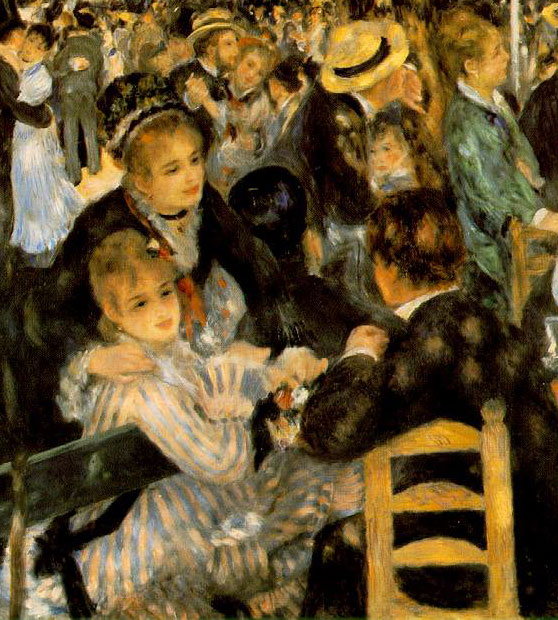
renoir conversation

detail from Pierre-Auguste Renoir: Le Moulin de la Galette, 1876


Yes, Zuhdi, let's talk. I'm ready, willing, and waiting.


Labels: , , , , ,

Thursday, December 13, 2007

just one question for Dr. Jasser

A great deal of Islamic scripture discourages war and encourages peace. Some argue that the peaceful verses are abrogated. Many Muslims however believe that unless a verse is specifically identified as abrogated and since God left it in the Koran it is still valid and His word and instruction cannot be abrogated but rather just put into the context of the time of its revelation. Thus, almost every Muslim I have ever known would not subscribe to the abrogation of peaceful verses.

from M. Zuhdi Jasser: NRO Q&A: Dr. J CAIRs [my emphasis]


If you won't subscribe to this abrogation, why not go one step further and reject Islam's purported abrogation of Christianity? If you want to remain a devoted man of god, what's wrong with the Christian way of doing it? Tell us plain and clear so we understand where you're coming from.

And by the way, you might brush up on your Freud given that you also stated [my emphasis]:

The question of the central nature of Islam rests on two issues. First, the values and morality of Islam are not derived de novo from the text itself, which can be twisted by any deviant who chooses to become God on earth. But rather, the individual morality comes from the superego or conscience of the individual reading the text. Thus the nature of Islam is measured more by the values which Muslim families teach their children, than by the radical published interpretations of passages, which can be more of a reflection of the thugs and theocrats in power over publishing houses, rather than the religion itself as it is practiced by the Muslim masses. Thus, while ultimately, all morality comes from God, the faithful are moral from within themselves and not from a text.


superego
In Freudian theory, the division of the unconscious that is formed through the internalization of moral standards of parents and society, and that censors and restrains the ego.

source


You see, Dr, Jasser, the superego is not a natural capacity for seeing right from wrong but a set of standards derived from one's early learning environment. Sure, you're a nice bloke and you were no doubt raised by gentle people from whom you derived many of your standards of morality. However, to the extent that your moral code - or superego - derives from Islamic and specifically Koranic influences - then your superego resembles Allah and/or Mohammad. So, it isn't some sort of independent capacity that can constrain your understanding of the Koran. There are not a hundred ways of interpreting passages like: "slay them wherever ye find them". Most Muslim children will understand that "them" refers to all those non-Muslims "out there", all those "others". You can't expect "them" to be suddenly understood as referring to super-pious Muslims like Osama bin Laden who scrupulously observes all the Islamic devotional duties. As an observer, standing outside of Islam, I would say that bin Laden's interpretation of a passage like that is forthright and not in the least bit deviant or twisted. You are the one who needs to get into weird logical contortions in order to uphold your distinction between a morally exalted spiritual Islam and the real thing as bin Laden understands it.

You also said [my emphasis]:

Second, the morality of the messenger of Islam, the Prophet Mohammed, is central to the believability of the question of the violent or non-violent nature of Islam. Ultimately, what matters the most is not whether I can come to an agreement with Osama bin Laden over how violently aggressive, or humbly nonviolent the Prophet Mohammed was. What matters most to the world today is that my interpretation of my faith, its messenger, and its scripture today is based upon a moral code which is consistent with the moral code of the vast majority of other Americans, and our rule of law in the 21st century. What matters most is that my construct of citizenship and belief in American exceptionalism is not at conflict with any aspect of being Muslim.


Leaving violence and war aside for a moment, what does your superego or moral code have to say about theft? It's pretty simple really: Was Mohammad "moral" when he used theft or brigandage as his supposed means of survival after his expulsion from Mecca? Did he not set a moral standard - of ends justifying means - here? Did not Jesus set precisely the opposite moral standard by submitting to His death by crucifixion? You decide which moral code to go by.

Perhaps, in the end and as the Sufis seem to have realized, there is merit in both moral codes and the surest way to achieve any goal - including that of reaching God - is to make use of both. A good place to start, though, is by clearing the fog of confusion between what is true and what you merely want to believe. It also helps to untie as many of those troublesome knots as possible instead of making more and more of them.


Labels: , , ,

Wednesday, December 12, 2007

medical opinions

There are currently two men of medicine pushing their views of Islam: the one characterizing it as incorrigibly jihad prone and the other as a spiritual treasure hijacked by the jihadists. The first is Andrew Bostom, author of The Legacy of Jihad and an associate professor of medicine. The second is M. Zuhdi Jasser, founder of the American Islamic Forum for Democracy and a specialist physician in private practice. Presumably both men have an instinct and a motivation for healing but their views are opposed in their essence and therefore the guidance offered is conflicting. It would be interesting to hear the two of them debate, whether directly or through representatives or surrogates.

In fact, I've been reminded of Bostom through just such a representative or surrogate in the form of Philip Carl Salzman, author of a Middle East Quarterly essay titled The Middle East's Tribal DNA. It is a useful essay in bringing together relevant data and ideas from cultural and political studies. However, Salzman relies a good deal on the work of Bostom as well as other writers of similar vein such as Bat Ye'or and Robert Spencer. He belongs to a school of thought that is gaining strength due, especially, to the absence of clearly formulated counterarguments. What I find original in Salzman's essay is the idea that a bedouin tribal culture over which Islam was to dominate has, instead, succeeded in dominating Islam itself. Here are his concluding sentences [my emphasis added]:

Middle Eastern societies are not "modern," however, in the sense that European and American societies are. The tribal spirit holds sway. Its influence upon Islam permeates even the most cosmopolitan Arab states even if the tribal influences enshrined in the religion espoused or revealed by Muhammad are, almost fourteen centuries later, forgotten. Indeed, had Islam, whatever its many dimensions and complexities, not incorporated the balanced opposition structure of the tribal society that it sought to overlay, it is doubtful whether it could have been as accepted and successful as it was.


Salzman is suggesting here not only that Islam failed to transcend the tribal culture out of which it arose but that its own success lay in its elevation and sacralization of that very tribal culture. Indeed, it doesn't take a great leap to conclude further that that is essentially what Islam consists of, viz, a sacralization of tribal political culture.

Something along these lines is mentioned by Salim Mansur, also for the Middle East Quarterly, in a review of Mohamed Charfi's Islam and Liberty. Mansur acknowledges a similar view among some modern Muslims though it is unclear whether and how his own view differs from this:

Charfi is unabashedly a modernist Muslim who contends that the traditional insistence of Muslims on religion and politics in Islam being inseparable is the source of much difficulty. Historically Islam was shaped by men in politics to legitimize their power, to make the state an instrument of faith, and to invest the successors of the Prophet, the caliphs, with an aura of sacred authority, an argument that others beside Charfi have also illustrated (most notably Ali Abderrazak in Islam and the Foundation of Power).

President George W. Bush has spoken eloquently about freedom being God's gift to mankind; Muslims have not been denied this gift of heaven but have squandered and abused it. Charfi's study will be of interest for both specialists in Arab-Muslim politics and general readers keenly concerned in contemporary affairs. The author is to be commended for striving to kindle an understanding of Islam that would take Muslims back to the religion's original impulse and help non-Muslims to appreciate how difficult is the process of reform.


Mansur does refer to "the religion's original impulse" suggesting that this might have formed the basis for a spiritual liberation. From this and other writings, it is clear that Mansur accepts Mohammad's primary message as represented in the Koran as just such a "gift of heaven" as the idea of freedom is for Bush, a gift that has been "squandered and abused". This is very close to the notion of a pure or spiritual Islam that has been hijacked by the jihadists.

Here is how Jasser expresses that notion [my emphasis]:

I will finally add a caveat that my only fear is that many exposed to the term [Islamofascism] will have little prior knowledge of Islam or contact with Muslims and will carry away a belief that Islam as a spiritual faith is fascistic in its ideology. That cannot be further from the truth of the Islam which I teach my children and so many of the vast majority of Muslims teach their families. But that should stimulate Muslims to even more actively defeat the Islamists who have hijacked our faith for their own political agenda. In fact we can also cannot forget that the Islamofascists are a subset of a much larger ideological threat to the west of the Islamists. The Islamists include all those who believe in political Islam from the fascists of Al Qaeda to the rank and file political Islamists who believe in democracy, elections, and parliaments but still hold tight to a theocratically exclusivist Islamic state.

source: A Muslim American


We have here, then, a spiritually pure inner circle of Muslims who reject the political character of Islam, surrounded by Islamists, jihadists, and Islamofascists. Jasser would like to believe that the inner circle represents "the vast majority of Muslims" but various polls and surveys make that very hard to believe, especially outside of the United States. Robert Spencer at Jihad Watch has almost daily opportunities to scoff at "The Tiny Minority of [Extremist] Muslims" as one news story after another pours in, indicating just how mainstream is the Islamist view of Islam.

Sadly, I believe that counterarguments to the "Jihadism is the real Islam" idea are lacking because they cannot be expressed in any clear, coherent or logical manner. Inevitably, inconsistencies and contradictions emerge, a feature not present in the jihadists' case. I have noted elsewhere (in the Koran according to Jasser and the hidden hand) that Jasser must suffer a perpetual cognitive dissonance if he is to uphold the Koran as the Word of God since it involves such blatant contradictions. Jasser's capacity for persevering within such a discordant mental framework is further evidenced in the above interview where he says:

My love for my faith should drive me to wage a counter-jihad, and not blame the messenger (users of this term) and demand that the term be stricken so that I can live in denial. These thugs spread an evil in the name of a warped version of the faith they believe is Islam. However, I become like “al Qaeda” if I refuse to call them “Muslim” and commit takfir (determining who is and who is not a Muslim) by saying they are not “Muslim.” Their Muslim or Islamic identity is between them and God as it is for every Muslim. Once we open the door to debate who is and who is not a Muslim it empowers a theological hierarchy which will purport to speak for the faith community. I will never subscribe to that. As a moral human being and as an American, it is obvious that their actions are evil and barbaric and we should do everything we can to destroy them and defeat them wherever we find them.


The last phrase is an echo from that famous (or infamous) passage from the Koran as follows:

And slay them wherever ye find them, and drive them out of the places whence they drove you out, for persecution is worse than slaughter. And fight not with them at the Inviolable Place of Worship until they first attack you there, but if they attack you (there) then slay them. Such is the reward of disbelievers.

Koran 2:191, trans Pickthall


Is it just me or does Jasser start the above paragraph by refusing to deny Islamofascists as fellow Muslims while ending the paragraph by characterizing them as trouble-making disbelievers who must be sought out and slain just as the jihadists themselves are seeking out and slaying all the rest of us? For at least this poor addled brain, this "argument" is far far too self-contradictory to swallow.

I'm afraid that in the current debate, such as it is, I must assign one point to Dr. Bostom (et al) and deny one point to Dr. Jasser (et al). I'm also disinclined at this stage to hold my breath in expectation of any change in the situation. Islam, for me, is an attempt to sacralize the "might is right" outlook which is directly opposed to every aspect of humanism and natural justice that I know of. There is only one way for Islam to go and that is down. Down into the dust where it belongs.


Labels: , , , , , ,

Tuesday, October 09, 2007

to and fro, forward and back

Thy gentleness says, "Come forward!" Thy
severity says, "Go back!" Let me know at once, which of them
speaks the truth?

from Rumi: Ghazal (Ode) 1310
trans William C. Chittick via Sunlight


The Canadian province of Ontario is due (tomorrow) for a general election in which an aspiring Premier is John Tory of the Ontario Progressive Conservative Party. As part of his campaign:

[Tory] has promised if elected to spend $400 million on funding for Jewish, Muslim and other religious schools provided they follow the Ontario curriculum, submit to provincial standardized testing and use certified teachers.

The commitment was hailed by religious groups, but has also proved controversial, with even some Tory candidates admitting it will be a tough sell on the hustings.

James Cowan: John Tory grilled on faith-based schools proposal


In his latest Toronto Sun article, Salim Mansur has spoken out very stongly against this idea:

Unintentionally fragmenting the existing school system, as Mr. Tory's proposal would do, weakens the one institution that pulls the divergent communities of Ontario together, and strengthens those elements in our society that pull us apart on ethno-religious grounds.

Salim Mansur: How stupid is this idea?


In a somewhat inchoate response on the CCD forum, Edmund James begs to disagree with Mansur's negativity. He defends John Tory as "the type of executive and leader who excels because he listens to the people and can be persuaded" and insists that his "faith-based idea wasn't stupid" partly on severe (security) grounds, because it is "better we know what the Muslim world funded by Saudi Wahhabists and/or other fundamentalists are teaching and doing"; and partly on gentle (community cohesion) grounds:

The point being we go in stages rather than forcing immigrants to become full Canadian immediately though many try. And one of the the attractions to this grand country, and the USA , is because we are open to reasonable religions, private schools, hopefully funded. The Catholics had a good thing going; they have excellent teachers and higher marks, in general, than the public schools; but why exclude the others?

Edmund James on CCD forum


This prompted Mansur to reply at length, explaining his writing priorities as follows [my emphasis]:

The matter of opposing in print publicly Mr Tory's policy, as I have done, was far more important than wasting my ink on the "reform" proposal that others were weighing from varying perspectives. Moreover, I was in a position to state publicly what others were not going to touch upon for fear of being labeled bigots, i.e. write without any equivocation about the perils of Muslim faith-based schools receiving public funding and getting entrenched in our society to the detriment of everyone. This was not fear-mongering on my part as you suggest; instead it was placing the interests of my country in the broadest terms ahead of any partisan or sectarian loyalties in assessing factually and objectively what Mr Tory's policy amounts to for Ontario and Canada.


He also restates his position with greater clarity and emphasis:

A proliferation of faith-based schools (once public funding is available such proliferation would be the expected result as given by the laws of economics where demand for them would grow since supply would be made available at public expense) will invariably affect our social environment that is largely secular, and affect it for the worse. But most importantly, my concern of what follows arises from the reality of the post-9/11 world.

You should know better, and surprisingly your partisanship has blinded you on this matter of what Islamism (radical Islamist ideology on a rampage worldwide) in our province would do as Islamists receive public legitimacy by receiving public money to spread their toxin. The fact that Wahhabi funds are readily available from Saudi sources to Islamists in our midst does not warrant providing the same people with our tax money. The two matters cannot be conflated except by partisans like yourself who have lost their perspectives and their logic. The external funds available to Islamists in Ontario needs to be closed, and this is much more of a federal (Ottawa) responsibility than it is provincial in jurisdictional terms, and we should all be putting pressures on Ottawa to take this matter seriously and find the means to stop Wahhabi funds sowing discord and peril in our society.

Salim Mansur: CCD forum


Since I have been banned from the CCD forum (I was never given a reason for this but I suspect that I'm seen as a Karen Armstrong look-alike with leftist sympathies for all things Islamic) I cannot enter the fray with a comment and, in a way, the affair seems far too local - too literally "provincial" - to justify my own involvement. However, I detect deeper or more subtle layers of meaning in this conflict that resonate with the wider conversations on Islam.

In particular, a major division among progressive Muslims has been witnessed recently by Melanie Phillips at a discussion which began with Ibn Warraq reminding us of the immutability of the Koran and its central place in Islam as the word of God, thus leaving little or no room for reform. He was then opposed by more optimistic reformers:

They argued that the concept of the absolute authority of the Koran itself was a profound misapprehension, because every statement of what it meant was merely a matter of interpretation. It was therefore a question of whose interpretation should be regarded as authoritative; and since there were reformist traditions in Islam, it followed that it was possible for there to be an Islamic ‘renaissance’ of Islamic values which renounced the jihad and the cult of death. In other words, while the words of the holy text are regarded as divinely inspired, the religion itself is simply contestable commentary. And so, theologically speaking, there is everything to play for.

Melanie Phillips at her diary


As I read this, however, I couldn't help but notice that Ibn Warraq is named and is a clearly visible, present, identifiable, and articulate proponent of his own position (along with equally visible colleagues such as Ali Sina, Wafa Sultan and Ayaan Hirsi Ali) while his opponents are simply referred to as "they". Nothing clear and convincing is coming from the side of the Muslim world that holds out hope of reform or renaissance.

Whatever "new" interpretation this side comes up with, it will have to be convincing to "the West" as well as to fellow Muslims. Initial efforts by the likes of Tariq Ramadan have failed miserably, sounding to our ears as so much taqiyya or Islamic dissimulation. More sincere but ineffectual efforts by the likes of Zuhdi Jasser must also be dismissed (see the Koran according to Jasser).

So, what is left then? It seems to me that Salim Mansur now remains as a kind of "last man standing" and perhaps Edmund James is expressing a frustration that Mansur is holding back too much. Perhaps part of the heat of this debate comes from these deeper roots. It may be time for Mansur to emulate John Tory by listening more carefully to people and allowing himself to be persuaded.

I watch with a mix of patience and frustration as God calls him - and us - both forwards and backwards.

Janus, illustration from Dr Smith's Classic Dictionary, 1895
with thanks to Timeless Myths


Labels: , , , , , ,