Sunday, December 21, 2008

quatrain 173

From Sunlight, two versions of quatrain 173:
I am filled with you.
Skin, blood, bone, brain and soul.
There's no room for lack of trust, or trust.
Nothing in this existence but that existence.

version by Coleman Barks

in my heart
inside and out
is all beloved
in my body
blood and veins
is none but beloved
how can there by any
room for religion
or Godlessness in me
since my existence
is overflowing
with beloved

trans by Nader Khalili

See also the Houshmand translation at my inner-outer.

Labels: , , ,

Thursday, October 02, 2008

quatrain 14

Sunlight has two interpretations of Quatrain 14:
i was first seduced by love
then put in a fire of agonies
as i won the mastery
of the beloved
the beloved dropped me
and was gone

translation by Nader Khalili

First, he tempted me
with infinite caresses.
He burnt me in the end
with pain and sorrow.
In this game of chess
I had to lose myself
in order to win Him.

translation by Azima Melita Kolin and Maryam Mafi

My earlier post on this quatrain is under to be or not to be and refers to the Houshmand translations.

Labels: , , ,

Tuesday, July 15, 2008

on sofa cushions

An exchange on sofa cushions at the atheists meetup message board:
JD: Anne, what would you say about the position taken by the fictional character of 'Nicky' in this fictional dialogue?

Nicky: I think you should know that I'm sitting on God.
Jerry: What do you mean?
Nicky: This sofa cushion. It's God.
Jerry: But God isn't a sofa cushion!
Nicky: I'm telling you that this sofa cushion is God.
Jerry: You're not telling me that that sofa cushion created the Universe!
Nicky: No, of course not.
Jerry: But you just said that that sofa cushion is God!
Nicky: That's right. It is.
Jerry: But God created the Universe!
Nicky: Don't be silly. How could a sofa cushion create the Universe?
Jerry: You're not making any sense!

full post

anne: I would say that he (or she) has his (or her) buttocks positioned on a sofa cushion.

If I were in Jerry's place I would simply accept that the sofa cushion is God and leave it at that.

Where Nicky says "Don't be silly. How could a sofa cushion create the Universe?" I think he (or she) is the one being silly for surely a sofa cushion can indeed create the Universe. That being said, Nicky is entitled to his (or her) opinion on the matter and again, if I were in Jerry's place I would leave it at that.

from this page

Ansgar: The interesting question is, why so much value is attached to the word "God". Anne said in another thread, that the "word god is god". If you look at the link that Anne provided to process theism, it is mentions explicitly that it disagrees in almost every aspects with how theists view god.But for some reason they are able let go of the every aspect that defines the word "god", but not of the word "god", itself. That is to say the least interesting.

anne:
Some scientists when canvassing these issues of philosophical theology may prefer to call themselves 'agnostics' rather than 'atheists' because they have been over impressed by a generalised philosophical scepticism or by a too simple understanding of Popper's dictum that we can never verify a theory but only refute it. Such a view would preclude us from saying quite reasonably that we know that the Sun consists largely of hydrogen and helium. When we say 'I know' we are saying something defeasible. If later we discover that though what we said was at the time justified, it nevertheless turned out to be false, we would say 'I thought I knew but I now see that I didn't know'. Never or hardly ever to say 'I know' would be to deprive these words of their usefulness, just as the fact that some promises have to be broken does not deprive the institution of promising of its legitimacy.

source: Atheism and Agnosticism @ Stanford

The one thing binding atheists to theists is the word "God". Neither group can get enough of this word.

I love God. I am God. I know God. I love the word "God" like Romeo loves the word "Juliet".

But as Rumi put it:

Believer, unbeliever, cynic, lover,
all combine in the spirit-form we are,

but no one yet is awake like Shams.

So it's also true that ...

I hate God. I reject God. I place my buttocks firmly onto God. I insist that I and God are separate and apart. And while I, my buttocks and my sofa cushion all quite clearly exist, poor God is not so blessed. Though given that life is such shit, perhaps God is the fortunate one after all.


Labels: ,

love dogs


LOVE DOGS

One night a man was crying, Allah! Allah!
His lips grew sweet with the praising,
until a cynic said,
"So! I have heard you calling out,
but have you ever gotten any response?"

The man had no answer to that.
He quit praying and fell into a confused sleep.

He dreamed he saw Khidr, the guide of souls,
in a thick, green foliage.

"Why did you stop praising?"

"Because I've never heard anything back."

"This longing you express IS the return message."

The grief you cry out from
draws you toward union.

Your pure sadness
that wants help
is the secret cup.

Listen to the moan of a dog for its master.
That whining is the connection.

There are love dogs
No one knows the names of.

Give your life
to be one of them.


Mathnawi III, 189 – 211, version by Coleman Barks

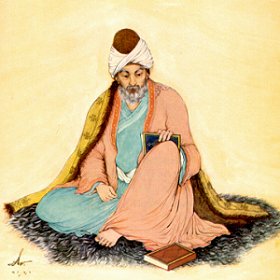
This poem is available at Sunlight but I found it at Crossword Bebop where Douglas provides a link to an exquisite reading of the poem. I also stole his image of Rumi. And I loved the Sufi tale he linked to in which Khidr also appears.


Labels: , ,

Saturday, July 12, 2008

quatrain 67

From Sunlight, three interpretations of Quatrain 67:
Sometimes I feel like a king,
sometimes I moan in my own prison.
Swaying between these states
I can't be proud of myself.
This "I" is a figment of my imagination.

trans Azima Melita Kolin and Maryam Mafi

I thought I had self-control,
so I regretted times I didn't.

With that considering over, the one thing I know
is I don't know who I am.

version by Coleman Barks

there was a time
when my thought
soared as a king
or a time when I mourned
like a prisoner
those days are gone
and I have promised
not to take myself
seriously again

trans Nader Khalili

Labels: , , ,

Thursday, July 03, 2008

quatrain 168

From Sunlight, two interpretations of Quatrain 168:
Tonight we go to that place of eternity.
This is the wedding night –
a never-ending union
of lover and Beloved.

We whisper gentle secrets to each other
and the child of the universe
takes its first breath.

version by Jonathan Star and Shahram Shiva

This night there are no limits to what may be given.
This is not a night but a marriage,
a couple whispering in bed in unison the same words.
Darkness simply lets down a curtain for that.

version by Coleman Barks

Labels: , ,

Wednesday, July 02, 2008

completely naked

I've given up on my brain.
I've torn the cloth to shreds
and thrown it away.

If you're not completely naked,
wrap your beautiful robe of words
around you,

and sleep.

ghazal 314 - version by Coleman Barks via Sunlight

Labels: ,

Saturday, June 21, 2008

quatrain 97

From Sunlight, three interpretations of Quatrain 97:

Our drunkenness does not come from wine.
The joy of our gathering
does not come from the harp or rubaab.
With no celestial beauty to fill our cup,
Without friends, without singing, without wine,
We burst out like madmen,
rolling drunk on the floor.

version by Jonathan Star and Shahram Shiva

We don't need wine to get drunk,
or instruments and singing to feel ecstatic.
No poets, no leaders, no songs,
yet we jump around totally wild.

version by Coleman Barks

i don't really need wine
to get drunk
i don't really need music
to feel delight
without a wine pal
music and dance
i'm intoxicated
happy and gone

trans Nader Khalili

Labels: , , ,

Saturday, June 14, 2008

quatrain 77

From Sunlight, four interpretations of Quatrain 77:

Doing as others told me,
I was blind.
Coming when others called me,
I was lost.

Then I left everyone,
myself as well.
Then I found everyone,
myself as well.

version by Jonathan Star and Shahram Shiva

for awhile
i chose myself to adore
losing me in me
i deserved no more
it seemed i couldn't
see myself
yet i knew
when i stepped out
then me and myself
i beheld

trans Nader Khalili

For years, copying other people, I tried to know myself.
From within, I couldn't decide what to do.
Unable to see, I heard my name being called.
Then I walked outside.

version by Coleman Barks

Imitating others,
I failed to find myself.
I looked inside and discovered
I only knew my name.
When I stepped outside
I found my real Self.

trans Azima Melita Kolin and Maryam Mafi

Labels: , , , ,

Monday, June 02, 2008

the secrets

A couple of additional translations of quatrain 1411, originally under the best joy.

I can't let you know
all the secrets
I can't open to you
all the doors
there is something inside
that makes me happy
but I can't put my finger
on its source

trans Nader Khalili

The secrets are bursting inside me
but to give them away and
expose them to mockery, I cannot.
Something inside me is bursting with joy
but to put my finger on it, I cannot.

trans Azima Melita Kolin and Maryam Mafi

Labels: , ,

Tuesday, May 20, 2008

quatrain 910

I planted roses, but without you they were thorns.
I hatched peacock eggs. Snakes were inside.
Played the harp, sour music.
I went to the eighth heaven. It was the lowest hell.


Quatrain 910, Coleman Barks and John Moyne


I plant some flowers without you,
they become thorns.
I see a peacock, it turns into a snake.
I play the rubaab – nothing but noise.
I go to the highest heaven, it's a burning hell.


Quatrain 910, Jonathan Star and Shahram Shiva


Thanks to Sunlight.

Labels:

Thursday, May 08, 2008

I can smell eternity

birds are free from the cage
cage is empty from the birds
where have you flown from
to be so happy
I can smell eternity
in your songs


-- Quatrain 1955
Translation by Nader Khalili

Labels:

Friday, May 02, 2008

common man comments

It often happens that some ordinary citizen comments on a website and provides a plain man's understanding of things esoteric. I've come across a couple of these lately so I'll start collecting them under "common-comments".

The first relates to a passage from the Mathnawi posted at the beliefnet.com message boards under Daily Muslim Wisdom.

To exalt oneself is to claim partnership with God.
Unless you have died and become living through Him,
you are an enemy seeking to hold the power.
But when you have come to live through God,
that which you have become is in truth He:
it is no longer copartnership, but absolute Unity.


Rumi: Mathnawi IV: 2765-2767
Version by Camille and Kabir Helminski


A reader, presumably a Muslim, inquires about this as follows:
JTornado1 9/3/2006

"But when you have come to live through God, that which you have become is in truth He: it is no longer copartnership, but absolute Unity." What does Rumi mean? Is is saying that one can become one with God in absolute Unity? Is that another way of saying one can become God? I don't understand what he is saying.


A second reader, apparently not a Muslim, replies as follows:
lightdancing 9/12/2006

Hello JTornado1,

I am not of your faith, but I like your question. Please understand that I am not offering anything other than my interpretation of a beautiful expression by Rumi.

If you find anything in this reply that helps you, well and good. If you find that nothing in this reply helps you, that is good too. Stay true to what works for you, what resonates within you.

Thanks so much for quoting this beautiful quote. I had no idea that Rumi was a part of the Muslim faith.

>To exalt oneself is to claim partnership with God.
>Unless you have died and become living through Him,
>you are an enemy seeking to hold the power.

To say that you, the person you think you are, is God, is to be blind to the truth of God. When you are blind to the truth of God, you will believe that whatever you dictate is God's word. You will not bring peace. You will not experience peace.

>But when you have come to live through God,
>that which you have become is in truth He:
>it is no longer copartnership, but absolute Unity.

When you come to realize that God is all there is, everything personal is surrendered. The love that is God is in your heart. You become a channel of God. God's love is expressed through you, bringing unity where there was once strife and division.

> Is is saying that one can become one with God in >absolute Unity? Is that another way of saying one can >become God? I don't understand what he is saying.

No, you don't become God. Instead, you become transparent and God shines through you. The you you believed yourself to be is only a shadow.

Blessings


I especially liked the idea that "you become transparent and God shines through you". It's a nice clear way of putting it.

The next comment I liked occurs at Gospel of Thomas Saying 22 which reads:

Jesus saw some infants who were being suckled. He said to his disciples: These infants being suckled are like those who enter the kingdom. They said to him: If we then become children, shall we enter the kingdom? Jesus said to them: When you make the two one, and when you make the inside as the outside, and the outside as the inside, and the upper as the lower, and when you make the male and the female into a single one, so that the male is not male and the female not female, and when you make eyes in place of an eye, and a hand in place of a hand, and a foot in place of a foot, an image in place of an image, then shall you enter [the kingdom].


Gospel of Thomas Saying 22, trans Blatz


Under Visitor Comments occurs this simple gem:
Children do not use words, nor do they divide the world into parts. They do not know themselves to exist as a separate "me," using the body as a point of reference, and so the world does not exist as a separate "not me." For children, all is One. Words are convenient tools that describe reality, but they are not themselves part of the real world.
- nothing


This is a very straightforward understanding of the original unity we experience before our intellect develops discernment. The mystic vision returns to that original unity, apparently at will.


Labels: , ,

Thursday, April 17, 2008

one dawn

unknown existence
undiscovered beauty
that's how you are
so far
but
one dawn
just like a sun
right from within
you will arise


Rumi: Quatrain 2840,
translation by Nader Khalili via Sunlight

Labels:

Tuesday, March 25, 2008

another halo


Nader Khalili, space architect and Rumi lover,
died this month, joining the beloved forever.


Labels: ,

Friday, February 22, 2008

on this and the "other" view

Mystical Meaning of "Daylight"

God has named the resurrection "that day;"
Day shows off the beauty of red and yellow.
Wherefore "Day" in truth is the mystery of the saints;
One day of their moons is as whole years.
Know, "Day " is the reflection of the mystery of the saints,
Eye-closing night that of their hidden secrets.
Therefore hath God revealed the chapter "Daylight," [Koran XCIII]
Which daylight is the light of the heart of Mustafa.
On the other view, that daylight means "The Friend,"
It is also a reflection of the same prophet.


Masnavi I Ma'navi Book II, Story I, trans Whinfield

In the Name of God, the Merciful, the Compassionate

93:1   By the white forenoon
           and the brooding night!
           Thy Lord has neither forsaken thee nor hates thee
           and the Last shall be better for thee than the First.

93:5   Thy Lord shall give thee, and thou shalt be satisfied.

           Did He not find thee an orphan, and shelter thee?
           Did He not find thee erring, and guide thee?
           Did He not find thee needy, and suffice thee?

93:9   As for the orphan, do not oppress him,
           and as for the beggar, scold him not;
           and as for thy Lord's blessing, declare it.


XCIII The Forenoon 93:1-11, trans Arberry

Labels: , , , , ,

Thursday, February 07, 2008

Rumi on speech and silence

People have three spiritual states. In the first they have no thought of God at all, but worship and pay service to everything else: friends and lovers, wealth and children, stones and clods. Once they gain a little knowledge and awareness, then they serve nothing but God. Yet, after learning and seeing more they enter a state of silence. They do not say, “I serve God,” nor “I do not serve God,” for they have transcended both. No sound issues from these people into the world.

"God is neither present nor absent,
For God is the Creator of both."

All words, all sciences, all skills, all professions derive their flavor and relish from Speech. The end of that chapter cannot be known, however, for they are only expressions, and not the state of itself. This is illustrated by the man, who in seeking the hand of a wealthy and beautiful woman, looks after her sheep and horses, and waters her orchards. Though his time is occupied with those services, their flavor derives from the woman. If the woman were to disappear, those tasks would become cold and lifeless. In this same way, all professions and sciences derive life, pleasure and warmth from the rays of the Saints’ inspiration. But for their inspiration, all tasks would be utterly without relish and enjoyment.


from Rumi: Discourse 53

Labels: ,

Tuesday, February 05, 2008

Rumi on Jews

Sometimes Rumi comes across as a "good Muslim", complete with the arrogance and ignorance we've become used to; sometimes he transcends that partisanship and heads toward his mystic universalism. Either way, his characterization of Jews is telling.

In the first passage below [my emphasis], from the Mathnawi, Rumi portrays the Jew as the archetypal non-Muslim: infidel, undiscerning, in the wrong, like a base coin, in the dark, with dust in his eyes, a hater of the light, and so on. The Jew is the Evil Guy or Baddy, the dark side of existence where all ugliness, deceit, folly, and blindness reside. This is just how most mainstream Muslims view modern Israelis (with the ever loyal exception of Salim Mansur). In the second passage below [my emphasis], Rumi emphasizes the One God that Muslims, Jews and Christians share and affirms the mystic union of the three.

Why the prophets were sent.


God sent the prophets for this purpose,

Namely, to sever infidelity from faith.

God sent the prophets to mankind

That they might gather the pure grain on their tray.

Infidel and faithful, Mosalman and Jew,

Before the prophets came, seemed all as one.


Before they came we were all alike,

No one knew whether he was right or wrong.

Genuine coin and base coin were current alike;

The world was a night, and we travelers in the dark,

Till the sun of the prophets arose, and cried,

"Begone. O slumber; welcome, O pure light!"

Now the eye sees how to distinguish colors,

It sees the difference between rubies and pebbles.

The eye distinguishes jewels from dust,

Hence it is dust makes the eyes smart.

Makers of base coin hate the daylight,

Coins of pure gold love the daylight,

Because daylight is the mirror that reflects them,

So that they see their own perfect beauty.


Rumi: Mathnawi Book II, Story I, trans Whinfield


Everywhere the secret of God is coming -
see how the people are coming uncontrollably;
From him for whom all souls are athirst,
to the thirsty the cry of the water carrier is coming.
They are milk drinkers of divine generosity,
and are on the watch to see from whence the mother is coming.
They are in separation, and all are waiting
to see whence union and encounter are coming.
From Moslems, Jews, and Christians alike
every dawn the sound of prayer is coming;

Blessed is that intelligence into whose heart's ear
from heaven the sound of "come hither" is coming.
Keep your ear clean of scum,
for a voice is coming from heaven;
The defiled ear hears not that sound -
only the deserving gets his deserts.
Defile not your eye with human cheek and mole,
for that Emperor of eternal life is coming;
And if it has become defiled, wash it with tears,
for the cure comes from those tears.
A caravan of sugar has arrived from Egypt;
the sound of footfall and bells is coming.
Ha, be silent, for to complete the ode
our speaking King is coming.


Rumi: Ghazal (Ode) 637, trans Arberry via Sunlight

Labels: , , , ,

Monday, February 04, 2008

the cup gets a bad press

Be not intoxicated with these goblets of forms,
Lest you become a maker and worshipper of idols.
Pass by these cups full of forms, linger not;
There is wine in the cups, but it proceeds not from them.
Look to the Giver of the wine with open mouth;
When His wine comes, is not cup too small to hold it?


Rumi: Mathnawi Book VI, Story IX, trans Whinfield


These are the opening verse lines of a story called "The King and his Three Sons". It has a classic fairy tale format in which the eldest and middle sons fail in an important quest but the youngest succeeds. Rumi left the story unfinished with little elaboration on how the third prince achieved what the first and the second did not.

Since Rumi often uses the idea of "the King" as a synonym for God, this story effectively allows that God might have three sons or have a trinity potential that can be manifested or realized as three divine offspring. The Jungians would see this as the Self differentiating into three conscious functions with the two primary ones being inadequate to the task of full individuation. It is the third - or "inferior" - function that connects consciousness to the unconscious and ultimately leads to wholeness or a state of kingliness.

Was Rumi beginning to understand this? Was it dawning on him - or had it already dawned on him - that the Christian trinity had some validity to it? Was this why he balked at finishing this story? According to one tradition - or edition of the Mathnawi - Rumi's own son provided a commentary as follows:

Part of the story remains untold; it was retained

In his mind and was not disclosed.

The story of the princes remains unfinished,

The pearl of the third brother remains unstrung.

Here speech, like a camel, breaks down on its road;

I will say no more, but guard my tongue from speech.

The rest is told without aid of tongue

To the heart of him whose spirit is alive.


by Bahau-'d-Din Sultan Valad according to Bulaq edition of Mathnawi, trans Whinfield as above


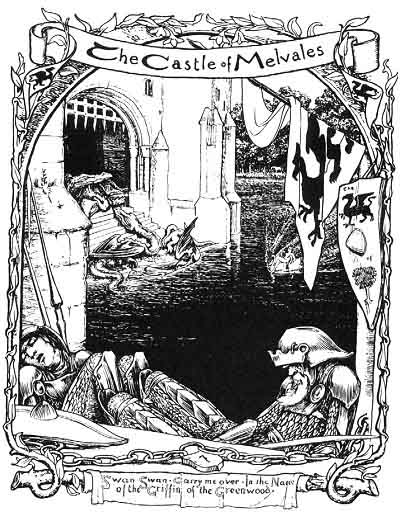
fairy tale illustration

Illustration by John D. Batten to the story
"The King of England and his Three Sons"
in Joseph Jacobs: More English Fairy Tales
@ Sacred Texts


Labels: , , ,

Sunday, February 03, 2008

and bread itself

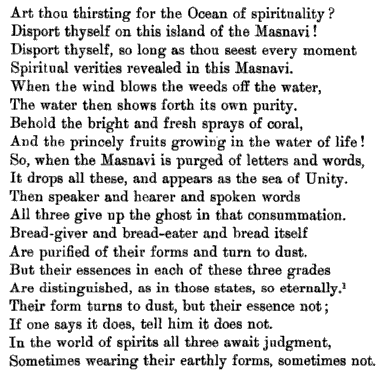
masnaviVI67

Mathnawi VI: 67-76, trans Whinfield
Masnavi I Ma'navi (2000, Routledge) @ google books


Update: Barks and Nicholson versions available at Sunlight.

Labels: ,