Wednesday, September 03, 2008

blogging the blog

I've been following Robert Spencer's Blogging the Qur'an which, up until recently, was shown at HotAir with a repeat at the JihadWatch site itself. I'd not been commenting since the main student-style questions arose at HotAir and I've not been able to register there. With the move, I decided to take up a student role and ask some questions relating to the entry on Suras 41, “Explained in Detail,” and 42, “Consultation”. I've received patient but, at times, somewhat defensive replies from Robert Spencer.

Basically, I've questioned Spencer's scholarship and impartiality in relation to his paraphrasing of verse 42:41 which arises out of the context of the previous verse. Ten translations of these two verses are given below, followed by Spencer's paraphrase:
Koran 42:40-41

Pickthall: The guerdon of an ill-deed is an ill the like thereof. But whosoever pardoneth and amendeth, his wage is the affair of Allah. Lo! He loveth not wrong-doers. And whoso defendeth himself after he hath suffered wrong - for such, there is no way (of blame) against them.

Yusuf Ali: The recompense for an injury is an injury equal thereto (in degree): but if a person forgives and makes reconciliation, his reward is due from God: for (God) loveth not those who do wrong. But indeed if any do help and defend themselves after a wrong (done) to them, against such there is no cause of blame.

Hilali-Khan: The recompense for an evil is an evil like thereof, but whoever forgives and makes reconciliation, his reward is due from Allah. Verily, He likes not the Zalimun (oppressors, polytheists, and wrong-doers, etc.). And indeed whosoever takes revenge after he has suffered wrong, for such there is no way (of blame) against them.

Shakir: And the recompense of evil is punishment like it, but whoever forgives and amends, he shall have his reward from Allah; surely He does not love the unjust. And whoever defends himself after his being oppressed, these it is against whom there is no way (to blame).

Sher Ali: Remember that the recompense of an injury is an injury the like thereof; but whoso forgives and thereby brings about an improvement, his reward is with ALLAH. Surely, HE loves not the wrongdoers. There is no blame on those who defend themselves after they have been wronged.

Khalifa: Although the just requital for an injustice is an equivalent retribution, those who pardon and maintain righteousness are rewarded by GOD. He does not love the unjust. Certainly, those who stand up for their rights, when injustice befalls them, are not committing any error.

Arberry: and the recompense of evil is evil the like of it; but whoso pardons and puts things right, his wage falls upon God; surely He loves not the evildoers. And whosoever helps himself after he has been wronged -- against them there is no way.

Palmer: For the recompence of evil is evil like unto it; but he who pardons and does well, then his reward is with God; verily, He loves not the unjust. And he who helps himself after he has been wronged, for these - there is no way against them.

Rodwell: - Yet let the recompense of evil be only a like evil but he who forgiveth and is reconciled, shall be rewarded by God himself; for He loveth not those who act unjustly. And there shall be no way open against those who, after being wronged, avenge themselves;

Sale: - And the retaliation of evil [ought to be] an evil proportionate thereto: - But he who forgiveth, and is reconciled [unto his enemy], shall receive his reward from God; for he loveth not the unjust doers. And whoso shall avenge himself, after he hath been injured; as to these, it is not lawful to punish them [for it]:


source

Robert Spencer: Then v. 40 says that an equal injury should be inflicted in retaliation for an injury – but Allah will reward those who forgive. However, taking revenge is not sinful (v. 41).

I've discussed this matter further with my son who has never read any of the Koran. Reading those above translations and Spencer's paraphrasing he immediately concluded that Spencer had indeed misrepresented the verses and even more so than I had questioned him over. In my son's view verse 40 suggests than an evil deed deserves a proportionate evil deed, not that such "equal injury should be inflicted in retaliation" as Spencer has it. The next part - "Lo! He loveth not wrong-doers" - is pretty clear in saying that Allah would prefer that the conflict end amicably and no further evil deeds be committed. Finally, if attempts at forgiveness and reconciliation fail, then and only then is a forthright self-defense advised and this is without blame since it has presumably followed the earlier efforts. So, rather than being a whitewash of mere revenge as Spencer's paraphrase suggests, the Koran is demanding an approach to conflict resolution which is, in fact, quite modern.

It's a pity that Spencer missed this opportunity to give a fairer reading of the Koran and reveal some of its inherent merits, at least in these purer or more directly revelatory Meccan verses.


Labels: , , ,

Friday, May 30, 2008

a good word

It's rare that I find a good word in the Koran and thereby a good word to say of the text.
Koran 14:29-30 (Arberry) Hast thou not seen how God has struck a similitude? A good word is as a good tree -- its roots are firm, and its branches are in heaven; it gives its produce every season by the leave of its Lord. So God strikes similitudes for men; haply they will remember.

Koran 14:24-25 (Yusuf Ali) Seest thou not how Allah sets forth a parable? - A goodly word like a goodly tree, whose root is firmly fixed, and its branches (reach) to the heavens,
It brings forth its fruit at all times, by the leave of its Lord. So Allah sets forth parables for men, in order that they may receive admonition.

Labels:

Saturday, April 19, 2008

love in the Koran

FrontPageMagazine.com has a forum on Islamic reform that focuses on an idea by Khalim Massoud to create a new Koran by removing contradictory and violent passages. One of Massoud's premises is that "God is the Most Merciful, the Most Compassionate" and, in a response to that premise from participant Bill Warner, there is an analysis of the occurrence of the word "love" in the Koran. It is a useful little piece, worth preserving here.

One of those opinions was stated by Mr. Massoud, "God is a loving God." I don't know anything about Allah, but I do know what the Koran says. While there are over 300 references in the Koran to Allah and fear, there are 49 references to love. Of these love references, 39 are negative such as the 14 negative references to love of money, power, other gods and status.

Three verses command humanity to love Allah and 2 verses are about how Allah loves a believer. There are 25 verses about how Allah does not love kafirs.

This leaves 5 verses about love. Of these 5, 3 are about loving kin or a Muslim brother. One verse commands a Muslim to give for the love of Allah. This leaves only one quasi-universal verse about love: give what you love to charity and even this is contaminated by dualism since Muslim charity only goes to other Muslims.

So much for love. Fear is what Allah demands.

source: Bill Warner in Symposium: A New Koran?

Labels: ,

Sunday, December 23, 2007

a letter in reply

Today, with Christmas approaching, Salim Mansur has chosen to share some words of that great mystic poet of the English language, William Blake.

Mystery surrounds us from the moment we arrive on Earth until we depart. At its most elementary the mystery is about what sustains this "brief crack of light" -- as the great writer Vladimir Nabokov in his autobiography, Speak, Memory, phrased his opening sentence -- "between two eternities of darkness."

Is life merely this fleeting moment compressed between eternal darkness on either side?

This remains the most compelling question that men and women of varying intellects through the ages have pondered over and most, I suspect, preferred believing that life is a passage, in the words of William Blake, "through Eternal Death! And of the awaking to Eternal Life."

Such belief rests on faith that there is an unseen power, eternally good, merciful, loving and beautiful beyond our earthly sight yet visible to our inner vision as Blake reminds us.

from Salim Mansur: Sharing Blake at Christmas


Whenever Mansur moves away from political commentary and into the more intimate world of faith, poetry and imagination, he seems less like a journalist and more like a friend writing to beloved friends, perhaps far away in time or space. Certainly, I get a feeling of receiving a letter from Salim, from half way across the world. I often have a similar feeling when reading Rumi at his intimate best but the distance then is not mere space but centuries of time as well.

vermeer

Johannes Vermeer: Woman in Blue Reading a Letter @ wikimedia commons


Indeed, Salim refers to this closeness in Blake's own experience of God.

All his life Blake was moved by the vision of God whose love was incarnated in the human form of Jesus.

God in Blake's vision was a personal Deity.

He was not lodged within the formal ornate settings of religious institutions or encountered in the lifeless pages of sacred texts.

In the long poem Jerusalem, Blake writes:

"I am not a God afar off, I am a brother and a friend;

Within your bosoms I reside, and you reside in me."


Three years ago, in the pre-Xmas season of 2004, our publicly funded TV broadcaster, ABC TV, ran a popular program called My Favourite Book in which viewers nominated and thereby voted in books that had made a major impact on them. The top four books were:

1. The Lord Of The Rings - by J.R.R. Tolkien
2. Pride and Prejudice - by Jane Austen
3. The Bible - by Various Contributors
4. To Kill a Mockingbird - by Harper Lee


The first and third books are epic tales on a grand scale, written by men; while the second and fourth are set in a more intimate or personal context and are written by women. There are intimate moments in the epic tales and there are grand themes woven into Austen's conventional love tale and the small town childhood experiences related by Lee. However, the grand predominates in the tales told by men while the small events of everyday life seem to be where women find their inspiration. The artist Vermeer, displayed above and painting a century before Blake, seems to have been atuned to a divine aesthetic present in the small and everyday feminine world. Below, that aesthetic finds voice in a female poet, a great but gentle mystic in her own right and following on soon after Blake.

THE SECRET.

Some things that fly there be, —
Birds, hours, the bumble-bee:
Of these no elegy.

Some things that stay there be, —
Grief, hills, eternity:
Nor this behooveth me.

There are, that resting, rise.
Can I expound the skies?
How still the riddle lies!

from Emily Dickinson: Poems


Perhaps, the essence of divinity lies in the intersection of these two worlds: the grander masculine and the more humble feminine. Where Blake finds the first in the second - Infinity in a hand, Eternity in an hour - perhaps it is the juncture that matters, just as Jesus stood and Christ ever stands at that juncture between humanity and God.

Because Salim is a Muslim and it behooves me to include at least a small element from his own faith tradition inside this article that attempts to act as a letter in reply to his, I would like to quote from the Koran:

We verily created man and We know what his soul whispereth to him, and We are nearer to him than his jugular vein.
Koran 50:16, trans Pickthall


In this verse the God of Mohammad's vision locates Himself at that most vulnerable spot in the neck where the life-blood flows and can so easily be spilt. He does not - like all those other deities in Blake's vision - "reside in the human breast", in that bosom or place of the heart. Allah is not a God of love but a God that threatens death, a God that reminds us of the thin line that separates a living soul from a corpse. It takes but a simple neat stroke to sever the jugular vein, to slit a throat. As that handful of Muslims demonstrated on that September 11, a lot can be achieved with a small box cutter held against a jugular vein.

At Christmas, English speakers love to listen to Handel's Messiah which tells the full tale of Jesus the Christ, from prophecies of His coming, to His humble birth, His suffering and death, and finally His resurrection. The last part affirms the life everlasting that will follow from this story.

I joined those many others in listening to this great masterpiece but the last part left me cold for I cannot believe that the life everlasting supercedes the life of today, the life of now, the life so simply depicted in so many of Vermeer's paintings.

There have also been celebrations lately around the date of Rumi's death which he himself described as his wedding day: the Urs or wedding with the Beloved. A poem from his own son portrays it thus:

From this foul, fulsome world, Rumi moved on

from Sultan Valad: Valad nameh, trans Franklin D. Lewis
via sunlight


I simply do not accept that this world is foul or fulsome. It's true that some eyes can see it so but others, with a different sensitivity, see it otherwise.

I simply do not accept that a man's world or a man's view is better than a woman's. Each has its own truth, its own validity, and its own necessity in the larger scheme of things.

Likewise, I simply do not accept that God (Heaven, Infinity, Eternity) is better than humanity (earth in time and space). Each needs the other and it is about time that God acknowledged that man created Him just as truly as He created man.


Labels: , , , ,

Sunday, December 16, 2007

still, Salim, I'd be happy to talk

Salim Mansur, the brave warrior for freedom, is again forthrightly condemning disgusting Muslim behaviour: a father's murder of his own daughter and a Muslim body's frivolous attack on the effervescent Canadian writer Mark Steyn. As always with Mansur, it is a perverted form of Islam that is to blame, never Islam itself.

The murder was prompted by an ideology of bigotry and terror masked as a faith-tradition -- an ideology of radical Islamism at war with the modern world of freedom and democracy.

from Salim Mansur: Bigotry, terror masked as faith


The Islam and the Muslims represented by a body like CIC (Canadian Islamic Congress) is not the true Islam and not the true Muslims:

Moreover, they are fraudulent in their claims of representing Muslims in general as the CIC does. The fact is, on the contrary, most Muslims in Canada and elsewhere in the West left their native lands to escape from unmitigated cruelty, heartlessness and hypocrisy of Muslim rulers and religious leaders.

[...] as fraudsters they have developed the swindler's art of blackmailing free societies [...]


For Mansur, the true Muslims and the bulk of Muslims are those that repudiate but also fear the Islamists. Apart from an initial close circle of Mohammad's and the successors of that inner elite this would seem to characterize all Muslims from the very start to the hopefully inevitable end. It is what you'd expect from a political ideology masked as a divine prescription. It is what has been in place from the beginning.

And that "beginning" is not simply the beginning of Islam but the beginning of life on this planet: for females and young offspring have always been vulnerable and have always been the first to be exploited or destroyed by life's urge to establish dominant and dominating genetic material. It is most glaringly exemplified in the behaviour of lions, an animal that Muslim men are quick to identify with. When a new male defeats the ruling male of the pride he sets out to obliterate the previous male's genetic material by killing every lion cub he can lay a claw on in the intervals of his systematic rape of each of the pride's lionesses. OK, "rape" is not correct as it assumes that a female might - or might not - give consent. In the leonine world, the female is simply not consulted. They are not known to refuse. This is in fact quite a good description of the average Muslim wife: she could never be "raped" by her husband as she has never been "known to refuse".

That was "in the beginning" but then God arrived. Humanity conceived of a divine law giver that dictated that things would be otherwise. Not that women and children were given particular consideration. First and foremost, the Divinity Itself had to be honoured and with an utterly singular focus:

  • I am the LORD thy God

  • Thou shalt have no other gods before me

  • Thou shalt not make unto thee any graven image

  • Thou shalt not take the name of the LORD thy God in vain


excerpts from Bible: Exodus 20, King James Version


From a woman's point of view, nothing has really changed here. The dominant male, the Lion King, has simply been transformed into a "LORD thy God".

For us women and children, it took the coming of Jesus to change all that. Or at least to begin to change it all. There is a controversial saying of Jesus on this topic, the last in the Gospel of Thomas:

Simon Peter said to them: Let Mariham go out from among us, for women are not worthy of the life. Jesus said: Look, I will lead her that I may make her male, in order that she too may become a living spirit resembling you males. For every woman who makes herself male will enter into the kingdom of heaven.

from Gospel of Thomas Saying 114, trans Blatz


I tend not to take offense at this passage, seeing it as an invitation to women to become Lion Kings themselves. This is how Elizabeth I, Catherine the Great, Margaret Thatcher, at some moments even Condoleeza Rice, have come about. However, I would prefer a better acknowledgment of the sanctity of women in any role, for any woman living true to her essential nature can enter into the kingdom of heaven. That would even include a prostitute if that is genuinely her chosen profession (and indeed some of the ancient goddess faith systems did cultivate a sacred form of prostitution).

From a modern woman's point of view, Mohammad turned back the clock and returned women to a place as chattels, as hardly better than a cow or ass or any other beast owned by a man. There are many cultures - most notably the Chinese - in which women are or have been until recently treated badly, where they have had little or no separate rights and responsibilities. However, Islam - as it expresses itself in the Koran - is not woman-friendly and it further has the arrogance to proclaim itself as being from God and therefore as having an absolute merit and an eternal validity. Chinese culture has been able to change for the better perhaps because it was not so burdened by a God message set in the stone of the written word.

Mansur has a strong voice when condemning the current behaviour of Muslims generally (but especially Arabs in the Middle East). He doesn't mince his words and he often says what the "supinely appeasing" non-Muslims are too timid to say. However, like Jasser, he is less convincing when trying to make a case for a "true" or spiritual Islam, a genuine faith tradition, that has been hijacked by these nasty Islamists. He has not succeeded in showing us the difference between this so-called "real thing" and what seems to us - when examining the Islamic historical and written record - to be the real thing.

Salim, like Zuhdi, is a fine man, courageous and energetic in his efforts to defeat this supremacist ideology coming out of Islam. However, I have become more and more convinced that what has come out of Islam is Islam itself. Devout but "nice" Muslims like these will, I'm sure, continue to discover and experience the numinous through their Islamic traditions but, aside from such inner satisfactions, they can have nothing further to offer to the current debate.

Still, as with Zuhdi, so with Salim: I'm happy to talk these things over anytime you want to.


Labels: , ,

yes, Zuhdi, let's talk

The final installment of the NRO Q&A with Zuhdi Jasser arrived in my inbox today. A key question was as follows [my emphasis]:

Lopez: What’s the most important question you get when you speak on radical Islam?

Jasser: I would weigh the importance of all of the various questions I get with their centrality in promoting American security. That said, the most important question or concern I get from audiences to which I have the privilege to speak, is whether spiritual Islam and political Islam are in fact contrary to my beliefs — inseparable? And whether I am whitewashing a dangerous political ideology? An appropriate answer to this question would need volumes of discourse. Ultimately, I ask them not only to believe my voice and my ideas, which appear to be in the wilderness, but rather to begin the ground work of speaking to Muslims in the grass roots about their political and spiritual constructs. We need to multiply this debate exponentially within the Muslim community.

from NRO Q&A: We Need a Hero


In the interests of contributing to those "volumes of discourse", I'll throw my tuppence worth in here.

Jasser asks me to believe his voice and his ideas. I have no trouble with his basic sincerity but I have grave doubts regarding his capacity to sell his story fully to Muslims and non-Muslims alike. As Robert Spencer of Jihad Watch has expressed it, first in the positive, then in the negative:

Meeting intimidation with a demonstration of nobility and generosity. Bravo, Zuhdi Jasser.

source: U.S. Islamic group ...


This is very good, but of course it doesn't go far enough. I hope that M. Zuhdi Jasser would be willing to confront Taheri-azar's abundant Qur'an quotations, and the role of the example of Muhammad in inspiring jihad violence today. If he is, and if others like him are, then there might really be some progress toward the ideological confrontation with jihadism that he calls for.

source: American Muslim leader ...


Jasser especially urges "speaking to Muslims in the grass roots" but this I have attempted several times, always with highly discouraging results. I'm met with a variety of evasions, defensive walls, threats and even pleas to desist, along the lines of:


  • "It is generally impolite to discuss religion and politics. Just raising these matters is offensive and a sign of belligerence and intolerance."

  • "You don't know Islam. You're an ignorant Kafir."

  • "Be careful what you say or even suggest against Islam as we Muslims will defend our faith with violence if need be and that includes violence against you, your loved ones, and your possessions. The police won't help either, not if you merely find your pet cat poisoned or a deep scrape in your car's paintwork."

  • "We're terrified ourselves of the violent Muslims and we don't want to be seen associating with a non-Muslim on anything more than the most superficial level. Let's talk about the weather, that's fine, but no more. And even there, let's not talk about God bringing the rain or the sunshine. Leave God out of it."


Nowhere is there any honest and forthright debate. Nowhere. Even Jasser himself is evasive, rarely making direct references to the Koran or the life of Mohammad.

At the very end of the interview Lopez asks: "Who are your heroes?" Jasser provides a list of four men: his grandfather and namesake Zuhdi Al-Jasser, US Presidents Reagan and Jefferson, and fictional TV hero Jack Bauer. What kind of a Muslim leaves Mohammad out of a list like that? Is Mohammad absent because Jasser has genuinely come to repudiate him as a role model or is he not there because Jasser is practising a form of taqiyyah, diplomatically neglecting to mention something that might sound too "un-American".

To convince me, Jasser will need to do far more than denounce Islamists (under whichever of their many names). He will need to put some substance into his airy-fairy assertion that there is a separate spiritual Islam unpolluted by Islamist political ideology.

This is how I see it:


  • The Koran, the life of Mohammad, the traditions and the classical interpretations form a coherent whole with a clear Islamic supremacist message: God is One, His Centre is located at Mecca, His Final Prophet was Mohammad, His Final Word was the Koran, no other conception of deity has any validity, the Jewish and Christian conceptions are especially pernicious for making apparently credible but deceptive claims, and it is the duty of every Muslim to spread the One True Faith of Islam whether by the sword, by unrestrained fertility, by the (literal or metaphoric) handing out of sweets to children, or by forceful evangelization.

  • "Nice" Muslims like Jasser are employing the tactic of handing out metaphoric sweets to gullible adults.

  • Yes, there is "a spiritual Islam" of sorts. There is a mystical tradition, called Sufism, which arose within the Islamic empire but has clear influences from abroad, from outside the core supremacist Islamic tradition described above. Those influences include much Hindu and Buddhist mysticism, deep and direct influences from Zoroastrian, Christian and Jewish sources (through an actual reading of and meditation on their sacred texts), as well as wider Mediterranean influences (such as Greek neoPlatonism and ancient strands of Egyptian alchemy and theosophy). The core values of Sufism can be represented by the poetic works of one man alone, known to us all as Rumi. However, if you took his two major works, the Mathnawi and the Shams collection, and removed from them every clear Islamic (Koranic or Mohammadan) reference, then you would still be left with an oceanic and essentially divine corpus. Take Islam out of Rumi and you're still left with the Divine.

  • Do a similar but opposite job on the main Islamic works, especially the Koran itself: remove every clear supremacist, political, ideological statement - every "Islamist" statement - and what remains? Perhaps a puddle or two of insipid and unoriginal pronouncements as to the glory of God. The kind of thing that a dozen monkeys on a dozen typewriters could easily produce in a dozen days.


I'm happy to discuss any of this with you, Zuhdi, at whatever length you wish, here or elsewhere.

I'm prepared to be infinitely patient but not to the point of holding my breath. I will continue to be engaged in many other activities such as enjoying the fruits of the rich culture to which I'm fortunate to be an heiress. Stuff like Beethoven and professional tennis, but especially stuff like civilized adult conversation unfettered by fear or favour.

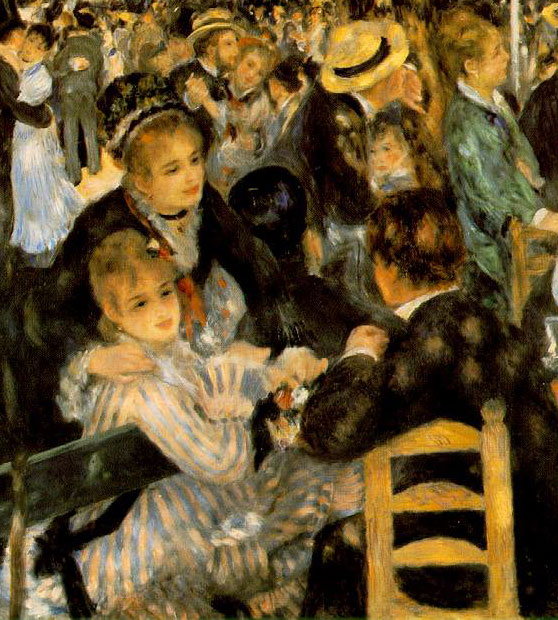
renoir conversation

detail from Pierre-Auguste Renoir: Le Moulin de la Galette, 1876


Yes, Zuhdi, let's talk. I'm ready, willing, and waiting.


Labels: , , , , ,

Thursday, December 13, 2007

just one question for Dr. Jasser

A great deal of Islamic scripture discourages war and encourages peace. Some argue that the peaceful verses are abrogated. Many Muslims however believe that unless a verse is specifically identified as abrogated and since God left it in the Koran it is still valid and His word and instruction cannot be abrogated but rather just put into the context of the time of its revelation. Thus, almost every Muslim I have ever known would not subscribe to the abrogation of peaceful verses.

from M. Zuhdi Jasser: NRO Q&A: Dr. J CAIRs [my emphasis]


If you won't subscribe to this abrogation, why not go one step further and reject Islam's purported abrogation of Christianity? If you want to remain a devoted man of god, what's wrong with the Christian way of doing it? Tell us plain and clear so we understand where you're coming from.

And by the way, you might brush up on your Freud given that you also stated [my emphasis]:

The question of the central nature of Islam rests on two issues. First, the values and morality of Islam are not derived de novo from the text itself, which can be twisted by any deviant who chooses to become God on earth. But rather, the individual morality comes from the superego or conscience of the individual reading the text. Thus the nature of Islam is measured more by the values which Muslim families teach their children, than by the radical published interpretations of passages, which can be more of a reflection of the thugs and theocrats in power over publishing houses, rather than the religion itself as it is practiced by the Muslim masses. Thus, while ultimately, all morality comes from God, the faithful are moral from within themselves and not from a text.


superego
In Freudian theory, the division of the unconscious that is formed through the internalization of moral standards of parents and society, and that censors and restrains the ego.

source


You see, Dr, Jasser, the superego is not a natural capacity for seeing right from wrong but a set of standards derived from one's early learning environment. Sure, you're a nice bloke and you were no doubt raised by gentle people from whom you derived many of your standards of morality. However, to the extent that your moral code - or superego - derives from Islamic and specifically Koranic influences - then your superego resembles Allah and/or Mohammad. So, it isn't some sort of independent capacity that can constrain your understanding of the Koran. There are not a hundred ways of interpreting passages like: "slay them wherever ye find them". Most Muslim children will understand that "them" refers to all those non-Muslims "out there", all those "others". You can't expect "them" to be suddenly understood as referring to super-pious Muslims like Osama bin Laden who scrupulously observes all the Islamic devotional duties. As an observer, standing outside of Islam, I would say that bin Laden's interpretation of a passage like that is forthright and not in the least bit deviant or twisted. You are the one who needs to get into weird logical contortions in order to uphold your distinction between a morally exalted spiritual Islam and the real thing as bin Laden understands it.

You also said [my emphasis]:

Second, the morality of the messenger of Islam, the Prophet Mohammed, is central to the believability of the question of the violent or non-violent nature of Islam. Ultimately, what matters the most is not whether I can come to an agreement with Osama bin Laden over how violently aggressive, or humbly nonviolent the Prophet Mohammed was. What matters most to the world today is that my interpretation of my faith, its messenger, and its scripture today is based upon a moral code which is consistent with the moral code of the vast majority of other Americans, and our rule of law in the 21st century. What matters most is that my construct of citizenship and belief in American exceptionalism is not at conflict with any aspect of being Muslim.


Leaving violence and war aside for a moment, what does your superego or moral code have to say about theft? It's pretty simple really: Was Mohammad "moral" when he used theft or brigandage as his supposed means of survival after his expulsion from Mecca? Did he not set a moral standard - of ends justifying means - here? Did not Jesus set precisely the opposite moral standard by submitting to His death by crucifixion? You decide which moral code to go by.

Perhaps, in the end and as the Sufis seem to have realized, there is merit in both moral codes and the surest way to achieve any goal - including that of reaching God - is to make use of both. A good place to start, though, is by clearing the fog of confusion between what is true and what you merely want to believe. It also helps to untie as many of those troublesome knots as possible instead of making more and more of them.


Labels: , , ,

Wednesday, December 12, 2007

medical opinions

There are currently two men of medicine pushing their views of Islam: the one characterizing it as incorrigibly jihad prone and the other as a spiritual treasure hijacked by the jihadists. The first is Andrew Bostom, author of The Legacy of Jihad and an associate professor of medicine. The second is M. Zuhdi Jasser, founder of the American Islamic Forum for Democracy and a specialist physician in private practice. Presumably both men have an instinct and a motivation for healing but their views are opposed in their essence and therefore the guidance offered is conflicting. It would be interesting to hear the two of them debate, whether directly or through representatives or surrogates.

In fact, I've been reminded of Bostom through just such a representative or surrogate in the form of Philip Carl Salzman, author of a Middle East Quarterly essay titled The Middle East's Tribal DNA. It is a useful essay in bringing together relevant data and ideas from cultural and political studies. However, Salzman relies a good deal on the work of Bostom as well as other writers of similar vein such as Bat Ye'or and Robert Spencer. He belongs to a school of thought that is gaining strength due, especially, to the absence of clearly formulated counterarguments. What I find original in Salzman's essay is the idea that a bedouin tribal culture over which Islam was to dominate has, instead, succeeded in dominating Islam itself. Here are his concluding sentences [my emphasis added]:

Middle Eastern societies are not "modern," however, in the sense that European and American societies are. The tribal spirit holds sway. Its influence upon Islam permeates even the most cosmopolitan Arab states even if the tribal influences enshrined in the religion espoused or revealed by Muhammad are, almost fourteen centuries later, forgotten. Indeed, had Islam, whatever its many dimensions and complexities, not incorporated the balanced opposition structure of the tribal society that it sought to overlay, it is doubtful whether it could have been as accepted and successful as it was.


Salzman is suggesting here not only that Islam failed to transcend the tribal culture out of which it arose but that its own success lay in its elevation and sacralization of that very tribal culture. Indeed, it doesn't take a great leap to conclude further that that is essentially what Islam consists of, viz, a sacralization of tribal political culture.

Something along these lines is mentioned by Salim Mansur, also for the Middle East Quarterly, in a review of Mohamed Charfi's Islam and Liberty. Mansur acknowledges a similar view among some modern Muslims though it is unclear whether and how his own view differs from this:

Charfi is unabashedly a modernist Muslim who contends that the traditional insistence of Muslims on religion and politics in Islam being inseparable is the source of much difficulty. Historically Islam was shaped by men in politics to legitimize their power, to make the state an instrument of faith, and to invest the successors of the Prophet, the caliphs, with an aura of sacred authority, an argument that others beside Charfi have also illustrated (most notably Ali Abderrazak in Islam and the Foundation of Power).

President George W. Bush has spoken eloquently about freedom being God's gift to mankind; Muslims have not been denied this gift of heaven but have squandered and abused it. Charfi's study will be of interest for both specialists in Arab-Muslim politics and general readers keenly concerned in contemporary affairs. The author is to be commended for striving to kindle an understanding of Islam that would take Muslims back to the religion's original impulse and help non-Muslims to appreciate how difficult is the process of reform.


Mansur does refer to "the religion's original impulse" suggesting that this might have formed the basis for a spiritual liberation. From this and other writings, it is clear that Mansur accepts Mohammad's primary message as represented in the Koran as just such a "gift of heaven" as the idea of freedom is for Bush, a gift that has been "squandered and abused". This is very close to the notion of a pure or spiritual Islam that has been hijacked by the jihadists.

Here is how Jasser expresses that notion [my emphasis]:

I will finally add a caveat that my only fear is that many exposed to the term [Islamofascism] will have little prior knowledge of Islam or contact with Muslims and will carry away a belief that Islam as a spiritual faith is fascistic in its ideology. That cannot be further from the truth of the Islam which I teach my children and so many of the vast majority of Muslims teach their families. But that should stimulate Muslims to even more actively defeat the Islamists who have hijacked our faith for their own political agenda. In fact we can also cannot forget that the Islamofascists are a subset of a much larger ideological threat to the west of the Islamists. The Islamists include all those who believe in political Islam from the fascists of Al Qaeda to the rank and file political Islamists who believe in democracy, elections, and parliaments but still hold tight to a theocratically exclusivist Islamic state.

source: A Muslim American


We have here, then, a spiritually pure inner circle of Muslims who reject the political character of Islam, surrounded by Islamists, jihadists, and Islamofascists. Jasser would like to believe that the inner circle represents "the vast majority of Muslims" but various polls and surveys make that very hard to believe, especially outside of the United States. Robert Spencer at Jihad Watch has almost daily opportunities to scoff at "The Tiny Minority of [Extremist] Muslims" as one news story after another pours in, indicating just how mainstream is the Islamist view of Islam.

Sadly, I believe that counterarguments to the "Jihadism is the real Islam" idea are lacking because they cannot be expressed in any clear, coherent or logical manner. Inevitably, inconsistencies and contradictions emerge, a feature not present in the jihadists' case. I have noted elsewhere (in the Koran according to Jasser and the hidden hand) that Jasser must suffer a perpetual cognitive dissonance if he is to uphold the Koran as the Word of God since it involves such blatant contradictions. Jasser's capacity for persevering within such a discordant mental framework is further evidenced in the above interview where he says:

My love for my faith should drive me to wage a counter-jihad, and not blame the messenger (users of this term) and demand that the term be stricken so that I can live in denial. These thugs spread an evil in the name of a warped version of the faith they believe is Islam. However, I become like “al Qaeda” if I refuse to call them “Muslim” and commit takfir (determining who is and who is not a Muslim) by saying they are not “Muslim.” Their Muslim or Islamic identity is between them and God as it is for every Muslim. Once we open the door to debate who is and who is not a Muslim it empowers a theological hierarchy which will purport to speak for the faith community. I will never subscribe to that. As a moral human being and as an American, it is obvious that their actions are evil and barbaric and we should do everything we can to destroy them and defeat them wherever we find them.


The last phrase is an echo from that famous (or infamous) passage from the Koran as follows:

And slay them wherever ye find them, and drive them out of the places whence they drove you out, for persecution is worse than slaughter. And fight not with them at the Inviolable Place of Worship until they first attack you there, but if they attack you (there) then slay them. Such is the reward of disbelievers.

Koran 2:191, trans Pickthall


Is it just me or does Jasser start the above paragraph by refusing to deny Islamofascists as fellow Muslims while ending the paragraph by characterizing them as trouble-making disbelievers who must be sought out and slain just as the jihadists themselves are seeking out and slaying all the rest of us? For at least this poor addled brain, this "argument" is far far too self-contradictory to swallow.

I'm afraid that in the current debate, such as it is, I must assign one point to Dr. Bostom (et al) and deny one point to Dr. Jasser (et al). I'm also disinclined at this stage to hold my breath in expectation of any change in the situation. Islam, for me, is an attempt to sacralize the "might is right" outlook which is directly opposed to every aspect of humanism and natural justice that I know of. There is only one way for Islam to go and that is down. Down into the dust where it belongs.


Labels: , , , , , ,

Sunday, December 09, 2007

taqiyyah

[A]ssessing the intentions of Iranian decision makers is a beguiling task since tactics of intentionally misinforming or blatantly lying is sanctioned by the Shiite practice of "taqiyyah" (dissembling or concealing truth).

from Salim Mansur: Questionable intelligence on Iran


taqiya or taqiyyah

In Islam, the practice of concealing one's faith and forgoing ordinary religious duties under threat of death or injury to oneself or one's fellow Muslims. Its basis is found in the Qur'an, and Muhammad is regarded as having set its first example when he chose to make the Hijrah. It has since been practiced mostly among minority groups, particularly those of the Shi'ite branch.

The Qur'an allows Muslims to profess friendship with the unbelievers (3:28) and even outwardly to deny their faith (16:106), if doing so would save them from imminent danger …

from Britannica Concise under taqiyyah
and Britannica under taqiya


Let not the believers Take for friends or helpers Unbelievers rather than believers: if any do that, in nothing will there be help from Allah: except by way of precaution, that ye may Guard yourselves from them. But Allah cautions you (To remember) Himself; for the final goal is to Allah.

Koran 3:28, trans Yusuf Ali


Any one who, after accepting faith in Allah, utters Unbelief,- except under compulsion, his heart remaining firm in Faith - but such as open their breast to Unbelief, on them is Wrath from Allah, and theirs will be a dreadful Penalty.

This because they love the life of this world better than the Hereafter: and Allah will not guide those who reject Faith.

Koran 16:106-107, trans Yusuf Ali

Whether conscious or unintentional, Mansur is practising a little taqiyyah in his introduction of this concept inside today's article. Since the idea originates in the Koran it is not an exclusively Shiite notion though its practice would inevitably be more common among such a minority group.

Incidentally, verse 16:107 - included above where it follows on and completes the second Koranic source for taqiyyah - puts every modern or "moderate" Muslim (such as Mansur himself) in a difficult place for it is a prime verse justifying suicide in the name of Islam. It also essentially contradicts the preceding verse since the only "compulsion" that could justify denying one's Islamic faith would be torture or death, both of which are trials or pains "of this world" and therefore not to be compared with those of the Hereafter Where It Really Counts.


see also hiding and revealing

Labels: , , , ,

Saturday, December 08, 2007

show no compassion

The woman and the man guilty of adultery or fornication, flog each of them with 100 stripes: Let no compassion move you in their case, in a matter prescribed by Allah, if you believe in Allah and the Last Day. (Koran 24:2)

Islamic justice is a proud institution, one to which more than a billion people subscribe, at least in theory, and in the heart of the Islamic world it is the law of the land. But take a look at the verse above: more compelling even than the order to flog adulterers is the command that the believer show no compassion. It is this order to choose Allah above his sense of conscience and compassion that imprisons the Muslim in a mindset that is archaic and extreme.

from Ayaan Hirsi Ali: Islam’s Silent Moderates

source

Labels: , , ,