Today, Salim Mansur has drawn my attention to the Swiss Roman Catholic theologian, Hans Küng. I've not read any of his many books but will look out for his writings when next at the library. For this post, I've relied on what is available on the internet, such as through wikipedia and reviews of his books. He appears to be a man of wide learning and of strong commitment, as well as having the personal gifts necessary to bring these into the public arena so as to make a real and practical impact on his world. I admire those qualities and cannot but be impressed.
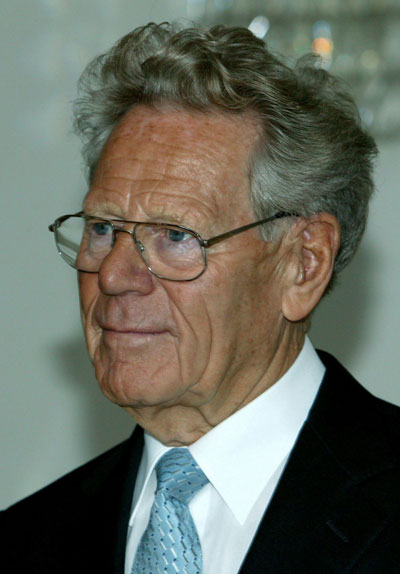
Hans Küng in 2005
Mansur opens with what he calls Küng's "theorem": "No peace among the nations without peace among the religions." As a mathematician myself, I find the use of this term puzzling since a theorem is something that can be formally proved. Küng's statement has more of the quality of a mantram or a slogan. The terms are ill-defined, making it impossible to assess the statement's real worth. It has an undeniable "feel good" ring to it and sets forth a worthy goal, but this is precisely what mantras and slogans merely amount to.
What has more substance for me is the simple fact that Mansur has bothered to read Küng's lengthy work on Islam and considered it worth a focus in his weekly article for the Toronto Sun. That demonstrates his continuing openness to the very dialogue that Küng recommends, albeit within the confines of a scholarly and somewhat prim conversation. As he himself reminds us, this openness is not too common among Muslims:
There is no Muslim scholar I can readily think of who might be mentioned in the same breath as Kung for engaging with similar devotion and humility in the study of Judaism and Christianity, while putting aside any expectation that Muslims should similarly engage in studying and learning from the faith-traditions nominally described as Eastern religions.
from Salim Mansur: Theologian finds peace path
The comparative study of religions has been very much a part of the scientific spirit of world discovery, perhaps more aptly described as a discovery of worlds since each faith-tradition is like a different world. There is indeed little evidence of a similar outgoing curiosity from within the Islamic world except, historically, among some of the Sufis.
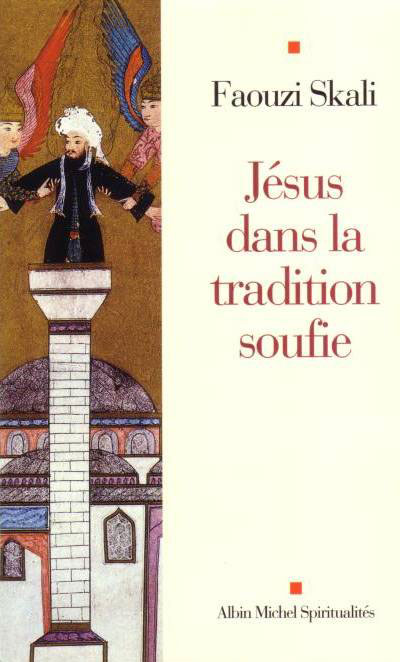
When Rumi, for example, touches on the life of Jesus or of Job, it is clear that he has researched these earlier "prophets" through the actual scriptures of Judaism and Christianity.
In the case of Job, there is virtually no information about him in the Koran. For a Muslim to know Job's story, he must go to the Old Testament book and read there directly. It's clear that Rumi had done this or had an intimate acquaintance with those who had. He knew his Job and he knew his Jesus.
I've never encountered this kind of knowledgeability among other Muslim writers, whether past or present.
And if the stories told of his funeral are even partly true, then Rumi did achieve this rare understanding across religions that Küng and similar proponents of "interfaith dialogue" are seeking.
There is, however, a fatal flaw in the approach of well meaning men like Küng. It is an easy exercise to find parallels and similarities between religions. However, real "peace" is not possible unless the differences are honestly and forthrightly confronted rather than politely glossed over. This is a main criticism coming out of the following review of Küng's book on Islam:
Although well aware of questionable, or at least all too human, aspects of Muhammad’s life, Küng demands categorically that Christian theology and the Christian Churches should recognise “without reservation” that: “Through the Qur’an the Prophet gave countless people in his century and in the centuries that followed infinite inspiration, courage and power to make a new religious beginning: a move towards greater truth and deeper knowledge and a breakthrough towards enlivening and renewing traditional religion. Islam was the great help in life”.
But the Christian believer and theologian cannot but judge this statement about the person of Muhammad and of the Qur’an as unqualified and undifferentiated, not least in the light of the absolutely central Christian theological question at issue here: in the light of the life and teaching of the great biblical prophets Hosea, Jeremiah and Isaiah and especially and finally of Jesus of Nazareth and his Gospel, what are the adequate and God-pleasing “means” and ways of acting, which the true messenger of God is to employ to further the cause of God? Does not the way Muhammad opted for, namely, political and military means in furthering the cause of Islam, need to be viewed as objectively irreconcilable with the life, example and teaching of the non-violent, suffering “servant of Yahweh”?
from Christian Troll: Book Review for The Tablet
Küng has been quoted as saying: "As a matter of fact, you have deficiencies in all religions, but you have truth in all religions." The word "deficiencies" is a polite way of saying "falsehood" but an honest dialogue must address both the true and the untrue and it must especially focus on those areas where the "truth" of one religion clashes with the "truth" of another in a way that does not readily allow for overlap. In the case of Christianity and Islam, there are two especially hot spots: the mystery of the trinity and the very factuality of Jesus' crucifixion, letting alone its meaning.
I have tried to look into the first issue in some of my recent posts (under
Trinity). On the second issue, I have considered the "dialogue" possibilities of looking at Rumi's ghazal 728 which compares Jesus with Hallaj. The pertinent lines are as follows:
That idea the Christian carries abroad, the Moslem has not that
idea, that He is slaying this Messiah upon the cross.
Every true lover is like Mansur, they slay themselves; show any
beside the lover who deliberately slays himself!
excerpt from ghazal 728, trans A.J. Arberry
Earlier this year, I offered this possibility to the Catholic priest conducting the course on
Mysticism: Islamic and Christian Perspectives but he showed no interest in pursuing it. I'm not sure why it is so but this reluctance to honestly face up to these differences is as evident on the one side as on the other.
So for me, it's: Dialogue, schmialogue. We can go nowhere if appeasement is the only approach used. A war of words must be started, else a war of nuclear weaponry will likely take its place.
Labels: Arberry, Christianity, Islam, Jesus, Mansur, Rumi, Trinity