Friday, September 05, 2008

models

The September 2008 issue of Commentary magazine has an excellent article by Bret Stephens: How to Manage Savagery. In it, Stephens examines developments in the world of Islamic terrorism and how that relates to the Muslim world at large. He considers the Huntington "clash of civilizations" paradigm against the realities of the past 15 years since it was first published and concludes:
Contrary to Huntington’s forecast, much of world conflict is now overwhelmingly characterized by fighting and competition not between or among civilizations but within them. And nowhere is this truer than in the Muslim world.

Stephens draws a dramatic parallel between al Qaeda's fate and that of the larger Islamic civilization:
Still, al Qaeda’s decline offers a kind of portrait-in-miniature of a civilization that seems perpetually to be collapsing in on itself. Here is a movement in which suicide—that is, self-destruction—is treated as the ultimate act of self-assertion. A movement that sees itself as an Islamic vanguard, leading the way toward a genuine Muslim umma, but is permanently at war with the Muslim communities it inhabits. A movement whose attacks beyond the Islamic world have mainly had the effect of accelerating the very forces by which it is sealing its own fate. To use an inexact astronomical analogy, this is a movement with the quality of a supernova: even as an envelope of superheated gas rapidly expands outward, its core is compressing and ultimately implodes.

He then considers the policy implications of this reality and identifies three broad approaches that have been considered. Below is my attempt to illustrate these three as models of relationship between the Muslim world and the Christian West:


The first model I've called "separation" and is described by Stephens as follows [my emphasis]:
As for how the United States and its allies should attempt to deal with this new reality, one temptation is simply to stay away, on the theory that no good can come from putting our hands in such a mess. This is roughly the view of the libertarian and paleoconservative Right, and perhaps a majority of the Left. But the view hardly bears discussion: all mention of Israel aside, access to Middle Eastern energy resources is a vital American interest and will almost certainly remain so for decades. The Muslim world is also inextricably a part of the Western one, particularly in Europe. Nor is the global terrorist threat likely to go away even if al Qaeda does. The possibility that a regime that sponsors or supports terrorists might be in a position to supply them with weapons of mass destruction is a direct threat to us.

The second model I've called "diplomacy" and Stephens elaborates thus:
A second option, associated with the so-called realist school, contends that with rare exceptions, the U.S. should deal with the Muslim world more or less as it is, without seeking to change it. This is a view that has much to recommend it—at least in the hands of a master diplomatic practitioner. But Metternichs are hard to come by, and in the hands of lesser statesmen, realism easily slides into passive acquiescence in an intolerable status quo—or into intolerable changes to it. Witness the readiness of Colin Powell, as chairman of the joint chiefs of staff during the first Bush administration, to accept Saddam Hussein’s invasion of Kuwait in 1990 as a fait accompli.

Finally, I have called the third model "one-way influence" and Stephens explains:
A third view, shared to varying degrees by neoconservatives and liberal internationalists, is that the U.S. and the West have no choice but actively to seek domestic reforms in Muslim countries. Needless to say, such a course is fraught with risks and often prone to mishandling, overreaching, and failure. But some version of it is the only approach that can, if not heal the pathologies of the Muslim world, then at least ameliorate and contain them so that they do not end up arriving unbidden on our doorstep, as they did one morning in September 2001.

Labels: , ,

Saturday, June 28, 2008

a shameful prayer

From comments at the Dry Bones post on the anti-Israel Presbyterian Conference:
eidel said...
My mother (of blessed memory) always warned me;"scratch a goy and you'll find an anti-Semite."
I poo pooed her but life has shown me she was right.

avi said...
Just proves that despite supposedly enlightened policies and minds of the goyim, the only ones we Jews can rely on is god and other Jews. We truly are alone in this world.

Arizona said...
What eidel and avi posted above, above goys being unreliable as allies, is quite untrue on an *individual basis*. I'm a post-Christian goy (even a neo-gnostic) and I'm 100% behind Israel. I would lay down my life for Israel if I thought it would really help. However, what eidel and avi have said is sadly quite true on a *group basis*. The major non-Jewish groups that could be and should be defending Israel are just not doing it. They include the UN and the EU but also the US. Bush, I think, remains personally loyal but Rice has sold out and the polls indicate that the US people at large will vote in Obama who will surely not defend Israel.

I was moved to tears when I recently read Hillel Halkin's "Israel's Lonely Last Resort", moved because I just know he's not exaggerating. In political terms, Israel is alone and I can but pray that she has the strength to get through all this alone. It is not a hopeless prayer but it is a deeply shameful one.

Labels: ,

Monday, June 23, 2008

remaking our gods

to Janusz S. Kowalik
Reader comment on article: The Enemy Has a Name
in response to reader comment: To Anne Julienne

Submitted by Anne Julienne (Australia), Jun 21, 2008 at 18:48

Your desire for "the total or nearly total secularization of the planet" is not realistic. Some parts of Europe are highly secularized (only 10-20% religious in France, Germany, etc) but most of the world is not like that and Europe is, in any case, succumbing to Islam in a slow and steady process of appeasement, demographic decline, and post-modern uncertainty. The current situation requires nothing less than that we remake our gods and especially our attitudes to our gods so that both the secular and the religious, both the Christians and the Muslims, can live in peace. Eliminating the one or the other from the equation is not gonna work, bloodshed or no bloodshed.

source

Labels: , , ,

Wednesday, June 04, 2008

a prayer for victory

These are terrible times for world Jewry. Islamic Jew-hatred is genocidal. The international Left has betrayed us. Our leaders are weak. Our friends are few and far between.

If we wish to persevere in this environment we must embrace those who support us while eschewing those - even in our own ranks - who tell us that support for Israel is conditional. Now is not the time to quibble over Christian theology. Now is the time to stand united with our friends against our common enemies.


from Caroline Glick: Jews united for Israel's friends


As one of the "few and far between", I pray that the Jews of the world will listen to this lady. May she gain victory over those ideologues, especially those Jewish ideologues, who would sacrifice Israel to anything short of the Very Ultimate.


Labels: , , , ,

Friday, April 25, 2008

tantalizing tales

Wikipedia on Winston Churchill (novelist):

Winston Churchill (November 10, 1871 - March 12, 1947) was an American novelist.

[...]

In 1919, Churchill decided to enter a prolonged period of self-reflection. He stopped writing and withdrew from public life. As a result of this he was gradually forgotten by the public. In 1940, The Uncharted Way, his first book in twenty years, was published. The book was a reflection of Churchill's thoughts on religion. He did not seek to publicize the book and it received little attention. Shortly before his death he said, "It is very difficult now for me to think of myself as a writer of novels, as all that seems to belong to another life."


churchill


TIME review of The Uncharted Way titled Prophet and dated June 17, 1940:

In the 23 years since U. S. Novelist Winston Churchill (The Crisis, Richard Carvel) last published a book, he has kept much to himself. He lived quietly in Cornish, N. H., and it was understood that he had stopped writing. Far from it: he was ruminating and writing his profession of religious faith, The Uncharted Way.

The book is an examination, chiefly through the Old Testament prophets and the parables of Jesus, of the roots of religion, individualism, science, human conduct, human hope. It is the work of a stonily independent amateur thinker. Winston Churchill is convinced that certain of the prophets, notably Isaiah (a collaboration) and Jesus (if he existed), had hold of a form of science, psychology and self-knowledge which all religions, including Christianity, have repudiated, and which science itself rather scorns than endorses.

The U. S. Churchill's thesis: The essence of the prophets' perception was a form of creative, evolutionary energy, through which an individual might free himself from fear, desire, moral death.

This form of energy is described in the Gospels, Churchill believes, by the Greek word agape: non-possessive rather than possessive love. This was and is, he believes, perhaps as actual a force as electricity. Fear is the root of all state-religions, it suffuses and gives shape to society, and is described by the prophets as Satan or the Tempter. Craving, a low state of creative energy, is the root of rebellion, and rebellion likewise is a state of sin or death. The technique by which the hostile power of the world is "bound" is broadly similar to Tolstoy's or Gandhi's nonresistance of evil.

Churchill divides the human career into three days or ages: that of the animal, free in his instincts; that of the human world, tortured between fear and craving; that of resurrection. Indirectly suggesting that the end of the second age, of the human world, is at hand, he recalls that Christ compared such catastrophes to the first leaves of a fig tree, by which men know that summer is near. In his closing chapter Winston Churchill begins to sketch a program for The Third Day. His resurrection is not supernatural but earthly. The reader who finds in this chapter cold comfort may perhaps be pardoned. But he who finds in it mere idiocy may perhaps be mistaken.

Winston Churchill is not to be confused with Great Britain's Prime Minister, but often has been. No kin, they are old acquaintances. Britain's Churchill once suggested that one of them change names; U. S. Churchill, as the senior, passed the buck. Britain's Churchill thenceforth signed his books Winston S. (for Spencer). In 1903, when Winston banqueted Winston S. at Boston's Copley-Plaza, Winston S. got the bill.


Update: A drawing of Churchill is available here.


Labels: ,

Saturday, April 05, 2008

no agnosticism on racism

Below are some key excerpts from a 1953 interview with Bertrand Russell. He speaks with great clarity and conciseness, yet in a very accessible conversational style. I've chosen these excerpts because they touch on the issue of how to evaluate Islam today.

When, in a recent book, I said that what the world needs is "love, Christian love, or compassion," many people thought this showed some changes in my views, although in fact, I might have said the same thing at any time. If you mean by a "Christian" a man who loves his neighbor, who has wide sympathy with suffering, and who ardently desires a world freed from the cruelties and abominations which at present disfigure it, then, certainly, you will be justified in calling me a Christian. And, in this sense, I think you will find more "Christians" among agnostics than among the orthodox. But, for my part, I cannot accept such a definition. Apart from other objections to it, it seems rude to Jews, Buddhists, Mohammedans, and other non-Christians, who, so far as history shows, have been at least as apt as Christians to practice the virtues which some modern Christians arrogantly claim as distinctive of their own religion.

[...]

Of the great religions of history, I prefer Buddhism, especially in its earliest forms, because it has had the smallest element of persecution.

source: Bertrand Russell: What is an Agnostic? (1953)


What Russell says of Muslims or "Mohammedans" is that they can behave as well or as badly as people of any other religion and this is hard to argue with. Christianity, especially, has a very very bad history in matters of persecution and in its failure to reign in emperial brutality as inherited from Rome.

However, Russell doesn't compare the core teachings in their fixed written forms. These are the ongoing legacy of the various religions, pretty much untouched by time and circumstance. It's true that interpretations and evaluations change over time - people "read" or understand the texts differently - but the words themselves have remained fairly stable despite being transmitted for much of their history through manual and not automatic means.

In my own estimation, the Bible remains as a valuable literary work and Jesus remains as a valuable moral leader. I have not found the Buddhist texts accessible, entertaining, or enlightening. I do find the Islamic texts - the Koran itself in conjunction with the traditions and life of Mohammad - to be problematic. I see no moral leadership there, no spiritual instruction, just practical guidance on how to manage political situations and conduct wars. Muslim dogma is not exploited so much in the interests of persecution as in the interests of supremacism through the sword, world domination on all levels: cultural, spiritual, geographical, genetic. On the last point, there is a very apparent Arab racial dominance element to Islam. It is chiefly expressed through the "right" of the conqueror to rape and enslave the women of the conquered. The cultural dominance is chiefly expressed through an insistence that the Koran - the word of God - is untranslatable so that it can only be properly accessed through the Arab language.

The racial element of Islamic supremacism is rarely talked about but its presence is felt most strongly when Muslims project their own racism onto all those who view Islam critically. The "racist" card is pulled out from their own sleeves and no one seems to be noticing this, let alone pointing it out.

So here goes, even if it is a lone voice in the wilderness:

Islam is a racist ideology and the Koran is a racist manifesto.


Labels: , , , , , ,

Thursday, March 27, 2008

fighting fire with fire

Zakaria Botros

Here is Zak
on the attack
condemning Mo
from go to whoa

Here is Zak
better than Mac
setting the scene
to make things clean


Though he is little known in the West, Coptic priest Zakaria Botros — named Islam’s “Public Enemy #1” by the Arabic newspaper, al-Insan al-Jadid — has been making waves in the Islamic world. Along with fellow missionaries — mostly Muslim converts — he appears frequently on the Arabic channel al-Hayat (i.e., “Life TV”). There, he addresses controversial topics of theological significance — free from the censorship imposed by Islamic authorities or self-imposed through fear of the zealous mobs who fulminated against the infamous cartoons of Mohammed. Botros’s excurses on little-known but embarrassing aspects of Islamic law and tradition have become a thorn in the side of Islamic leaders throughout the Middle East.

[...]

Botros’s motive is not to incite the West against Islam, promote “Israeli interests,” or “demonize” Muslims, but to draw Muslims away from the dead legalism of sharia to the spirituality of Christianity. Many Western critics fail to appreciate that, to disempower radical Islam, something theocentric and spiritually satisfying — not secularism, democracy, capitalism, materialism, feminism, etc. — must be offered in its place. The truths of one religion can only be challenged and supplanted by the truths of another. And so Father Zakaria Botros has been fighting fire with fire.

source: Raymond Ibrahim: Islam’s ‘Public Enemy #1’: Coptic priest Zakaria Botros fights fire with fire

Labels: , ,

Friday, February 22, 2008

satan complete

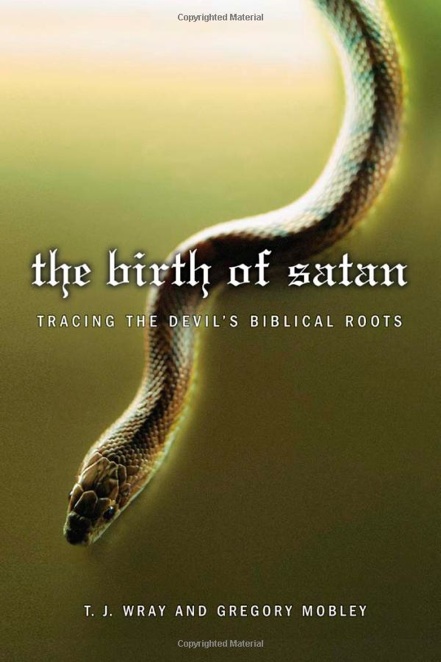
Another book completed: T.J. Wray and Gregory Mobley: the birth of satan. As with the Ondaatje novel, I was enthusiastic to begin with but tired of this book about half way through. It was wonderful to learn about the latest findings in Biblical research, especially as told in such an entertaining or "engaging" (Spong's word) style. However, beyond the Hebrew Bible and into the chapters on foreign, intertestamental and New Testament sources, I started to lose interest. The most fascinating part of the book are the sections on the very, very beginnings of the satan idea.

book cover


The authors' conclusions are not outstanding or original: frequent and annoying notes acknowledge this. The full text of the concluding pages is available online - Postscript: Is Satan Real? - with the final two paragraphs here:

Finally, we return to the perennial question: Is Satan real? The theological and scriptural arguments for and against the existence of Satan are as vast and as formidable as are the variations in personal beliefs concerning Satan. Yet whether Satan is to be taken as a metaphor, as a symbolic, or literal being, Satan is real in the sense that evil is real. Indeed, the fearsome red demon who pursued so many of us in our childhood nightmares pales in comparison to the real and palpable evil at work in the world today in the form of murderous regimes, maniacal serial killers, and suicide bombers.

When we dismiss the biblical Satan as a primitive or outdated concept, when we effectively edit him out of the theological equation and ignore the truths of the stories about him, we run the risk of missing the great lessons the biblical writers were trying to impart. They did not try to explain away evil, for evil was then, and is now, a reality that cannot be denied. And yet, in the final analysis, the Bible reassures us that God is on our side, that the Devil can be resisted, that love wins out in the end.


I want here simply to review the very few references to Islam, besides the mention above of "suicide bombers" who, in their more terrifying and immediately threatening forms, have tended to emerge out of the Islamic world.

There are two mentions of the Qur'an. In the first (p.109), the story of Satan's fall in verse 2:34 is characterized as preserving a tradition established in a first-century C.E. work titled Life of Adam and Eve in which "Satan is banished because he refused to genuflect before the newly created Adam".

According to that work, Satan said: "I will not worship one inferior and subsequent to me. I am prior in creation; before [Adam] was made, I was already made. He ought to worship me" (Life of Adam and Eve 12:3). The Qur'an also preserves this tradition ...

And when We said unto the angels: Prostrate yourselves before Adam, they fell prostrate, all save Iblis. He demurred through pride, and so became a disbeliever.


2:34 Pickthall


The second mention of the Qur'an (p.173) is in the section reviewing Satan's function as The Father of Lies:

This satanic function grows along with Satan himself through history. This is the Islamic shaitan who tampers with the Qur'an, inserting "satanic verses" that lead the weak from the path of sound doctrine.


For me, the most important reference to Islam arrives (at p.170) within a list of candidate conspiracy theories and I will quote it at length as it also provides a good example of the authors' entertaining style [my bold emphasis]:

We have also noted that the apocalyptic style of thinking is not only ancient. It persists, even thrives, in pockets of contemporary culture. Modern sociologists use the term "subversion theory" to describe the patterns of thought that collect the discarded pearls of medieval heretics and secret societies, and rites and symbols from pre-Christian European, ancient Mediterranean, Near Eastern, and Indo-Aryan religions, and arrange them along the thinnest strings of logic in order to fashion the jewelry of folk belief.

If the subversion theory is advanced in communities or individuals suspicious of the government, its Satan and demons are an international network of elites who purportedly control the powers that seem to be. The identity of this cabal of elites varies according to the social prejudices of the theory's adherents. Anti-Semites suspect an international Jewish conspiracy. This, by the way, is the cruelest irony: that a narrative pattern invented by ancient Jews would be reversed to make its original composers into the enemy. Right-wingers suspect a Communist or atheistic conspiracy while left-wingers fear a military-industrial complex. Protestant John Birchers fear the Vatican, and hysterical Roman Catholics fear the Freemasons. Some middle-class Americans coping with the enormous economic and cultural changes of the late twentieth-century have imagined that a network of Satanists and sexual deviants seek to abduct their children from shopping malls or violate their children in day care centers. Many Westerners see an international Islamic conspiracy dedicated to destroying Jewish and Christian culture, while some Muslims fear the reverse. There is and will always be enough evidence of human chicanery from all these alleged perpetrators to keep such theories afloat. There are also the U.F.O. enthusiasts who warn us about the advance corps of aliens that have already begun to infiltrate our atmosphere. The "thickest" subversion theories manage to combine two or more of these stocks into a hearty stew of paranormal paranoia, such as in the X-Files movie where the aliens are in league with a government elite.


However amusing this list might be - and surely "paranormal paranoia" is its most felicitous phrase - it does tend to trivialize genuine, rational concerns about real and present threats. I don't think that "chicanery" adequately sums up what Iran's current President is threatening to do to Israel and, in a different arena, I don't think that parents are unwise to hesitate before delivering their children into the care of "celibate" priests. The authors show no inclination to discriminate between an exaggerated or "hysterical" fear and a well-grounded concern for the safety of those dear to us.


Labels: , , , ,

and I thought such things only happened in the Islamic world

An Italian judge has been sentenced to a year in prison for refusing to sit in a courtroom with a crucifix on the wall, his lawyer said.

[...]

Crucifixes have been present in Italian courtrooms since a 1926 justice ministry directive under the fascist regime of Benito Mussolini that has never been repealed in mainly Catholic Italy.

Italian judge jailed for refusing to sit in courtroom with crucifix

Labels: ,

Friday, January 25, 2008

dumb on deity

After reading the atheistic Dawkins book (see collateral damage), I thought it appropriate to read a book from the opposing theistic camp. The library was accommodating in presenting me with Francis S. Collins' The Language of God (Free Press, 2006). This writer is earnest and at times quite sympathetic but he lacks the theatrical flair of Dawkins. Because he has a strong background and wide personal experiences in the areas he covers, his book is both informative and credible. However, there were several gaffes arising from what I perceive to be a shallow theism that matches Dawkins' shallow atheism.

The first most glaring gaffe occurs on page 41 [my emphasis]:
While the prophet Muhammad never himself used violence in responding to persecutors, Islamic jihads, dating to the earliest of his followers and including present-day violent attacks such as that of September 11, 2001, have created the false impression that the Islamic faith is intrinsically violent.


Never? Muhammad never himself used violence? What has Collins been doing since Sep11? Surely not reading any of the discussion on violence in Islam. Definitely never venturing anywhere near JihadWatch.org let alone FaithFreedom.org, AnsweringIslam.org, or other similar sites. If he had, he would know at least some of the following:

  • In the initial phase of Mohammad's "prophetic" career, while he was in Mecca with but a few followers, he had no power or opportunity to use violence. He deserves no credit for that restraint.

  • Shortly after being forced to leave Mecca and settle in Medina, Mohammad began to order (and also lead) raids against Quraysh caravans, killing the guards and stealing the loot from the camels' backs. He was thus a thief, an armed robber, and a murderer to boot. Details of the very first act of violence, a raid ordered against a caravan at Nakhla, are given in The earliest biography of Muhammad, by ibn Ishaq and also from page 97 of Robert Spencer's The Truth About Muhammad: Founder of the World's Most Intolerant Religion (Regnery Publishing, 2007). I will refer mainly to the latter resource for details as I have found Spencer to be reliable in his own reliance on original Muslim sources.

  • These violent raids progressed to full-blown battle at Badr where victory for the Muslims was claimed as evidence of the "truth" of Islam. See Koran 8:8 - "That He might cause the Truth to triumph" - and surrounding verses.

  • Following a victorious battle against a Jewish tribe, the Banu Quraysah, Mohammad ordered and supervised the massacre of all the men of the tribe. The women were distributed among his gang to be raped and, along with their children, taken as slaves. Details are given from page 128 of Spencer.

  • Mohammad was happy to order the torture of a captive, simply to extract information on the whereabouts of treasure. For details, see page 140 of Spencer. Torture was used on other occasions with clearly little other than sadistic intent as, for example, detailed in a Bukhari hadith.

  • Mohammad encouraged - or effectively ordered - the assassination of a Jewish poet guilty of composing "verses of an insulting nature". See page 115 of Spencer. There were several other similar incidents as listed at page 197 of Spencer.

  • For me, Mohammad's greatest sin of violence was indirect, relating to his approval of his followers' murder of women guilty of "disparaging" him. Details and sources can be found at my hearing the breath post.


Any of the above victims of Mohammad's cruelty and brutality could be characterized as his "persecutors", people who criticized or opposed him. Once he had the means to do so, he pursued his goals on the basis of a "might is right" prescription, terrorizing and murdering without scruple and often with supposedly "divine" approval.

Perhaps Collins has not educated himself sufficiently to be aware of every gory detail of this saga but he should have become acquainted with at least one detail by now, sufficient at least to balk at the use of the word "never" in the passage quoted above. He comes across as a very very naive man indeed, as one who sees the world - and other faith traditions - through the rose-coloured glasses of Christian sentimentality. If he can get this much so wrong, what value can there be in the remainder of his views?

The most positive element of Collins' book is his forthright defense of Darwinian "truth" and the lucidly presented details gleaned from his own field of genetics. It was fascinating, for example, to learn how the apparent extra chromosome (24 total) of our nearest relative, the chimpanzee, appears to have fused with another chromosome to result in the lesser count (23 total) in humans. Everything falls into place as Darwin would have predicted it.

If Collins can influence a good number of his fellow theistic Americans then he will have done a good service to science and to evolutionary biology in particular.

However, on the side of religious "truth", he sounds to me as hollow as Dawkins. He does not use the aggressive arrogance of Dawkins but a softly-softly "Christian" approach, gently trying to persuade any atheistic audience of the reasonableness of his own position. However, at bottom, he really is but a Christian apologist. He really does, quite literally, believe in the unique godhead of Jesus Christ and in the miracle of His resurrection.

To be fair, however, Collins states his Christian beliefs in a special chapter providing a more personal perspective. In terms of a more universal "truth" he proposes a faith he terms BioLogos, which includes 6 points. The first 3 are summaries of what science has come to know of the age of the universe, its physical properties "precisely tuned for life", and the onset of evolution as a process leading to life's diversity and complexity. In the next 2 points, the divine is specifically excluded and our animal nature affirmed:

4. Once evolution got under way, no special supernatural intervention was required.
5. Humans are part of this process, sharing a common ancestor with the great apes.


All of the theistic "damage" occurs in the final point:

6. But humans are also unique in ways that defy evolutionary explanation and point to our spiritual nature. This includes the existence of the Moral Law (the knowledge of right and wrong) and the search for God that characterizes all human cultures throughout history.


For me, this still looks like a "god of the gaps" and an arbitrary place to introduce God. From my observation of plants, animals, and fellow humans, I see no good reason to make such a radical distinction between "us" and "them". I see as strong a sense of right and wrong in my cat as I do in my human neighbour (or myself) and I'm not sure the unfolding of a seed into a plant is not a silent striving toward deity, a plant's version of "the search for God". Collins' BioLogos contains the same human arrogance as is present especially in the Judaically derived faiths, being all so influenced by the dreaded Book of Genesis.

Collins introduces the idea of the Moral Law much earlier in his book, in the chapter where he describes his own journey "From Atheism to Belief". It is in that section (on page 24) that he makes, ironically, a huge moral gaffe:

In some unusual cultures the law takes on surprising trappings - consider witch burning in seventeenth-century America. Yet when surveyed closely, these apparent aberrations can be seen to arise from strongly held but misguided conclusions about who or what is good or evil. If you firmly believed that a witch is the personification of evil on earth, an apostle of the devil himself, would it not seem justified to take such drastic action?


I will leave it to another reviewer to respond more fully to this and, at the same time, I would recommend Korthof's more detailed elaboration of problems with point 6 of BioLogos, similar to my own concerns stated but briefly above.

Shockingly, Collins highest priority is showing that witch burning does not invalidate the Moral Law and he does not bother to tell his readers that he is unconditionally against all torture of all human beings or against the death penalty. Or did he just forget to tell us? It should be easy to condemn an inhuman practice of more than 300 years ago. The 'aberration' seems to be that they burned the wrong people and that the Moral Law they tried to follow is good. The implication would be that Christians today more accurately know which people they have to burn. At the time they only got a few minor details wrong and executed 60,000 people. 'Some unusual cultures'? The European witch-hunt was not a single historical event, but took place from Scotland to Transylvania and from Spain to Finland over a 300-year period (1450 - 1750). Collins completely overlooks that witch burning is not an aberration of otherwise clear and sound concepts and principles. These poor individuals were charged with killing babies, causing sterility among cattle, and destroying crops by magical means, worship the Devil, and nocturnal flight (yes, the executors believed that witches can fly). An ordinary criminal could have been imprisoned or have a painless and quick death penalty. What is the harm done by witches to their neighbours? Does Collins think that magic works and that it has been proven by the inquisitors? Does Collins think that babies are killed and crops fail by magic? Does Collins think that the Devil exists and that 'the pact with the devil' has been proven in any case? Does Collins think that a 'firm belief' in stead of legal proof is enough to execute people in the cruellest way? The real aberration is in the abstract and fictional nature of the theological concepts such as 'witch', 'personification of evil', 'apostle of the devil'. There is the problem. There is the danger. Collins provides on these pages the best evidence of the dangers of fictional, abstract concepts so characteristic of religion. A closely related religious concept is eternal burning in hell. He completely fails to attempt a scientific analysis of this kind of thinking, instead he is part of the problem and he is completely carried away by abstract concepts himself.

from Gert Korthof's review of The Language of God (linked sources in the original)


Finally, near the end of the book, I found myself cringing at the arrogance of Collins' exclusive monotheism and two-faced "tolerance" of other faith traditions. First, on page 225, is the first face of his "tolerance" [with my own read-between-the-line additions]:
I do not mean by telling this story to evangelize or proselytize. [though that is, in fact, what I'm doing] Each person must carry out his or her own search for spiritual truth. If God is real, He will assist. [that man or woman to come to Him, that is, Christ] Far too much has been said by Christians about the exclusive club they inhabit. Tolerance is a virtue; intolerance is a vice. [and I so want to appear virtuous both to the reader and to myself] I find it deeply disturbing when believers in one faith tradition dismiss the spiritual experiences of others. [though I will do this myself in a few pages from here] Regrettably, Christians seem particularly prone to do this. Personally, I have found much to learn from and admire in other spiritual traditions, though I have found the special revelation of God's nature in Jesus Christ to be an essential component of my own faith.


Two pages later, on page 227, there is an about-turn followed by a final about-turn back to the initial "tolerant" face [my emphasis]:
Many of these [Golden Rule] principles can be found in other great religions of the world. Yet if faith is not just a cultural practice, but rather a search for absolute truth, we must not go so far as to commit the logical fallacy of saying that all conflicting points of view are equally true. Monotheism and polytheism cannot both be right. Through my own search, Christianity has provided for me that special ring of eternal truth. But you must conduct your own search.


Well, mate, I have conducted my own search and let me tell you this: Why can't there be different doorways to deity? Different approaches that suit different people? Many of the great mystics have exclaimed that God (or nirvana or the Tao) transcends all of our human intellectual categories including the apparently opposing ideas that God is One and that It is Many. Maybe God is indeed "above" your petty distinction between monotheism and polytheism. Isn't it possible that Unity and Multiplicity are two paradoxical aspects of God just as light sometimes seems wave-like and sometimes matter-like? James Hillman, an advocate of polytheistic psychology (see my Kali Xronia post for some background), contends that it includes non-exclusive (though not exclusive) monotheism. Some people may be more suited to a monotheistic approach, others to a polytheistic. Making dogmatic pseudo-logical assertions may not be helpful when facing a mystery as deep as deity.

Dawkins likes the propagandist motto that "atheists are bright" and I would have to agree with him that Collins does not deserve the label, at least when it comes to theology. He is "bright" when it comes to genetic science and so also is Dawkins when it comes to evolutionary biology. But both men are equally dumb on deity.

Labels: , , , ,

Wednesday, January 02, 2008

creepy quotes from quadrant

A long but fascinating essay from Australia's Quadrant Magazine turned up today. Written by Fr Paul Stenhouse, it is titled Islam's Trojan Horse? Turkish Nationalism and the Nakshibendi Sufi Order. It piqued my interest especially since it relates to the local (Melbourne) scene, to interfaith efforts within the Roman Catholic Church, as well as to the issue of whether Sufism can serve as a counterpoint to Islamism.

As the title suggests, Stenhouse provides background information on the Nakshibendi Sufi Order and its influence within Turkish politics. He profiles leading lights of the Order such as Said Nursi and Fethullah Gülen and it is from sermons of the latter that the "creepy quotes" occur.

"You must move in the arteries of the system, without anyone noticing your existence, until you reach all the power centers …"

"The philosophy of our service is that we open a house somewhere and, with the patience of a spider, we lay our web, to wait for people to get caught in the web; and we teach those who do. We don’t lay the web to eat or consume them, but to show them the way to their resurrection, to blow life into their dead bodies and souls, to give them a life."

from sermons by Fethullah Gülen quoted in Paul Stenhouse: Islam's Trojan Horse? Turkish Nationalism and the Nakshibendi Sufi Order


web

photo from flickr/wikimedia commons


Stenhouse is clearly warning the naive interfaith dialogue enthusiast about the dangers of Islamist propaganda efforts, known as da'wa and quite likely to be clothed precisely in "dialogue" terms.

Dialogue has always been of paramount concern to Catholics. Nevertheless, goodwill alone, unsupported by accurate and comprehensive knowledge of Islam, is demonstrably not enough. In fact it can fatally distort the process for all participants in the “dialogue”, non-Muslims and Muslims alike. The latter immediately sense when good-hearted but ignorant and incautious non-Muslims are utterly unaware of, or are not in agreement about, what is at stake, or what the rules of the game are.

However we may wish it to be otherwise, it is a kind of mind game that we are playing. The stakes are high—and none of the clichés and double-talk of coffee-table ecumenism will serve us well in this struggle of wits.


My attention was also drawn to Stenhouse's bringing in Salim Mansur as a fellow repudiator of "the appeasement mentality" of elements in the liberal-left (which clearly can include the "softer" side of the Church itself).

A similar criticism of Western naivety and “suicidal” complacence was articulated recently by Salim Mansur, a columnist in the Toronto Sun. Mansur is a Muslim and the relevance of his insight is not confined to Canada. He describes what he calls “the appeasement mentality” of the mainstream liberal-left media, and of “politicians trolling for ethnic votes” and of “bureaucrats running public institutions” in the West. He quotes Theodore Dalrymple, a retired physician and prolific writer, who reported in New York’s City Journal:

“In an effort to ensure that no Muslim doctors ever again try to bomb Glasgow Airport, bureaucrats at Glasgow’s public hospitals have decreed that henceforth no staff may eat lunch at their desks or in their offices during the holy month of Ramadan, so that fasting Muslims shall not be offended by the sight or smell of their food. Vending machines will also disappear from the premises during that period.”

“Imagine the uproar,” comments Mansur, that would greet “any suggestion that the mainstream liberal-left media, in appearance at least, is treasonously on side with the newest enemies of freedom and democracy.”


For me, a central message of Stenhouse's long essay comes from a quote he gives from a fellow priest [my emphasis added]:

[T]he Director of the Centre for Arab–Christian Documentation and Research in Beirut, Father Samir Khalil Samir, SJ, ... noted that Christians often suffer from:

“a false understanding of the concept of tolerance. All this is an error and leads to the loss of one’s own identity. Never attack in word or deed, but seek the truth and always point out error. To say only half of what one is thinking is a lie; a complicit silence. Truth cannot co-exist with lies, intolerance and injustice.”


There is far, far too much of this kind of lying coming from the Christian but especially from the Catholic and Anglican Churches. Sadly, even though Salim Mansur might be the last Muslim the West can trust, he may also be guilty of this kind of lying.

For various different reasons, we are all too afraid to tell it frankly as it is and as we truly feel it.

Labels: , , , ,

Sunday, December 30, 2007

peace through appeasement? nay, peace through war

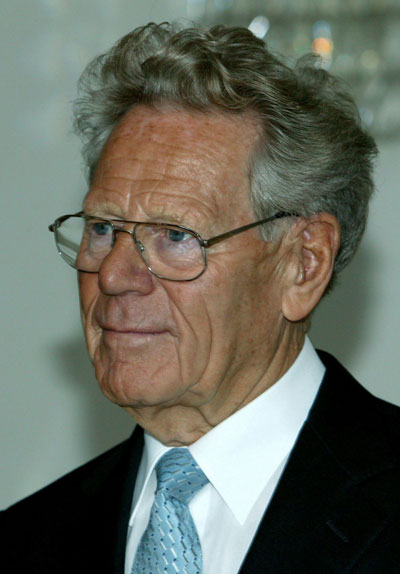
Today, Salim Mansur has drawn my attention to the Swiss Roman Catholic theologian, Hans Küng. I've not read any of his many books but will look out for his writings when next at the library. For this post, I've relied on what is available on the internet, such as through wikipedia and reviews of his books. He appears to be a man of wide learning and of strong commitment, as well as having the personal gifts necessary to bring these into the public arena so as to make a real and practical impact on his world. I admire those qualities and cannot but be impressed.

küng

Hans Küng in 2005


Mansur opens with what he calls Küng's "theorem": "No peace among the nations without peace among the religions." As a mathematician myself, I find the use of this term puzzling since a theorem is something that can be formally proved. Küng's statement has more of the quality of a mantram or a slogan. The terms are ill-defined, making it impossible to assess the statement's real worth. It has an undeniable "feel good" ring to it and sets forth a worthy goal, but this is precisely what mantras and slogans merely amount to.

What has more substance for me is the simple fact that Mansur has bothered to read Küng's lengthy work on Islam and considered it worth a focus in his weekly article for the Toronto Sun. That demonstrates his continuing openness to the very dialogue that Küng recommends, albeit within the confines of a scholarly and somewhat prim conversation. As he himself reminds us, this openness is not too common among Muslims:

There is no Muslim scholar I can readily think of who might be mentioned in the same breath as Kung for engaging with similar devotion and humility in the study of Judaism and Christianity, while putting aside any expectation that Muslims should similarly engage in studying and learning from the faith-traditions nominally described as Eastern religions.

from Salim Mansur: Theologian finds peace path


The comparative study of religions has been very much a part of the scientific spirit of world discovery, perhaps more aptly described as a discovery of worlds since each faith-tradition is like a different world. There is indeed little evidence of a similar outgoing curiosity from within the Islamic world except, historically, among some of the Sufis.

When Rumi, for example, touches on the life of Jesus or of Job, it is clear that he has researched these earlier "prophets" through the actual scriptures of Judaism and Christianity.

In the case of Job, there is virtually no information about him in the Koran. For a Muslim to know Job's story, he must go to the Old Testament book and read there directly. It's clear that Rumi had done this or had an intimate acquaintance with those who had. He knew his Job and he knew his Jesus.

I've never encountered this kind of knowledgeability among other Muslim writers, whether past or present.

And if the stories told of his funeral are even partly true, then Rumi did achieve this rare understanding across religions that Küng and similar proponents of "interfaith dialogue" are seeking.

There is, however, a fatal flaw in the approach of well meaning men like Küng. It is an easy exercise to find parallels and similarities between religions. However, real "peace" is not possible unless the differences are honestly and forthrightly confronted rather than politely glossed over. This is a main criticism coming out of the following review of Küng's book on Islam:

Although well aware of questionable, or at least all too human, aspects of Muhammad’s life, Küng demands categorically that Christian theology and the Christian Churches should recognise “without reservation” that: “Through the Qur’an the Prophet gave countless people in his century and in the centuries that followed infinite inspiration, courage and power to make a new religious beginning: a move towards greater truth and deeper knowledge and a breakthrough towards enlivening and renewing traditional religion. Islam was the great help in life”.

But the Christian believer and theologian cannot but judge this statement about the person of Muhammad and of the Qur’an as unqualified and undifferentiated, not least in the light of the absolutely central Christian theological question at issue here: in the light of the life and teaching of the great biblical prophets Hosea, Jeremiah and Isaiah and especially and finally of Jesus of Nazareth and his Gospel, what are the adequate and God-pleasing “means” and ways of acting, which the true messenger of God is to employ to further the cause of God? Does not the way Muhammad opted for, namely, political and military means in furthering the cause of Islam, need to be viewed as objectively irreconcilable with the life, example and teaching of the non-violent, suffering “servant of Yahweh”?

from Christian Troll: Book Review for The Tablet


Küng has been quoted as saying: "As a matter of fact, you have deficiencies in all religions, but you have truth in all religions." The word "deficiencies" is a polite way of saying "falsehood" but an honest dialogue must address both the true and the untrue and it must especially focus on those areas where the "truth" of one religion clashes with the "truth" of another in a way that does not readily allow for overlap. In the case of Christianity and Islam, there are two especially hot spots: the mystery of the trinity and the very factuality of Jesus' crucifixion, letting alone its meaning.

I have tried to look into the first issue in some of my recent posts (under Trinity). On the second issue, I have considered the "dialogue" possibilities of looking at Rumi's ghazal 728 which compares Jesus with Hallaj. The pertinent lines are as follows:

That idea the Christian carries abroad, the Moslem has not that
idea, that He is slaying this Messiah upon the cross.
Every true lover is like Mansur, they slay themselves; show any
beside the lover who deliberately slays himself!


excerpt from ghazal 728, trans A.J. Arberry


Earlier this year, I offered this possibility to the Catholic priest conducting the course on Mysticism: Islamic and Christian Perspectives but he showed no interest in pursuing it. I'm not sure why it is so but this reluctance to honestly face up to these differences is as evident on the one side as on the other.

So for me, it's: Dialogue, schmialogue. We can go nowhere if appeasement is the only approach used. A war of words must be started, else a war of nuclear weaponry will likely take its place.

Labels: , , , , , ,

Tuesday, December 25, 2007

holy glow in the dark

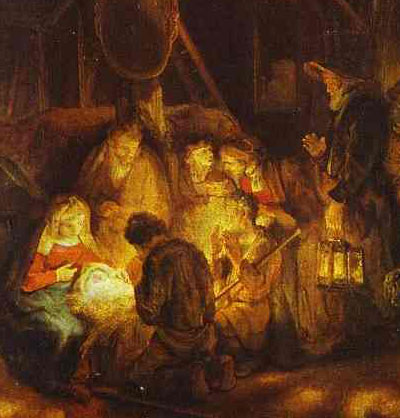
rembrandt

detail from Rembrandt: Adoration of the Shepherds


Labels: ,

Sunday, December 23, 2007

a letter in reply

Today, with Christmas approaching, Salim Mansur has chosen to share some words of that great mystic poet of the English language, William Blake.

Mystery surrounds us from the moment we arrive on Earth until we depart. At its most elementary the mystery is about what sustains this "brief crack of light" -- as the great writer Vladimir Nabokov in his autobiography, Speak, Memory, phrased his opening sentence -- "between two eternities of darkness."

Is life merely this fleeting moment compressed between eternal darkness on either side?

This remains the most compelling question that men and women of varying intellects through the ages have pondered over and most, I suspect, preferred believing that life is a passage, in the words of William Blake, "through Eternal Death! And of the awaking to Eternal Life."

Such belief rests on faith that there is an unseen power, eternally good, merciful, loving and beautiful beyond our earthly sight yet visible to our inner vision as Blake reminds us.

from Salim Mansur: Sharing Blake at Christmas


Whenever Mansur moves away from political commentary and into the more intimate world of faith, poetry and imagination, he seems less like a journalist and more like a friend writing to beloved friends, perhaps far away in time or space. Certainly, I get a feeling of receiving a letter from Salim, from half way across the world. I often have a similar feeling when reading Rumi at his intimate best but the distance then is not mere space but centuries of time as well.

vermeer

Johannes Vermeer: Woman in Blue Reading a Letter @ wikimedia commons


Indeed, Salim refers to this closeness in Blake's own experience of God.

All his life Blake was moved by the vision of God whose love was incarnated in the human form of Jesus.

God in Blake's vision was a personal Deity.

He was not lodged within the formal ornate settings of religious institutions or encountered in the lifeless pages of sacred texts.

In the long poem Jerusalem, Blake writes:

"I am not a God afar off, I am a brother and a friend;

Within your bosoms I reside, and you reside in me."


Three years ago, in the pre-Xmas season of 2004, our publicly funded TV broadcaster, ABC TV, ran a popular program called My Favourite Book in which viewers nominated and thereby voted in books that had made a major impact on them. The top four books were:

1. The Lord Of The Rings - by J.R.R. Tolkien
2. Pride and Prejudice - by Jane Austen
3. The Bible - by Various Contributors
4. To Kill a Mockingbird - by Harper Lee


The first and third books are epic tales on a grand scale, written by men; while the second and fourth are set in a more intimate or personal context and are written by women. There are intimate moments in the epic tales and there are grand themes woven into Austen's conventional love tale and the small town childhood experiences related by Lee. However, the grand predominates in the tales told by men while the small events of everyday life seem to be where women find their inspiration. The artist Vermeer, displayed above and painting a century before Blake, seems to have been atuned to a divine aesthetic present in the small and everyday feminine world. Below, that aesthetic finds voice in a female poet, a great but gentle mystic in her own right and following on soon after Blake.

THE SECRET.

Some things that fly there be, —
Birds, hours, the bumble-bee:
Of these no elegy.

Some things that stay there be, —
Grief, hills, eternity:
Nor this behooveth me.

There are, that resting, rise.
Can I expound the skies?
How still the riddle lies!

from Emily Dickinson: Poems


Perhaps, the essence of divinity lies in the intersection of these two worlds: the grander masculine and the more humble feminine. Where Blake finds the first in the second - Infinity in a hand, Eternity in an hour - perhaps it is the juncture that matters, just as Jesus stood and Christ ever stands at that juncture between humanity and God.

Because Salim is a Muslim and it behooves me to include at least a small element from his own faith tradition inside this article that attempts to act as a letter in reply to his, I would like to quote from the Koran:

We verily created man and We know what his soul whispereth to him, and We are nearer to him than his jugular vein.
Koran 50:16, trans Pickthall


In this verse the God of Mohammad's vision locates Himself at that most vulnerable spot in the neck where the life-blood flows and can so easily be spilt. He does not - like all those other deities in Blake's vision - "reside in the human breast", in that bosom or place of the heart. Allah is not a God of love but a God that threatens death, a God that reminds us of the thin line that separates a living soul from a corpse. It takes but a simple neat stroke to sever the jugular vein, to slit a throat. As that handful of Muslims demonstrated on that September 11, a lot can be achieved with a small box cutter held against a jugular vein.

At Christmas, English speakers love to listen to Handel's Messiah which tells the full tale of Jesus the Christ, from prophecies of His coming, to His humble birth, His suffering and death, and finally His resurrection. The last part affirms the life everlasting that will follow from this story.

I joined those many others in listening to this great masterpiece but the last part left me cold for I cannot believe that the life everlasting supercedes the life of today, the life of now, the life so simply depicted in so many of Vermeer's paintings.

There have also been celebrations lately around the date of Rumi's death which he himself described as his wedding day: the Urs or wedding with the Beloved. A poem from his own son portrays it thus:

From this foul, fulsome world, Rumi moved on

from Sultan Valad: Valad nameh, trans Franklin D. Lewis
via sunlight


I simply do not accept that this world is foul or fulsome. It's true that some eyes can see it so but others, with a different sensitivity, see it otherwise.

I simply do not accept that a man's world or a man's view is better than a woman's. Each has its own truth, its own validity, and its own necessity in the larger scheme of things.

Likewise, I simply do not accept that God (Heaven, Infinity, Eternity) is better than humanity (earth in time and space). Each needs the other and it is about time that God acknowledged that man created Him just as truly as He created man.


Labels: , , , ,

Saturday, December 22, 2007

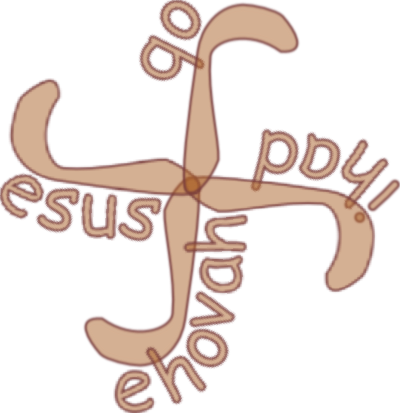
J swastika

Arizona: Jehovah-Job-Jesus-Jihad, made in Inkscape


Jehovah is the original God of the Jews, also rendered as Yahweh.

Job stood up to God and questioned His goodness and justice, indeed his very consciousness.

Jesus was God's response, as He strove toward an enlightened humanism.

Jihad was the backlash, reinstating God's inhuman or animal characteristics, returning Him to his completeness.

The swastika is fluid: it can be manipulated this way or that, to align with evil forces as happened under Nazi Germany or to align with a flow toward a greater light on the world, as I've tried to convey above.


Labels: , , , ,