Tuesday, March 01, 2011

evidence for god - again

A disappointing ending to what is a thorough (at least in the sense of detailed) attempt to answer the question: "Is the Qur'an the Word of God?"
In the end we are left with little on which to hold. Muslim sources are found to be questionable, while non-Muslim sources point to a dearth of any real evidence for the accurateness of the Qur'an. There is indeed, much disturbing material here with which the Muslim apologist must now contend. Yet, I do find solace in the fact that the next time I see a Muslim holding his Qur'an aloft as evidence of Allah's blueprint for humanity, I can ask him one simple question, the same question historians are now asking, "Where, indeed is the evidence for that which they believe?"

from Jay Smith: "Is the Qur'an the Word of God?"

Labels:

Wednesday, September 03, 2008

blogging the blog

I've been following Robert Spencer's Blogging the Qur'an which, up until recently, was shown at HotAir with a repeat at the JihadWatch site itself. I'd not been commenting since the main student-style questions arose at HotAir and I've not been able to register there. With the move, I decided to take up a student role and ask some questions relating to the entry on Suras 41, “Explained in Detail,” and 42, “Consultation”. I've received patient but, at times, somewhat defensive replies from Robert Spencer.

Basically, I've questioned Spencer's scholarship and impartiality in relation to his paraphrasing of verse 42:41 which arises out of the context of the previous verse. Ten translations of these two verses are given below, followed by Spencer's paraphrase:
Koran 42:40-41

Pickthall: The guerdon of an ill-deed is an ill the like thereof. But whosoever pardoneth and amendeth, his wage is the affair of Allah. Lo! He loveth not wrong-doers. And whoso defendeth himself after he hath suffered wrong - for such, there is no way (of blame) against them.

Yusuf Ali: The recompense for an injury is an injury equal thereto (in degree): but if a person forgives and makes reconciliation, his reward is due from God: for (God) loveth not those who do wrong. But indeed if any do help and defend themselves after a wrong (done) to them, against such there is no cause of blame.

Hilali-Khan: The recompense for an evil is an evil like thereof, but whoever forgives and makes reconciliation, his reward is due from Allah. Verily, He likes not the Zalimun (oppressors, polytheists, and wrong-doers, etc.). And indeed whosoever takes revenge after he has suffered wrong, for such there is no way (of blame) against them.

Shakir: And the recompense of evil is punishment like it, but whoever forgives and amends, he shall have his reward from Allah; surely He does not love the unjust. And whoever defends himself after his being oppressed, these it is against whom there is no way (to blame).

Sher Ali: Remember that the recompense of an injury is an injury the like thereof; but whoso forgives and thereby brings about an improvement, his reward is with ALLAH. Surely, HE loves not the wrongdoers. There is no blame on those who defend themselves after they have been wronged.

Khalifa: Although the just requital for an injustice is an equivalent retribution, those who pardon and maintain righteousness are rewarded by GOD. He does not love the unjust. Certainly, those who stand up for their rights, when injustice befalls them, are not committing any error.

Arberry: and the recompense of evil is evil the like of it; but whoso pardons and puts things right, his wage falls upon God; surely He loves not the evildoers. And whosoever helps himself after he has been wronged -- against them there is no way.

Palmer: For the recompence of evil is evil like unto it; but he who pardons and does well, then his reward is with God; verily, He loves not the unjust. And he who helps himself after he has been wronged, for these - there is no way against them.

Rodwell: - Yet let the recompense of evil be only a like evil but he who forgiveth and is reconciled, shall be rewarded by God himself; for He loveth not those who act unjustly. And there shall be no way open against those who, after being wronged, avenge themselves;

Sale: - And the retaliation of evil [ought to be] an evil proportionate thereto: - But he who forgiveth, and is reconciled [unto his enemy], shall receive his reward from God; for he loveth not the unjust doers. And whoso shall avenge himself, after he hath been injured; as to these, it is not lawful to punish them [for it]:


source

Robert Spencer: Then v. 40 says that an equal injury should be inflicted in retaliation for an injury – but Allah will reward those who forgive. However, taking revenge is not sinful (v. 41).

I've discussed this matter further with my son who has never read any of the Koran. Reading those above translations and Spencer's paraphrasing he immediately concluded that Spencer had indeed misrepresented the verses and even more so than I had questioned him over. In my son's view verse 40 suggests than an evil deed deserves a proportionate evil deed, not that such "equal injury should be inflicted in retaliation" as Spencer has it. The next part - "Lo! He loveth not wrong-doers" - is pretty clear in saying that Allah would prefer that the conflict end amicably and no further evil deeds be committed. Finally, if attempts at forgiveness and reconciliation fail, then and only then is a forthright self-defense advised and this is without blame since it has presumably followed the earlier efforts. So, rather than being a whitewash of mere revenge as Spencer's paraphrase suggests, the Koran is demanding an approach to conflict resolution which is, in fact, quite modern.

It's a pity that Spencer missed this opportunity to give a fairer reading of the Koran and reveal some of its inherent merits, at least in these purer or more directly revelatory Meccan verses.


Labels: , , ,

Monday, February 04, 2008

patient research

The latest book I've been looking at is The place of tolerance in Islam by Khaled Abou El Fadl (as main author) and edited by Joshua Cohen and Ian Lague for Boston review (Beacon Press, 2002).

book cover


I found (Abou El) Fadl's initial long essay quite reasonable, despite its apologist overtones. A main difficulty arises in his shifting of moral judgment and clarity away from the Qur'an and onto the reader (p.14-15) [my emphasis]:

In a further example, as to justice, the Qur'an states: "O you who believe, stand firmly for justice, as witnesses for God, even if it means testifying against yourselves, or your parents, or you kin, and whether it is against the rich or poor, for God prevails upon all. Follow not the lusts of your hearts, lest you swerve, and if you distort justice or decline to do justice, verily God knows what you do." [Qur'an 4:135] The idea that Muslims must stand up for justice even against their own self-interests is predicated on the notion that human beings are capable of achieving a high level of moral agency. As agents, Muslims are expected to achieve a level of moral conscientiousness, which they will bring to their relationship with God. In regards to every ethical obligation, the Qur'anic text assumes that readers will bring a pre-existing, innate moral sense to the text. Hence, the text will morally enrich the reader, but only if the reader will morally enrich the text. The meaning of the religious text is not fixed simply by the literal meaning of its words, but depends, too, on the moral construction given to it by the reader. So if the reader approaches the text without moral commitments, it will almost inevitably yield nothing but discrete, legalistic, technical insights.

see also online: The Place of Tolerance in Islam


However, it is in his Reply to the eleven other contributors that I find him unreasonable or leaning toward an Islamist view. It is especially evident in his frequent - and often subtle - shifting of responsibility away from Muslims and onto non-Muslims. An example (p.96): "After all, isn't the real question whether non-Muslims are willing to tolerate Muslims, instead of the other way around?" Another (p.104): "[...] I believe that Muslims such as the Taliban [...] are not the outgrowth of a religious process, as much as a reaction to external secular forces, such as colonialism or corporate capitalism. "

The most serious example, however, is the moral equivalence demonstrated here (p.98) [my emphasis]:

If Americans allow the attacks of September [11, 2001] to alienate them from their moral values and from the civil liberties won in countless battles over two hundred years, then the terrorists have won. Similarly, if the Muslim response to the state terror inflicted upon them by Israel and other countries is to become alienated from their religious morality, then Muslims have lost something that is far more important than the political struggle - they have lost their moral grounding.


The exact repetition of wording here affirms that Israeli "state terror" is equivalent to the Islamist terror of Sep11, a deliberate act of murder against innocent and unsuspecting civilians. And since Israel has been indulging in "state terror" since (no doubt) at least 1967, it follows that the Sep11 attacks are what you'd expect as a justified retaliation. My own "pre-existing, innate moral sense" tells me that Fadl himself has completely lost his own moral grounding.

This is a man touted as a "moderate" and a respectable scholar of Islamic law (an identity he promotes on his own website: Scholar of the House). This kind of guy gives me the creeps. Utterly. I'm so glad that truer and better scholars like Daniel Pipes are keeping an eye on people like him:

The case of Abou El Fadl points to the challenge of how to discern Islamists who present themselves as moderates. This is still possible to do with Abou El Fadl, who has left a long paper trail; it is harder with those who keep their opinions to themselves. In either case, the key is old-fashioned elbow grease: reading, listening, and watching. There is no substitute for research. It needs to be done by White House staffers, district attorneys, university search committees, journalists, Jewish defense agencies, and churches. Failing proper research, Islamists will push their way through Western institutions and ultimately subvert them.

from Daniel Pipes: Stealth Islamist: Khaled Abou El Fadl


Finally, here is the last paragraph of Fadl's Reply (p.111):

God relegated to Muslims a moral trust. At no point in history can Muslims ignore their unending obligations to appropriately discharge this moral trust. The basic and invariable point is that Muslims - and non-Muslims - must understand that it is in the power and is in fact the duty of Muslims of every generation to answer the question: What Islam? The response must not be left in the hands of the bin Ladens of the world.

also online in draft version as: Khaled Abou El Fadl Replies


I would simply add that the response should never have been left in the hands of a man like Mohammad on whom bin Laden conscientiously - and quite precisely - models himself. Mohammad was a thief, a terrorist, an assassin, and a mass murderer. If, as Muslims believe, he is "the best of men" then it follows that Sep11 was a noble act along similarly "noble" lines. Deep down inside men like Fadl - and bin Laden - there must lie a numb and dumb and quivering mass of terrified "innate moral sense" too frightened even to squeak in the name of authentic Truth and Justice. How pathetic and pitiful are these poor Muslims, how cruel has been that Allah that led them to this dire circumstance. I can only thank God that I was not born into that world myself.

Labels: , , , , , ,

Tuesday, January 08, 2008

a second blogging of the qur'an

I have been following Robert Spencer's weekly series of which the latest is Blogging the Qur’an: Sura 10, “Jonah” and now, much to his own delight, Spencer will be joined by a second blogging the qur'an series, only this time by a prominent Muslim writer, Ziauddin Sardar. I've not come across this guy before but I accept the Guardian's blurb on him as a man "considered a pioneering writer on Islam" and "widely known for his radio and television appearances". I will certainly follow Sardar as assiduously as I have been following Spencer.

The first blog entry is a personal account of his Muslim upbringing, starting with Koranic readings from his mother's lap, moving through the stricter environment of the madrassa, and culminating in an ongoing process of adult appraisal. I am happy to enter into Sardar's world to get a better feel for how the Koran moves the Muslim soul but there nevertheless remains a gap in the writing culture for we non-Muslims must also write about how the Koran moves us, though in different ways, and I would like to see Muslims making a genuine open-hearted attempt to enter into our own non-Muslim's Koranic world. For me, this starts at the beginning with the Fatiha which, I'm sure, has a happy sound for Muslims but for me and other non-Muslims sounds deeply offensive because it is so clearly pointing at us in a wrathful and derogatory manner. It makes my flesh creep and I would dearly love - one day - to read a Muslim acknowledging that this offense and apprehension are realistically based and not some paranoid symptom of "Islamophobia". For now, I will wait and see what develops in this and the corresponding series by Spencer.

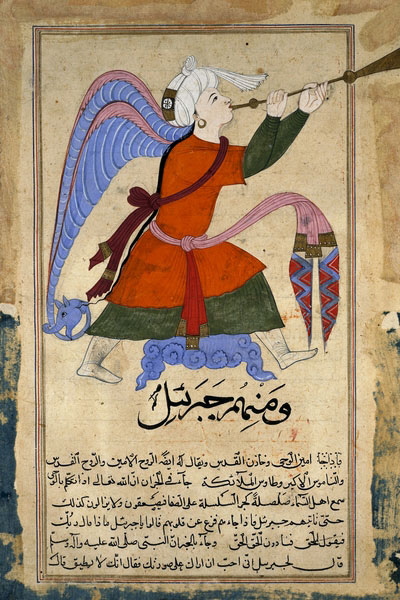
In point of fact, my attention was more strongly drawn to the illustration that The Guardian provided. It was curious, for example, that the British Museum page on this image names the figure Gabriel (the archangel that announced Jesus' coming to Mary) rather than Israfil (or Raphael). The latter has a strongly Islamic function of standing at the ready with trumpet to mouth for he will blow two blasts at the Final Hour: one to mark the death of us all and the second to mark our resurrection - more precisely, the resurrection of all good Muslims - from the dead.

Israfil

Archangel Israfil @ British Museum


My research also turned up some other variants of this image, clearly less refined ones but both contained in the same book. It seems that both the text and the artwork were copied by one to the next artist scribe, with results exhibiting more or less artistic merit or refinement. There is always a certain charm in the more primitive forms but the British Museum variant is stunningly beautiful. It doesn't really matter who created the first form of this angelic image but one does get a sense of the Islamic straightjacket that forbade innovation, specifically in theology but surely in any field - such as religious art - touched by deity.


Labels: , , ,

Wednesday, September 19, 2007

the hidden hand

See how the hand is invisible while the pen is writing;
the horse careening, yet the rider unseen;
the arrow flying, but the bow is out of sight;
individual souls existing,
while the Soul of souls is hidden.

Rumi: Mathnawi II:1303-1304
version by Camille and Kabir Helminski via Sunlight


These lines come from a lengthier meditation around the Koran 8:17 which reads:

You did not slay them, but God slew them; and when thou threwest, it was not thyself that threw, but God threw, and that He might confer on the believers a fair benefit; surely God is All-hearing, All-knowing.


trans Arberry


The first line (of this excerpt) also seems to be echoing that most famous quatrain from Omar Khayyam:

The Moving Finger writes: and, having writ,
Moves on: nor all thy Piety nor Wit
Shall lure it back to cancel half a Line,
Nor all thy Tears wash out a Word of it.


Omar Khayyam, version by Edward Fitzgerald


In Khayyam's version, we get a sense of the inevitability of events as nature's immutable laws are applied to the "now", creating a fixed past and (implicitly) determining a fated future. It is very much a Newtonian world befitting an astronomer-poet but it can be read as equally true whether from an atheistic or from a theistic standpoint (as is quite common in Khayyam).

In the Whinfield version, Rumi's meditation ends with another echo from Khayyam as follows:

Whatsoever is seen is weak and base and impotent;
What is hidden is equally fierce and headstrong.
We are the captured game; who is the snare?
We are the balls; where is the bat?
He tears and mends; who is this tailor?
He fans and kindles the flame; who is this kindler?
At one time He makes the faithful one an infidel,
At another He makes the atheist a devotee!


Rumi: Masnavi I Ma'navi: Book II, Story V, trans E.H. Whinfield


The Ball no Question makes of Ayes and Noes,
But Right or Left as strikes the Player goes;
And He that toss'd Thee down into the Field,
He knows about it all--HE knows--HE knows!


Omar Khayyam, version by Edward Fitzgerald


Clearly this Ultimate Agent is capable of both "yes" and "no", of both "right" and "left", of both tearing and mending, of driving humanity to despair or to total worshipful commitment. Put baldly, this Ultimate Agent is capable of both Good and Evil, of both Just and Unjust, of both True and False, of both Beauty and Filth. As embodied in the Islamic deity Allah, He even admits such quite plainly:

Wherever you may be, death will overtake you, though you should be in raised-up towers. And if a good thing visits them, they say, 'This is from God'; but if an evil thing visits them, they say, 'This is from thee.'

Say: 'Everything is from God.' How is it with this people? They scarcely understand any tiding.

Whatever good visits thee, it is of God; whatever evil visits thee is of thyself. And We have sent thee to men a Messenger; God suffices for a witness.

Whosoever obeys the Messenger, thereby obeys God; and whosoever turns his back -- We have not sent thee to be a watcher over them.

They say, 'Obedience'; but when they sally forth from thee, a party of them meditate all night on other than what thou sayest. God writes down their meditations; so turn away from them, and put thy trust in God; God suffices for a guardian.

What, do they not ponder the Koran? If it had been from other than God surely they would have found in it much inconsistency.


Arberrry version: IV:80-84 [my emphasis]


In case Arberry is confused, here is another version:

78 Wheresoever ye may be, death will overtake you, even though ye were in lofty towers. Yet if a happy thing befalleth them they say: This is from Allah; and if an evil thing befalleth them they say: This is of thy doing (O Muhammad). Say (unto them): All is from Allah. What is amiss with these people that they come not nigh to understand a happening ?

79 Whatever of good befalleth thee (O man) it is from Allah, and whatever of ill befalleth thee it is from thyself. We have sent thee (Muhammad) as a messenger unto mankind and Allah is sufficient as Witness.

80 Whoso obeyeth the messenger hath obeyed Allah, and whoso turneth away: We have not sent thee as a warder over them.

81 And they say: (It is) obedience; but when they have gone forth from thee a party of them spend the night in planning other than what thou sayest. Allah recordeth what they plan by night. So oppose them and put thy trust in Allah. Allah is sufficient as Trustee.

82 Will they not then ponder on the Qur'an ? If it had been from other than Allah they would have found therein much incongruity.


Pickthall version: 4:78-82 [my emphasis]


In summary, then, Allah is the Absolute Agent behind Absolutely Everything (implicitly including both Good and Evil). And yet - almost in the same breath - Allah denies that He is behind the Evil, for that is humanity's responsibility, not His. Thus does He demonstrate His capacity for mendacity, injustice, delusion, or witlessness, depending on how one reads this second declaration. Finally, just two breaths away, He boasts of His own logical consistency as evidence of His authorship of the Koran. The implication is that it would have come from Satan had it contained incongruities. Since He has just baldly demonstrated these very incongruities, we are left with a Being that surely embodies both Good and Evil, both Allah and His own shadow Satan.

Much as Islam, through Jasser, shot itself in the foot in my last post, so in this one it is Allah Himself who shoots Himself in the foot.

I'm adult enough and have seen enough of the world to know that it is true that Good and Evil sit together in this world, as do Truth and Falsehood, Justice and Injustice, and so on. It is in my nature to prefer a deity that admits as much rather than indulging in this hypocritical game that Allah so delights in. That is why I prefer my own Goddess of the Perfect Mind:

For I am the first and the last.
I am the honored one and the scorned one.
I am the whore and the holy one.
I am the wife and the virgin.

...

I am the one who is honored, and who is praised,
and who is despised scornfully.
I am peace,
and war has come because of me.
And I am an alien and a citizen.
I am the substance and the one who has no substance.

...

I, I am sinless,
and the root of sin derives from me.
I am lust in (outward) appearance,
and interior self-control exists within me.
I am the hearing which is attainable to everyone
and the speech which cannot be grasped.
I am a mute who does not speak,
and great is my multitude of words.


The Nag Hammadi Library: The Thunder, Perfect Mind, translated by George W. MacRae @ gnosis.org
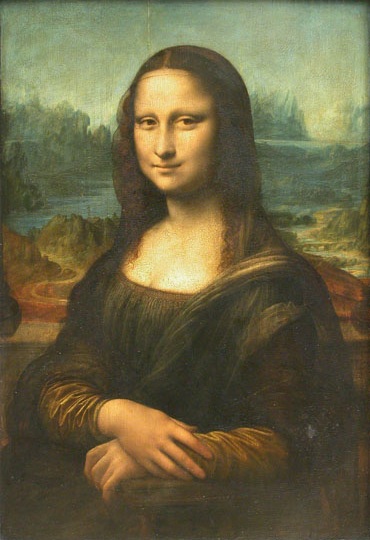

mona lisa


.

Labels: , , , ,